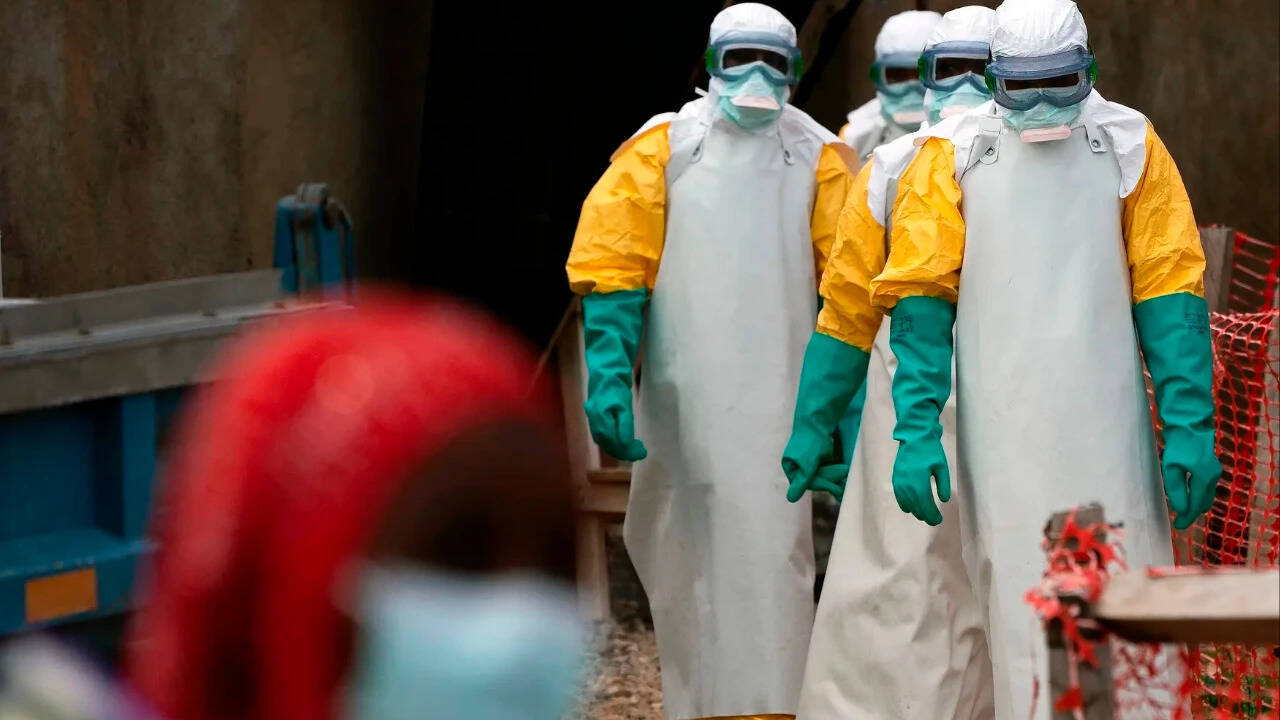
The media has found its new magic number. "Ebola cases top 1,000 in Congo; 254 dead as outbreak spreads." The headline reads like a countdown to an inevitable global catastrophe. Newsrooms copy and paste the figures, epidemiologists offer somber quotes, and the international community prepares to dump billions of dollars into a familiar, broken containment machine.
They are measuring the wrong thing.
Treating raw case counts as the definitive barometer of an outbreak is a systemic failure of public health journalism. By focusing on a cumulative 1,000-case milestone, observers treat an active, shifting crisis as a static math problem. It misallocates resources, terrifies the public unnecessarily, and completely ignores the hard mechanics of how viral transmission actually slows down in conflict zones.
I have watched public health agencies burn millions of dollars chasing cumulative case numbers while missing the hyper-localized clusters driving the actual transmission. The real battle is not against a four-digit figure on a spreadsheet in Geneva. It is against localized transmission chains, broken community trust, and a total failure to track asymptomatic immunity.
The Cumulative Case Fallacy
A cumulative case count is a historical ledger, not a predictive tool. When a headline screams that cases have topped 1,000, it bundles people who contracted the virus six months ago and are now fully recovered with individuals who are currently highly infectious.
In epidemiology, mixing historical cases with active vectors leads to disastrous resource allocation. Imagine a scenario where a provincial hub reports 500 cumulative cases, but zero new infections over the last three weeks. Meanwhile, a remote mining village reports only 15 cumulative cases, but 10 of them popped up in the last 48 hours. If you allocate your isolation beds, contact tracers, and experimental therapeutics based on the "crisis centers" highlighted by cumulative data, you send help to a graveyard or a recovery ward while letting a fresh wildfire consume the village.
Viruses do not move linearly. They move exponentially until they hit a wall of human behavior, geography, or immunity.
By the time an outbreak in the Democratic Republic of Congo hits 1,000 recorded cases, the raw number tells you less about the virus and more about the sudden deployment of surveillance. The surge in numbers is frequently just an artifact of better testing, not a sign that the virus is winning. When response teams finally secure a dangerous red-zone district, they uncover dozens of existing cases within days. The chart spikes. The media panics. In reality, the situation has improved because those cases are finally isolated.
The Brutal Physics of the R0 Metric
To understand why the 1,000-case panic is flawed, look at the basic reproductive number of the virus ($R_0$). This value represents the average number of secondary infections generated by a single infectious individual in a completely susceptible population.
$$\text{If } R_0 > 1, \text{ the outbreak grows. If } R_0 < 1, \text{ the outbreak dies.}$$
Ebola actually has a surprisingly low $R_0$, typically hovering between 1.5 and 2.0 in urban environments without intervention. Compare that to measles, which boasts an $R_0$ upwards of 15. Ebola is a clumsy traveler. It requires direct contact with infected bodily fluids—blood, vomit, feces—at the height of the illness. It does not hang in the air of a crowded marketplace.
The real danger in the Congo is not that the virus has mutated into a super-pathway. The danger is that the effective reproduction number ($R_t$), which changes over time based on real-world conditions, is being kept artificially high by external human variables.
- The Conflict Vector: Active militia violence in North Kivu and Ituri makes traditional contact tracing mathematically impossible. When a health worker cannot enter a neighborhood without an armed escort, contacts vanish into the bush.
- The Institutional Trust Deficit: Decades of political marginalization mean local populations view government-backed health interventions with extreme suspicion.
When you see cases rise, do not blame viral virility. Blame the fact that containment protocols are treating a sociological crisis as a purely medical one.
Dismantling the "People Also Ask" Consensus
Public health forums and search trends show a predictable pattern of worry. The questions asked by the public reveal exactly how the current narrative misleads them.
Is Ebola about to become an uncontrollable global pandemic?
No. The premise assumes Ebola can adapt to highly sanitized, structured healthcare environments the same way it exploits a collapsed medical infrastructure. In a modern city with basic infection control, private rooms, and running water, Ebola struggles to find a second host. The 2014 outbreak in West Africa proved this. Despite sporadic importations to the United States and Europe, the virus stalled immediately upon hitting standard triage protocols. The threat remains overwhelmingly regional, localized, and tied to specific systemic vulnerabilities.
Why can't we just vaccinate the entire population to stop it?
The current strategy relies on rVSV-ZEBOV, an incredibly effective ring vaccination tool. But deployment is restricted by logistics, not just supply. The vaccine requires ultra-cold chain storage ($$-60^\circ\text{C to } -80^\circ\text{C}$$) in regions without reliable electricity. Mass vaccination is a logistical fantasy. Instead, teams must map a circle of contacts around an active case and vaccinate that specific "ring." When community resistance or violence breaks that map, the ring shatters. The bottleneck is trust and infrastructure, not manufacturing capacity.
The Downside of the Contrarian Reality
Shifting our focus away from big, scary cumulative numbers toward hyper-local active transmission rates has a distinct drawback. It lacks political utility.
Big numbers unlock big budgets. When the World Health Organization or local ministries want to shake loose emergency funding from international donors, a headline about breaking the 1,000-case barrier is a powerful tool. Nuanced charts showing a declining $R_t$ value in four out of five zones do not loosen the purse strings of global philanthropists.
If we stop treating the cumulative count as the ultimate truth, we risk brief periods of donor apathy. But continuing to feed the monster of raw case panic forces us into a permanent cycle of reactive firefighting. We pour money into building massive, centralized treatment centers that sit empty by the time they are finished because the virus has already skipped two districts over.
Move the Goalposts Instantly
If you want to evaluate whether the response in the Congo is succeeding or failing, stop looking at the total case count. Look at these three metrics instead:
- Time from Symptom Onset to Isolation: If an Ebola patient is walking around their community for five days before being admitted to a transit center, the response is losing. If that window drops below 24 hours, the transmission chain is dead, regardless of how high the cumulative case ledger stands.
- Percentage of New Cases from Known Contact Lists: If a new patient pops up and they were already on a monitoring list, the system is working perfectly. The surprise cases—the ones discovered post-mortem in communities—are the true measure of failure.
- The Scale of Asymptomatic Seroprevalence: We consistently fail to measure how many people in these zones develop antibodies without ever showing severe symptoms. Studies following past outbreaks suggest a meaningful percentage of mild or asymptomatic cases go unrecorded. By ignoring them, we skew our mortality rates higher and misunderstand the true baseline of community exposure.
Stop reading the milestone trackers. Ignore the round numbers designed to trigger panic alerts on your phone. The 1,000th case in the Congo matters no more than the 999th or the 101st. Watch the contact lists, track the isolation velocity, and look at the micro-zones.
Everything else is just noise masking a broken system.