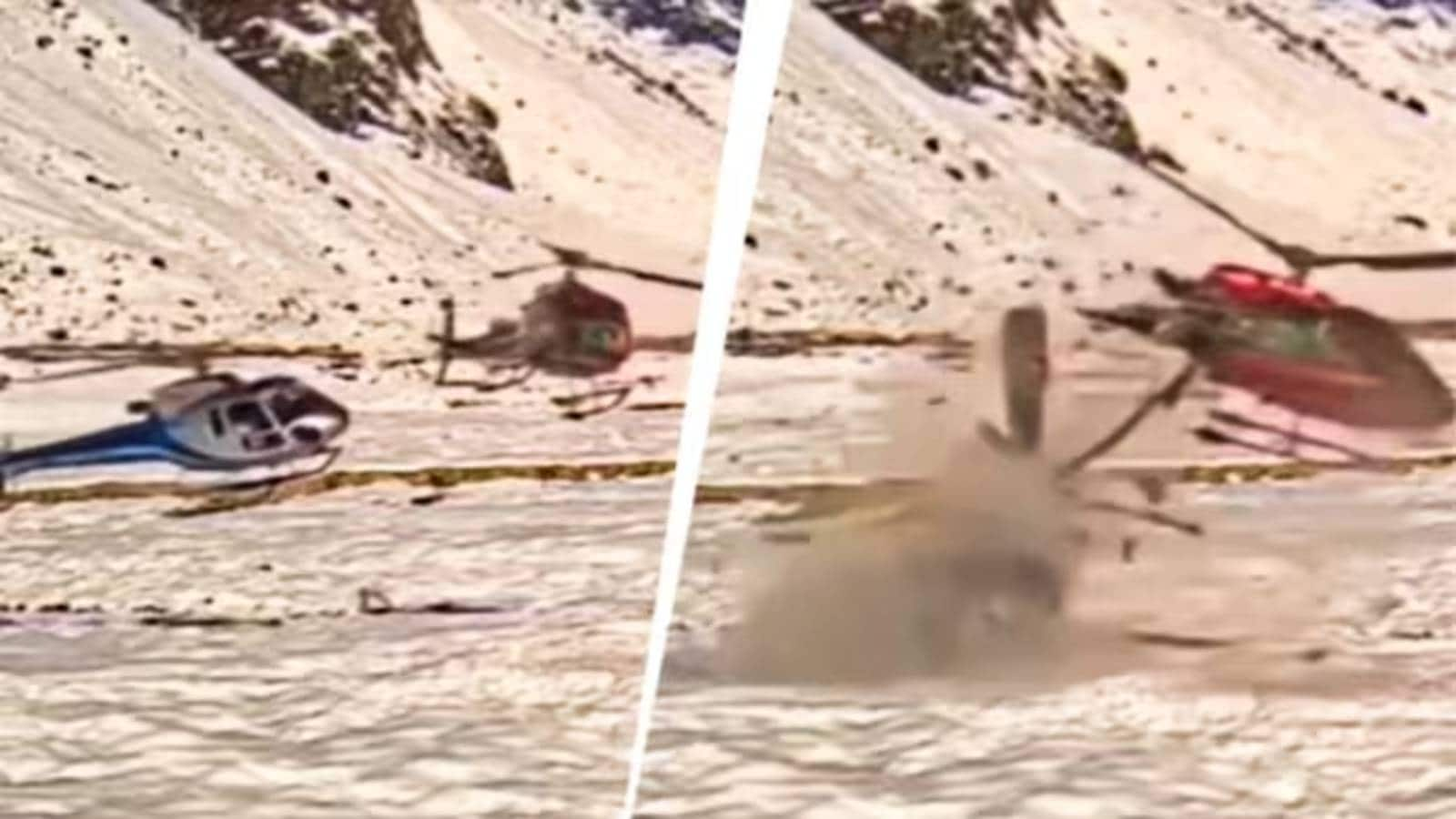
Two helicopters collided on the ground near Everest Base Camp, killing one Indian national and shattering the comfortable lie the Himalayan aviation industry tells itself every single season.
Whenever a rotorcraft goes down in the Khumbu region, the mainstream press runs the exact same playbook. They print the casualty count, mention the victim's nationality, and immediately pivot to the "treacherous mountain weather" or "unpredictable Himalayan winds." It is lazy journalism. It absolves the people holding the controls and the executives signing the flight manifests.
Two helicopters do not smack into each other during a landing sequence because of a sudden gust of wind. That happens because of commercial greed, broken air traffic protocols, and a tourism model that treats the world's highest mountain like a suburban Uber drop-off zone.
The Illusion of "Freak Accidents" in the Khumbu
If you spend enough time around Lukla or the helipads scattered between Namche Bazaar and Gorak Shep, you stop believing in freak accidents. You start seeing the math of inevitable failure.
Mainstream news reports frame a collision near Base Camp as an unavoidable tragedy of extreme geography. They want you to believe that flying at 17,000 feet is inherently a coin toss. It is not. Physics does not take days off, and aerodynamics at high altitude are entirely predictable if you respect the margins.
The real issue is that commercial operators in Nepal routinely erase those margins to maximize daily sorties.
During peak trekking windows in April, May, October, and November, the airspace between Kathmandu, Lukla, and Everest Base Camp turns into an unregulated parking lot. Hundreds of tourists who either lack the time to trek or suffer from preventable altitude sickness demand immediate extraction or luxury sightseeing loops. Operators respond by stacking flights back-to-back, compressing turnaround times to mere minutes.
When two aircraft occupy the same narrow approach path at a makeshift landing zone without active ground marshaling or positive radar control, a collision is not a surprise. It is a scheduled event.
Why High-Altitude Aerodynamics Leave Zero Room for Ego
To understand why these crashes keep happening, you have to understand what a helicopter is actually doing near Everest Base Camp. Most travelers assume a chopper flies at 17,500 feet the same way it flies at sea level. That assumption gets people killed.
At sea level, air is dense. The main rotor blades bite into thick molecules, generating massive lift with plenty of engine power to spare. Climb to the elevation of Everest Base Camp, and air density drops by roughly half.
The Deadly Trap of Density Altitude
Pilots call this density altitude—the pressure altitude corrected for non-standard temperature. When density altitude spikes, three brutal things happen simultaneously to a light utility helicopter like an Airbus H125 (the workhorse of the Himalayas):
- Rotor efficiency plummets. The blades have to spin at maximum RPM and pitch aggressively just to keep the aircraft hovering.
- Engine power degrades. Even turbine engines starve for oxygen, slashing the available torque when a pilot needs it most.
- Tail rotor authority vanishes. At high altitude, the anti-torque tail rotor loses its bite, making the aircraft prone to uncommanded spinning—a phenomenon known as Loss of Tail Rotor Effectiveness (LTE).
Now, picture a pilot fighting all three of those aerodynamic penalties while descending into a rocky, uneven landing zone surrounded by moraine walls. There is no runway. There is no Instrument Landing System. There is often a blinding cloud of kicked-up glacial dust—a brownout—that wipes out visual references inches before touchdown.
In that environment, a pilot's entire cognitive bandwidth is maxed out just keeping the skids level. If a second helicopter is hovering thirty feet away because dispatch cleared both for the same window to save fuel, neither pilot has the visual peripheral awareness or the aerodynamic power margin to abort safely.
The Dirty Secret of "Rescue" Insurance Fraud
You cannot fix the skies over Everest without talking about the money fueling the traffic jam. A massive percentage of the helicopters crowding those narrow valleys are not carrying mountaineers. They are carrying trekkers executing a well-known scam.
Over the past decade, the Nepalese trekking industry developed a lucrative side hustle: fake helicopter evacuations.
Here is how the machine works. A budget trekking agency sells a trekker a cheap package to Base Camp, knowing full well they will make almost zero profit on the ground logistics. Once the client reaches 14,000 feet and feels a mild headache—normal acclimatization discomfort—the guide convinces them they have life-threatening cerebral edema. A helicopter is called. The trekker gets a thrilling, Instagram-worthy ride back to Kathmandu, and the agency splits a massive kickback with the helicopter operator and a private hospital, billing the tourist's international travel insurance for $5,000 to $10,000.
The European Union Aviation Safety Agency (EASA) has kept all Nepalese airlines on its air safety blacklist for over a decade for a reason. The Civil Aviation Authority of Nepal (CAAN) acts as both the regulator and the service provider—a textbook conflict of interest that international aviation bodies have condemned repeatedly.
When you flood a high-altitude canyon with unnecessary flights driven by insurance payouts and luxury "breakfast at Everest" tours, you multiply the collision risk for every legitimate rescue pilot on the mountain.
Dismantling the Wrong Questions Travelers Ask
Whenever news breaks of another crash in Nepal, search engines light up with the exact same predictable queries. Almost all of them miss the point.
"Is it safe to take a helicopter to Everest Base Camp?"
This is the wrong question. Safety is not a binary switch; it is a spectrum of risk management. Taking a helicopter to Base Camp on a clear morning with an operator who enforces strict single-ship landing protocols and conservative weight limits carries a manageable risk. Taking one during a peak-season afternoon rush, when clouds are rolling up the Khumbu Valley and pilots are rushing to beat the 1:00 PM wind shift, is playing Russian roulette.
"Which helicopter model is safest in the Himalayas?"
Tourists love obsessing over hardware. They ask whether the Airbus H125 (formerly the AS350 B3e) or the Bell 407 is better. The machine is rarely the weak link. The H125 holds the world record for landing on the summit of Everest, yet H125s make up the bulk of the wreckage in Nepal. A state-of-the-art airframe cannot save you from a pilot who has flown twelve hours straight without rest or an operator who ignores basic separation minimums.
"Why doesn't Nepal build better airports near Everest?"
Because geography forbids it. Lukla's Tenzing-Hillary Airport already sits on a cliff face with an angled runway and a stone wall at one end. Beyond Lukla, the Khumbu Valley narrows into vertical granite walls and shifting glacial moraines. You cannot pave a runway at Base Camp. Helicopters will always be the primary lifeline, which makes disciplined air traffic management—not concrete—the only viable solution.
What Actually Needs to Change (And Why Operators Will Fight It)
If the aviation authorities in Kathmandu actually wanted to stop mid-air and ground-pad collisions near Everest, they could do it before the next climbing season starts. The solutions are not mysterious. They are standard operating procedures in every other alpine aviation sector, from the Swiss Alps to the Canadian Rockies.
1. Hard Caps on Daily Sorties
Every helipad above Namche Bazaar needs a strict slot system. One aircraft in, one aircraft out. No hovering in a holding pattern a hundred yards away while another ship unloads passengers. If a slot is full, the second aircraft stays on the ground at Lukla or Syangboche until the pad is confirmed clear via radio.
2. Mandatory Ground Marshals at High-Traffic Pads
During peak months, operators pool millions of dollars in revenue. They can afford to station trained, radio-equipped ground marshals at Gorak Shep, Lobuche, and Pheriche. A pilot fighting high density altitude and brownout conditions should never have to guess where another helicopter is parked relative to their tail rotor.
3. Split the Regulator
Until the Civil Aviation Authority of Nepal is legally split into an independent safety regulator and a separate airport/air-navigation operator, enforcement will remain a joke. You cannot police an industry when your own agency profits from the landing fees and flight permits.
4. The Downside of Stricter Rules
Let's be brutally honest about the trade-off. Enforcing real safety margins means fewer flights per day. Fewer flights mean ticket prices for Everest heli-tours will double, wait times for non-critical evacuations will stretch from hours to days, and some local operators will go bankrupt. Tourists will complain about ruined itineraries.
That is the price of keeping people alive. Right now, the industry is subsidizing cheap, instant access to the highest place on earth with the lives of passengers and pilots.
Stop Buying the "Mountain Magic" Marketing
If you are planning a trip to Nepal and thinking about booking a helicopter tour—or relying on one as your backup plan when you skip acclimatization days—stop looking at glossy brochures.
Ask the operator three uncomfortable questions before you hand over a credit card:
- What is your company's policy on simultaneous landings at high-altitude pads?
- How many flight hours has my pilot logged in the last seven days?
- Will you cancel the flight if the afternoon wind shear picks up, even if it ruins my connecting flight out of Kathmandu?
If they hesitate, dodge the question, or promise you a "guaranteed" landing regardless of conditions, walk away. In the Himalayas, a guarantee is just a polite word for a gamble you didn't agree to take.