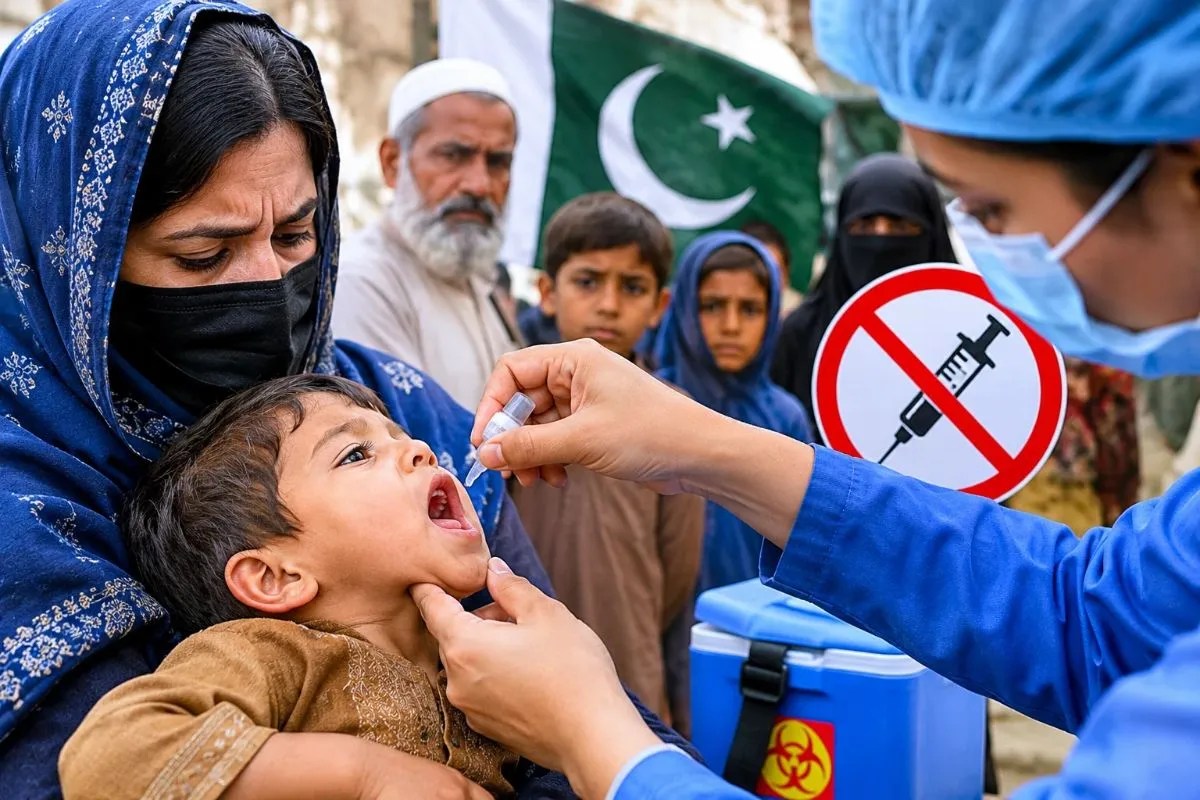
Blaming ignorant parents for Pakistan’s polio resurgence is the laziest lie in global public health.
Every time a new case of wild poliovirus type 1 (WPV1) paralyzes a child in Khyber Pakhtunkhwa or Balochistan, the international press dust off the exact same template. They write about "stubborn vaccine refusals," "deep-seated public distrust," and "religious misinformation." It is clean, simple, and completely misses the point. It lets billion-dollar health agencies off the hook by pinning a systemic, logistical, and political collapse on impoverished families who have zero clean drinking water.
When a father in North Waziristan refuses polio drops at his front door, he is not rejecting modern medicine. He is pulling the only lever of political power he possesses.
The Myth of the "Anti-Vax" Villager
Western coverage of Pakistan’s polio eradication program suffers from a fatal projection bias. Journalists look at Pashtun tribal districts through the lens of suburban American vaccine skepticism—imagining parents scrolling through conspiracy theories on their phones. That is a fundamental misreading of the ground reality.
I have spent years dissecting public health logistics across South Asia, watching donor money evaporate into poorly conceived behavioral campaigns while basic infrastructure rots. When you actually look at the data from the Independent Monitoring Board (IMB) of the Global Polio Eradication Initiative (GPEI), a starkly different picture emerges. True ideological refusals—people who genuinely believe the oral polio vaccine (OPV) causes infertility or contains pork—represent a tiny fraction of missed children.
The overwhelming majority of "refusals" recorded by vaccinators are actually demand-driven boycotts and operational misses.
In communities where open sewage runs past front doors, where malnutrition is endemic, and where the nearest functioning clinic is three hours away over broken roads, the arrival of a heavily armed escort delivering only two drops of polio vaccine feels like an insult. Residents in districts like Lakki Marwat and Bannu have openly stated their position for years: Fix our roads, give us clean water, bring us basic primary care, and then you can give our children the drops.
Calling this "vaccine hesitancy" is an act of bureaucratic cowardice. It rebrands a rational political protest into a psychological defect.
The Oral Vaccine Paradox Nobody Wants to Explain
To understand why Pakistan and neighboring Afghanistan remain the last two endemic reservoirs on Earth, you have to understand the virology that mainstream health reporting glosses over.
Most of the developed world eradicated polio using the Inactivated Polio Vaccine (IPV), developed by Jonas Salk. IPV is injected, contains killed virus, and provides individual immunity in the bloodstream. However, it does not stop the virus from replicating in the gut and spreading through sewage.
Pakistan relies primarily on the Oral Polio Vaccine (OPV), developed by Albert Sabin. OPV uses a live, weakened virus. It is cheap, requires no needles, and builds mucosal immunity in the intestines, which is essential for stopping transmission in areas with poor sanitation.
Here is the catch that complicates the messaging on the ground: because OPV uses a live weakened virus, vaccinated children shed that virus in their stool for weeks. In communities without functioning sewage systems, that weakened virus circulates. On rare occasions, if a population is severely under-immunized, that weakened virus mutates back into a virulent form capable of causing paralysis. This is known as circulating vaccine-derived poliovirus (cVDPV).
Imagine trying to explain that nuance to a grieving mother whose neighbor's child developed paralysis from a vaccine-derived strain while health officials simultaneously insist the drops are completely harmless. When agencies treat local populations like children and hide the biological realities of OPV behind simplistic slogans, the inevitable discovery of cVDPV cases destroys whatever fragile credibility the program had left. Secrecy breeds the very distrust the agencies claim to be fighting.
Why Billions of Dollars Still Can't Buy Trust
The Global Polio Eradication Initiative—backed by the WHO, UNICEF, the Gates Foundation, Rotary International, and the CDC—has poured billions into Pakistan over the past three decades. Yet, wild poliovirus remains stubbornly entrenched in specific endemic corridors: the Peshawar-Khyber block, southern Khyber Pakhtunkhwa, and the Quetta block in Balochistan.
Why does a single-disease vertical program fail where integrated healthcare succeeds? Because vertical programs create perverse incentives.
- The Quota Trap: Vaccinators are under immense pressure from provincial supervisors to hit 100% coverage targets during Supplementary Immunization Activities (SIAs). When you punish field workers for reporting missed children, they stop reporting them. They mark chalk on doors without administering drops, or they falsify finger-marking data. High reported coverage masks massive immunity gaps—until sewage surveillance lights up positive for WPV1.
- The Weaponization of Health: You cannot talk about public distrust in Pakistan without addressing the 2011 CIA fake hepatitis vaccination campaign in Abbottabad used to hunt Osama bin Laden. That single intelligence operation validated every conspiracy theory in the region overnight. It turned frontline health workers—mostly underpaid Pakistani women—into legitimate targets for militant groups like the Tehrik-i-Taliban Pakistan (TTP).
- The Security Paradox: To protect vaccinators from militant attacks, the Pakistani state attaches armed police escorts to polio teams. While necessary to keep workers alive, the optics are catastrophic. To a villager in a conflict zone, a convoy of armed men kicking down gates to force medical drops into a child’s mouth looks indistinguishable from a military raid.
Dismantling the Wrong Questions
When people search for answers about Pakistan’s polio crisis, they usually ask the wrong questions, trapped by the framing of mainstream news outlets.
Why do Pakistani parents refuse the polio vaccine?
They largely don't. Over 90% of parents in Pakistan accept the vaccine when it is reliably delivered. The crisis is driven by hyper-localized pockets of resistance where communities are trading vaccine compliance for basic state services—electricity, clean water, and maternal health—that the government has denied them for decades.
Can polio ever be eradicated in Pakistan?
Not through door-to-door polio-only campaigns. As long as polio eradication operates as a siloed, foreign-funded mandate disconnected from general healthcare and sanitation, it will remain stuck in a permanent game of whack-a-mole. Every time security operations disrupt campaigns in southern KP, the virus rebounds.
Are religious leaders the main obstacle to polio eradication?
No. While fringe clerics have issued anti-vaccine fatwas in the past, major Islamic institutions—including Al-Azhar University and top Pakistani religious scholars—have repeatedly endorsed the vaccine. Blaming religion is a convenient distraction from administrative failure and geopolitical blowback.
The Uncomfortable Fix
If you want to wipe out wild poliovirus in Pakistan, you have to stop treating it as a messaging problem and start treating it as a governance and sanitation failure.
First, kill the standalone polio campaign model. Stop sending teams to doors carrying nothing but a cold box of OPV while mothers are begging for paracetamol, oral rehydration salts for diarrhea, and basic prenatal care. When you bundle polio drops inside comprehensive mobile health clinics that actually solve the immediate, visible crises killing children in those districts—malaria, pneumonia, malnutrition—vaccine refusals evaporate overnight. People do not reject doctors who save their children's lives.
Second, follow the sewage, not just the syringes. Polio is an enterovirus transmitted via the fecal-oral route. You cannot vaccinate your way out of open defecation and contaminated drinking water forever. Every dollar spent on repetitive, twenty-round-a-year polio campaigns in Karachi's informal settlements without investing in basic sewage infrastructure is a subsidy for the virus's survival.
Third, radically depoliticize the delivery. Take the armed guards off the front porch where possible, and hand the program over to trusted, local female health workers (Lady Health Workers) who live in those exact neighborhoods and already deliver routine care. Outsiders with clipboards and police escorts trigger immediate defensive hostility. Neighbors do not.
There is a massive downside to this approach, and it is the exact reason international donors resist it: it is slow, expensive, and messy. Fixing primary healthcare and sewage systems in conflict-ridden borderlands takes decades, requires painful political reform inside Pakistan, and cannot be neatly packaged into a five-year donor grant cycle with tidy metrics. It is much easier for global health executives to blame illiterate villagers for "distrust" and print another batch of awareness posters.
Stop printing posters, stop blaming parents, and start fixing the water.