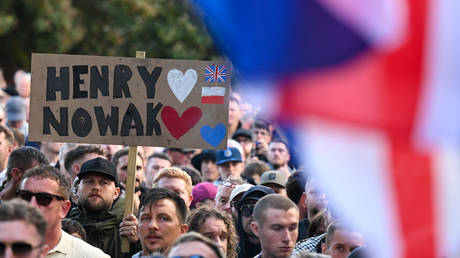
The mainstream media has found its comfortable, predictable narrative in the wake of the tragic murder of 18-year-old student Henry Nowak in Southampton. On one side, the political right points aggressively to the harrowing bodycam footage of a dying white teenager being handcuffed while his killer stands by, shouting that this is definitive proof of "two-tier policing" and anti-white prejudice fueled by the state's diversity mandates. On the other side, the left-leaning establishment frantically scolds the public for "hijacking a tragedy to stir up division," pretending the institutional failure on display was just an isolated, unfortunate procedural error.
Both sides are entirely wrong. They are asking the wrong questions because they are terrified of the actual answer.
What happened on that pavement on December 3, 2025, was not an explicit manifestation of systemic anti-white bias, nor was it a simple operational oversight. It was something far more insidious. It was the natural, catastrophic consequence of institutional cowardice. British policing did not handcuff a dying boy because they hated his demographic; they handcuffed him because they have been trained to fear an accusation of racism more than they value a human life.
The Fatal Illusion of Procedural Absolute
When Vickrum Digwa used a 21cm blade to stab an unarmed finance student five times, he did not just commit a brutal act of murder. He deployed a weapon he knew would instantly paralyze the Hampshire constabulary: a weaponized allegation of racial abuse.
Digwa and his brother lied to the responding officers, claiming that Nowak had knocked off his turban and hurled racial slurs. Consider the mechanics of that exact moment. You have a teenager dying on the ground, gasping "I can't breathe" and stating nine separate times that he has been stabbed. You have a male officer responding with the now-infamous words, "Don't think you have, mate."
The lazy consensus screams that this is proof of an anti-white hierarchy. But as someone who has tracked institutional behavior and crisis response protocols for over a decade, I know that systems do not operate on raw malice; they operate on systemic incentives.
For the past several years, British police forces have been subjected to relentless institutional remodeling aimed at eliminating what inquiries have deemed "institutional racism." The result? A frontline workforce that is profoundly, deeply terrified. They are not assessing the physical reality in front of them—the blood trail, the collapsing body, the frantic pleas for air. They are calculating bureaucratic survival.
To an officer conditioned by modern administrative incentives, an accusation of a hate crime is an immediate, career-ending radioactive zone. When Digwa leveled that charge, the officers' cognitive processors short-circuited. They did not see a victim and a perpetrator; they saw a compliance nightmare. They instinctively chose to placate the accuser making the identity-based claim to ensure their paperwork looked flawless, completely blinding themselves to the physical reality that a human being was actively bleeding out into his own lungs.
The Dangerous Myth of the Religious Exemption
We must also dismantle the hand-wringing political discourse surrounding the murder weapon itself. In the aftermath of the trial, Hampshire's Police and Crime Commissioner Donna Jones announced she was writing to Prime Minister Keir Starmer to demand a national review of religious exemptions for carrying bladed articles.
This is classic political theater designed to avoid the actual issue. It is a completely flawed premise.
Vickrum Digwa was indeed wearing a small, legitimate kirpan under his clothes, which satisfied his religious obligations as an initiated Sikh. But he chose to carry a massive, 21-centimeter offensive weapon in public because he had a documented obsession with knives. The prosecution proved this explicitly during the trial. The Sikh Federation itself immediately came out to clarify that this weapon was entirely separate from their faith's practices.
By shifting the debate onto a legalistic argument about religious exemptions, politicians are trying to solve a cultural and enforcement collapse with bureaucratic paperwork. The UK does not have a "religious knife loophole" problem; it has a fundamental failure of deterrence and an inability to recognize violent intent when it wraps itself in the language of grievance.
Why Both Political Factions Are Poisoning the Truth
Let's look at how the political establishment has utterly failed to diagnose this crisis.
- The Populist Error: Figures like Nigel Farage claim this case proves "two-tier policing" against the white working class. This diagnosis is shallow. It implies a conscious, top-down conspiracy to oppress one group. The reality is far worse. The police are treating people differently not out of a calculated ideology, but out of absolute terror of the administrative mob. It is an inequality of courage, not an inequality of law.
- The Government Error: Home Secretary Shabana Mahmood and Prime Minister Starmer have focused almost entirely on suppressing the resulting protests and protecting the police from "vigilante justice." They are treating the symptoms while ignoring the rot. When a police force tells a dying boy "Don't think you have, mate" while handcuffing him, the public's loss of trust isn't being "exploited" by the far right—it was actively earned by the state.
The pathologist in Digwa’s trial testified that Nowak's internal injuries were so severe that he likely would not have survived even with immediate medical intervention on the scene. The establishment has seized on this as a bizarre comfort blanket, as if to say, "Well, the handcuffs didn't technically kill him."
What an utterly bankrupt metric for success. Henry Nowak was stripped of his dignity, his safety, and his basic humanity in his final moments by the very people paid to protect him. That is the stain that cannot be washed away by a pathological report or an independent Office for Police Conduct (IOPC) review.
The Actionable Reality
If we actually want to prevent another tragedy like the one in Southampton, we have to stop looking at this through the lens of identity politics. The solution is brutal, simple, and entirely unpalatable to the current political class.
We must completely decouple emergency physical triage from administrative compliance. When an officer arrives at a scene where someone says they cannot breathe and have been stabbed, all considerations of identity, alleged slurs, and racial dynamics must be legally and procedurally mandated to drop to zero until physical safety is established. An officer who prioritizes investigating a verbal claim over treating a visible, physical trauma must face immediate criminal negligence charges—not just a quiet resignation before the disciplinary hearing.
Until the state fears the consequences of cowardice more than it fears the consequences of a bad public relations cycle, the streets of the UK will remain fundamentally unsafe for everyone, regardless of their background. Henry Nowak didn't die because of a flawed diversity policy. He died because the system has systematically beaten the moral courage out of its own protectors.
The tragic reality of modern policing is that it has become an exercise in risk aversion rather than public safety. For an incisive breakdown of how these institutional dynamics completely paralyze emergency services during critical incidents, you should watch this detailed analysis on Institutional Failures and Police Response.


