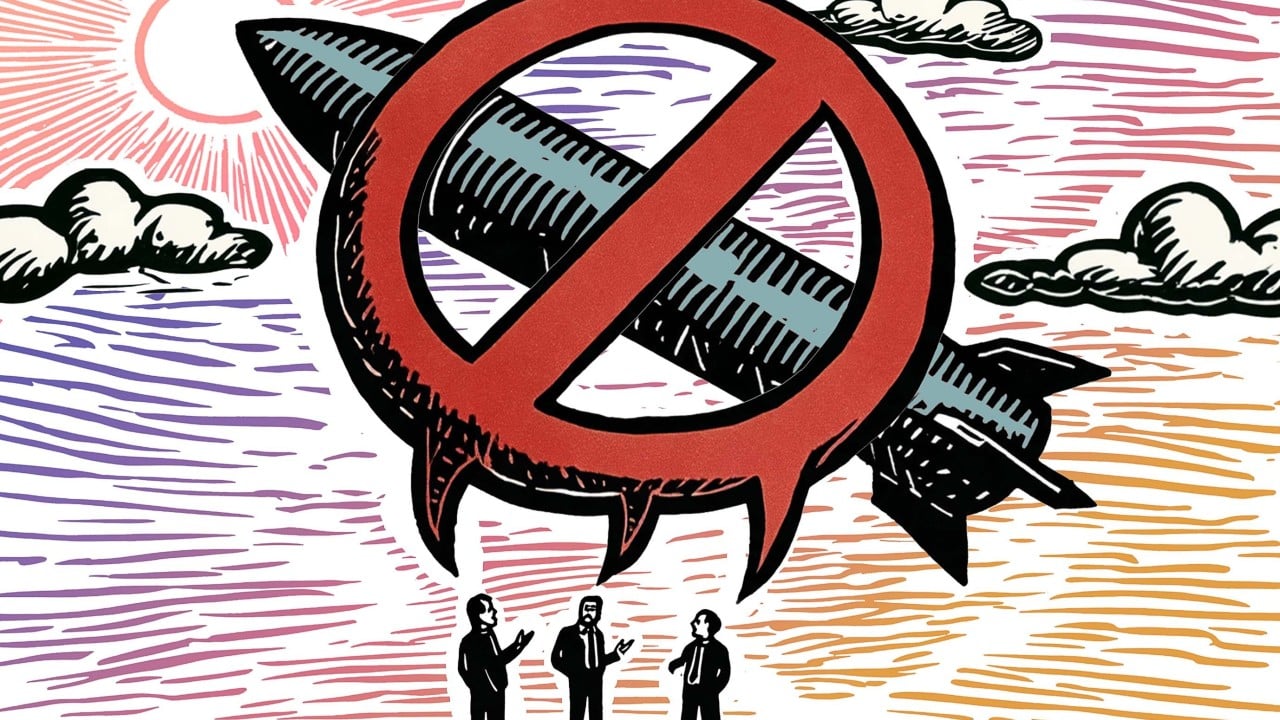
Every time an Asia-Pacific Economic Cooperation summit rolls around, the arms control punditry trots out the exact same fantasy. They publish five-point wishlists begging Washington, Beijing, and Moscow to sit down between trade panels, hold hands, and sign pledges to defuse nuclear risk.
It is pure diplomatic theater. Worse, it is actively dangerous.
Treating APEC like a backdoor Geneva summit misunderstands what APEC is, how nuclear deterrence actually operates in the twenty-first century, and why Beijing and Moscow flatly reject Western arms control orthodoxy. You cannot bolt nuclear risk reduction onto an economic forum designed to lower tariffs on semiconductors and soybeans. When policy wonks demand "five easy steps" at APEC—usually some recycled variation of missile launch notifications, no-first-use pledges, AI-in-command bans, hotlines, and crisis communication protocols—they are selling a placebo to a patient with acute radiation poisoning.
I have sat in Track 1.5 dialogues in Singapore and Geneva watching Western delegates pitch these exact confidence-building measures to Chinese and Russian counterparts. The reaction is always the same. Polite nods. Tea poured. Zero movement.
Why? Because the lazy consensus in Washington and Brussels assumes nuclear risk is a technical misunderstanding waiting for a better phone line. It is not. Nuclear risk in the Indo-Pacific is a deliberate, structural feature of great-power competition. Until analysts stop pretending otherwise, every APEC summit will end with the same hollow communiqués while silos keep pouring concrete in Gansu and hypersonic glide vehicles keep rolling off assembly lines in Votkinsk.
The Institutional Fallacy of APEC Arms Control
Let us start with basic institutional literacy, something the five-step crowd routinely ignores.
APEC is not a security alliance. It is not even a treaty organization. It consists of 21 "member economies"—a deliberate semantic dodge invented in 1989 so Beijing, Hong Kong, and Taipei could sit in the same room without triggering a diplomatic meltdown over sovereignty. APEC operates strictly by non-binding consensus on trade, investment, and supply chain resilience.
Trying to shoehorn trilateral nuclear diplomacy into APEC breaks the venue's foundational architecture.
First, Russia is barely tolerated at APEC table settings anymore, routinely represented by mid-level bureaucrats rather than decision-makers with the authority to discuss Strategic Rocket Forces posture. Second, Taiwan is a full member economy of APEC. Imagine a scenario where US and Chinese negotiators attempt to hash out strategic stability and nuclear signaling in a forum where Taiwanese trade ministers are sitting three tables away. Beijing would walk out before the espresso arrived.
Even if the leaders hold bilateral or trilateral pull-aside meetings on the margins of the summit, the optics of a trade summit poison the well. Leaders arrive at APEC primed to talk about market access, industrial subsidies, and export controls. Shifting gears from microchip sanctions to thermonuclear launch-on-warning postures in a forty-five-minute pull-aside guarantees superficial talking points rather than substantive verification.
Why "Five Easy Steps" Actually Increase Instability
The standard five-step wishlist—hotlines, launch notifications, AI guardrails, warhead caps, and no-first-use declarations—sounds eminently reasonable to the casual reader. To anyone who has studied deterrence theory since Thomas Schelling wrote The Strategy of Conflict, half of these steps are dead on arrival, and the other half invite miscalculation.
Take the perennial favorite: establishing reliable nuclear hotlines.
The US and China already have a defense telephone link. It was established in 2008. You know what happens when the Pentagon calls it during a crisis? Nobody picks up. During the 2021 South China Sea submarine incident, and again during the 2023 spy balloon crisis, Beijing let the phone ring.
Chinese strategic culture does not view crisis communication as a neutral safety valve. In Beijing's calculus, refusing to answer the phone during a crisis is a deliberate coercive signal. It forces Washington to guess China's red lines and induces caution. Building a shinier, faster hotline at APEC does nothing when silence is the intended message.
Then there is the demand for pre-launch missile notifications.
The US and Russia maintain bilateral notification regimes under the 1988 Ballistic Missile Launch Notification Agreement and New START data exchanges (though Moscow suspended New START inspections in 2023). The US and China signed a much weaker bilateral notification agreement in 2014 covering major military activities, which barely touches missile testing.
Pundits scream that expanding this to all ballistic and hypersonic tests at APEC would prevent accidental war. Here is the catch: China's nuclear deterrent relies heavily on opacity. Unlike the US and Russia, which historically flaunted massive arsenals to deter each other, China maintained a smaller force for decades whose survivability depended on Washington not knowing exactly where the mobile launchers were or when they were moving. Mandatory, granular launch notifications strip away the very ambiguity Beijing relies on to keep its second-strike capability survivable against US precision conventional strikes and missile defenses.
The Trilemma Nobody Wants to Admit
The fatal flaw in the APEC five-step formula is mathematical. You cannot solve a three-body problem with two-body tools.
Cold War arms control worked—when it worked—because the United States and the Soviet Union were roughly symmetric superpowers locked in a bilateral standoff. One warhead cut in Omaha matched one warhead cut in Saratov.
Today, we face an asymmetric nuclear trilemma:
- The United States must deter two peer nuclear adversaries simultaneously—Russia and China—while extending a nuclear umbrella over non-nuclear allies like Japan, South Korea, and Australia.
- China is rapidly expanding its arsenal toward a projected 1,000 to 1,500 warheads by the mid-2030s, according to Pentagon assessments, to achieve parity and survive a potential US first strike.
- Russia relies on a massive arsenal of non-strategic (tactical) nuclear weapons—estimated at roughly 1,500 to 2,000 warheads—to offset its conventional military inferiority against NATO and its growing economic subordination to Beijing.
Look at those three positions. They are mutually irreconcilable under traditional arms control frameworks.
If Washington caps its deployed warheads at New START limits (1,550) to appease Moscow, it leaves itself numerically outgunned once China crosses the 1,000-warhead threshold. If Washington builds up to deter both Russia and China combined, Moscow tears up whatever remains of bilateral restraints, and Beijing accelerates its silo construction in Xinjiang and Inner Mongolia.
Asking these three states to hammer out "risk reduction steps" on the sidelines of an APEC summit ignores the core physics of the trilemma. None of the three capitals believes the current balance of forces is stable enough to freeze.
Dismantling the AI and "No First Use" Myths
Every modern arms control article inevitably includes a plea for two trendy pledges: keeping artificial intelligence out of nuclear command and control (NC3), and adopting a universal No First Use (NFU) policy. Both sound noble. Both fail under scrutiny.
The AI Command-and-Control Mirage
Pundits love calling for an APEC declaration banning AI from nuclear launch decisions. Let us be precise about what "AI in NC3" actually means.
No nuclear-armed state is handing launch codes to a large language model or an autonomous drone swarm. That is Hollywood nonsense. Where machine learning and advanced automation actually sit is in early-warning radar processing, satellite imagery analysis, and sensor fusion—filtering out false alarms from solar flares or flocks of geese before a human general ever sees the screen.
If you ban AI integration in early-warning networks, you do not make the world safer. You slow down threat detection in an era of hypersonic glide vehicles that compress decision windows from thirty minutes to under ten. Slower detection forces human commanders to make hair-trigger launch-on-warning decisions with worse data. Furthermore, verifying an AI ban in software code is impossible without invasive, real-time access to a nation's most classified command bunkers. No country on earth will ever grant that.
The Empty Theater of No First Use
China has maintained an official No First Use policy since 1964. Every few months, commentators demand that the US and Russia adopt the same pledge at summits like APEC to lower tensions.
In nuclear strategy, declaratory policy without verifiable posture changes is worthless.
The United States refuses to adopt NFU because its allies in Tokyo, Seoul, and Berlin rely on the threat of US nuclear escalation to deter overwhelming conventional or chemical/biological aggression. If Washington declares NFU tomorrow, South Korea and Japan immediately face massive domestic pressure to build their own nuclear weapons. Proliferation in East Asia does not reduce nuclear risk; it multiplies it exponentially.
Meanwhile, Western defense analysts routinely question whether China's own NFU pledge would survive a conventional conflict over Taiwan if US strikes threatened China's conventional missile forces, which are co-located with nuclear brigades in the PLA Rocket Force. A pledge written on APEC stationery will not stop a commander under fire from using what he has.
What Actually Works (And Why It Has Nothing to Do With APEC)
If begging for five-step wishlists at trade summits is a dead end, what is the alternative? How do you actually manage nuclear risk among three hostile, asymmetric powers?
You stop chasing grand summit declarations and focus on unilateral posture adjustments, hard deterrence, and unglamorous bilateral decoupling.
1. Decouple Conventional and Nuclear Command Systems
The single highest nuclear risk in the Indo-Pacific is entanglement—the dangerous overlap between conventional and nuclear weapons, sensors, and command centers.
China's PLA Rocket Force operates both conventional DF-21/DF-26 ballistic missiles and nuclear-capable variants from overlapping bases and shared command networks. Similarly, US dual-capable aircraft and shared early-warning satellites serve both conventional warfighting and nuclear deterrence. In a conventional war over the Taiwan Strait, a US strike on a Chinese radar station meant to blind anti-ship missiles could accidentally blind China's nuclear early-warning system, triggering panic in Beijing.
The real fix is unilateral architectural separation. Both Washington and Beijing have overwhelming self-interest in physically separating their nuclear command networks from their conventional warfighting grids—not because of a treaty signed at APEC, but because neither wants to stumble into Armageddon by accident.
2. Ditch Trilateralism for Parallel Bilateral Tracks
Forcing Russia, China, and the US into a single room creates an automatic two-against-one dynamic. Moscow and Beijing will inevitably coordinate to gang up on Washington's missile defense systems and forward-deployed allies while shielding each other's arsenals from scrutiny.
Washington must abandon the trilateral fantasy. Nuclear risk reduction needs two completely separate tracks:
- With Moscow: Focus strictly on salvaging basic data exchanges and telemetry transparency to prevent a blind arms race after New START expires in February 2026. Do not link this to Beijing.
- With Beijing: Stop demanding warhead caps China will never accept while it feels inferior. Instead, pursue quiet, technical military-to-military discussions focused exclusively on space debris, satellite interference, and cyber hygiene around early-warning assets.
3. Harden Deterrence to Buy Time
It sounds counter-intuitive to the disarmament crowd, but vulnerable nuclear forces are the primary driver of hair-trigger postures. When a nation fears its missiles can be wiped out in a surprise first strike, it adopts a "use them or lose them" posture.
The most stabilizing move Washington can make is ensuring its nuclear triad—specifically the Columbia-class submarine fleet and modernized NC3 networks—is demonstrably survivable without needing to launch on warning. Similarly, as China shifts from vulnerable liquid-fueled silos to quiet Type 096 ballistic missile submarines and mobile launchers, its incentive to fire early in a crisis drops. Survival breeds patience. Patience prevents nuclear war.
The Honest Downside of the Realist Approach
Let us be candid about the flaws in this approach. Abandoning summit-driven arms control and leaning into survivable deterrence is expensive, slow, and offers zero political theater for leaders craving headlines.
First, unilateral posture adjustments and force modernization cost hundreds of billions of dollars. The US nuclear modernization program is already projected to cost over $750 billion across the next decade, straining defense budgets needed for conventional shipbuilding and munitions.
Second, accepting nuclear asymmetry while building survivable forces means tolerating an uncomfortable period of strategic ambiguity. Publics hate ambiguity. Voters and journalists want crisp, signed agreements promising peace in our time, even when those agreements are unenforceable.
Third, relying on unilateral restraint and quiet technical talks lacks the diplomatic momentum of high-profile summits. Without leaders publicly staking their reputations on risk reduction, bureaucratic inertia in the Pentagon, the Kremlin, and Zhongnanhai can easily stall progress for years.
Stop Confusing Motion With Progress
Every November, the international press corps descends on the APEC host city looking for signs of a thaw between the world's nuclear titans. And every November, arms control advocates hand them a neat five-point checklist to measure success.
It is time to throw the checklist in the shredder.
Nuclear deterrence is not a customer service dispute that can be smoothed over with better communication protocols on the sidelines of an economic forum. It is a brutal, high-stakes equilibrium built on credible capability, survivable forces, and clear red lines.
If Washington, Beijing, and Moscow want to avoid nuclear catastrophe, they do not need another communiqué drafted by trade sherpas at APEC. They need to separate their conventional and nuclear command architectures, harden their second-strike capabilities so nobody feels forced to shoot first, and keep their military-to-military channels open when the cameras are turned off. Everything else is just noise.