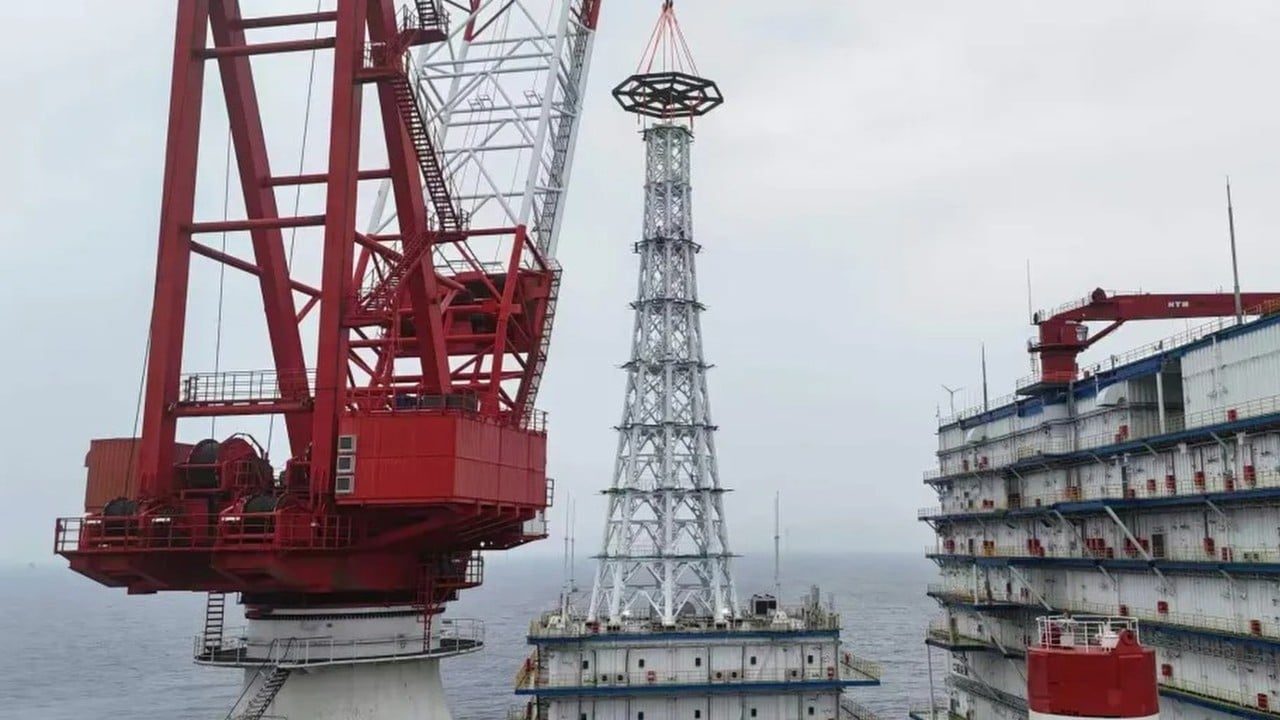
The wind at the edge of the world does not blow. It whips. It carries the heavy, metallic tang of saltwater and the unmistakable scent of a gathering storm. If you stand on the grated steel platform of a modern maritime structure, suspended hundreds of feet above a roiling ocean, the horizon ceases to be a flat line. It curves. You feel small. Insignificant.
For decades, the South China Sea has been defined by horizontal tension. Ships cutting through disputed waters. Drills biting into the seabed. Coast guard vessels playing high-stakes games of chicken. But recently, the geometry of this contested arena changed forever. It went vertical.
China quietly completed a engineering marvel that alters the very physics of maritime observation. It is a record-breaking, 100-meter-tall observation tower. It sits anchored to a reef in the middle of one of the most volatile bodies of water on Earth. To the casual observer reading a brief news snippet, it is just a statistic. A big number on a screen. But to understand what this tower truly represents, you have to leave the dry press releases behind. You have to climb it.
The Anatomy of the Iron Giant
Imagine a skeleton of hardened steel alloy, thicker than the hull of a battleship, driven deep into the coral bedrock. Let us create a hypothetical engineer to understand the sheer scale of this undertaking. We will call him Chen. Chen does not sleep well. For three years, Chen’s entire universe was dictated by typhoon tracks and the corrosive reality of salt fog.
In Chen’s world, standard construction rules do not apply. If you build a 100-meter tower on land, you worry about earthquakes and wind load. If you build it on a remote reef in the South China Sea, you are fighting the ocean itself.
The tower stands roughly as tall as a 30-story skyscraper. It is the tallest offshore observation platform of its kind in the world. But it is not just a hollow pole. It is a multi-layered, self-sustaining ecosystem designed to withstand Category 5 typhoons without blinking.
Consider the logistics. Every bolt, every beam, every ounce of specialized concrete had to be shipped hundreds of miles from the Chinese mainland. Waves frequently cresting over five meters hammered the construction barges. The heat was oppressive. The humidity, absolute. Metal rusted before the workers could even weld it into place.
Why endure this logistical nightmare? Because height is everything.
The Tyranny of the Horizon
To understand why a 100-meter tower changes the chess board, we must look at a simple law of physics: the curvature of the Earth.
If you are standing on the deck of a naval destroyer, your eyes are perhaps 10 meters above the waterline. Because the planet is a sphere, the horizon drops away from you. Your direct line of sight is limited to about 11 kilometers. Even with standard radar, detecting low-flying drones, small skiffs, or subtle changes in the water's surface at a distance is incredibly difficult. The ocean hides things.
Now, change the variables. Move the observer from the deck of a ship to the apex of China’s new tower.
At 100 meters in the air, the horizon suddenly pushes backward. The line of sight expands exponentially to over 35 kilometers. The tower effectively tears the blanket of invisibility off a massive swath of ocean.
But China did not build this giant just to station soldiers with binoculars at the top. The structure is a highly advanced nervous system. The upper tiers are bristling with state-of-the-art sensory equipment. We are talking about dual-band maritime radars, high-definition electro-optical tracking systems that can spot a floating life jacket from miles away, and atmospheric monitoring suites that track weather patterns with terrifying precision.
It is a permanent, unblinking eye. Unlike a satellite, which passes overhead only once every few hours, this tower never leaves. Unlike a drone, it never needs to refuel. It simply sits, watches, and records.
The Human Toll of Isolation
It is easy to marvel at the technology, but the reality of the tower is deeply human. Someone has to live there.
Picture the crew quarters nestled within the mid-sections of the steel lattice. The rooms are compact, mimicking the design of a submarine. The walls are insulated to drown out the perpetual, low-frequency hum of the massive diesel generators and desalination units below. Outside, the wind screams through the structural beams. It is a sound that never stops. It becomes a psychological weight.
For the technicians stationed on this iron island, life is measured in shifts and steps. There are no walks on the beach. There is no green grass. There is only the gray of the steel and the blue of the water.
A sudden storm hits. The tower is designed to sway; flexibility prevents fracturing. Up at the 90-meter mark, the world moves. It is a slow, rhythmic tilt. One foot to the left. One foot to the right. Inside the control room, the coffee in your mug sloshes back and forth. Your stomach does the same. You are acutely aware that beneath your feet lies a drop into a dark, unforgiving sea, and the nearest hospital is a helicopter ride away—assuming the weather permits flight.
This isolation breeds a unique kind of resilience. The crew members are not just technicians; they are survivalists. They maintain the systems that keep them alive while managing data streams that are piped directly back to command centers in Hainan and Beijing.
The Ripples Across the Water
The construction of this tower has sent shockwaves through neighboring nations. Vietnam, the Philippines, and Malaysia watch the horizon with growing unease.
For years, the geopolitical struggle in these waters was a game of presence. Whoever had the most ships in an area claimed dominance. But this tower introduces a new factor: informational asymmetry. If one side can see everything, the other side is always at a disadvantage.
Naval strategists are now forced to rethink their routes. A reconnaissance vessel that used to slip through the gaps between island bases can no longer do so unnoticed. The tower acts as a digital lighthouse, but instead of warning ships away from rocks, it warns a superpower of their approach.
It also serves a dual purpose. Beijing insists the tower is a civilian asset meant to aid in maritime search and rescue, environmental protection, and scientific research. There is truth to this angle. The South China Sea is home to some of the busiest shipping lanes on the planet. When a container ship loses power or a fishing boat capsizes during monsoon season, seconds save lives. A 100-meter observation platform equipped with advanced radar can pinpoint a vessel in distress far faster than conventional methods.
Yet, in this part of the world, civilian utility and military capability are two sides of the same coin. The exact radar that spots a sinking fishing boat can just as easily track a foreign navy's littoral combat ship.
Shifting the Balance
The true significance of the 100-meter tower lies not in its height, but in its permanence.
Ships can be recalled. Submarines must return to port. Island bases can be politically complicated. But a massive steel pillar, anchored directly into the geography of the sea, is a statement of intent. It says, We are here, and we are not leaving.
It represents a broader shift in how humanity interacts with the ocean. We are no longer just skimming the surface or diving to the bottom; we are building permanent, high-altitude outposts in the middle of nowhere. The line between land and sea is blurring.
As night falls over the South China Sea, the tower changes. The harsh glare of the tropical sun fades, replaced by the blinking red aviation lights at its summit. From miles away, it looks like a solitary red star suspended over the black water.
A lone technician stands by the glass in the upper observation deck. Below him, the ocean is a dark, churning void. He checks the radar screens. The green sweeps pulse rhythmically, painting a digital picture of the invisible world outside. Every wave, every vessel, every breath of wind is captured, quantified, and beamed away.
The tower stands silent in the gale, a monument to human ambition and a stark reminder of the lengths to which nations will go to claim the sky above the sea.