The ocean does not care about the size of your engine or the prestige of your flag. At three in the morning, in the claustrophobic corridors of a Nimitz-class supercarrier, the ocean is nothing more than a dark weight pressing against the hull. The real enemy is always inside. It is the heat. It is the smell of scorched insulation and the sudden, heart-stopping realization that the air has turned thick with something that shouldn’t be there.
A fire on a nuclear-powered aircraft carrier is not a routine incident. It is a Tier-1 nightmare. Read more on a similar topic: this related article.
When the alarm bells cut through the hum of the ventilation system on the USS Harry S. Truman, the transition from slumber to survival happened in seconds. This is a city of five thousand souls. It is a floating airfield, a nuclear power plant, and a sovereign piece of American territory all rolled into one hundred thousand tons of steel. When a fire breaks out in a machine room, the "city" holds its breath.
The Anatomy of a Spark
Every sailor knows the smell. It starts as something sweet, almost like ozone, before turning into the acrid, throat-stripping stench of a "Class Charlie" fire—electrical. In the dense wiring of a modern carrier, a single short circuit can become a serpent of flame, racing through cable runs that span the length of football fields. Further journalism by TIME delves into similar views on the subject.
The official reports are clinical. They speak of "localized damage" and "precautionary measures." They tell us the fire was extinguished quickly and that the nuclear reactors—the twin hearts of the beast—remained untouched. But the facts on a spreadsheet cannot capture the sensory assault of a darkened compartment filling with smoke, where the only thing visible is the glow of a teammate’s reflective vest and the spray of a CO2 extinguisher.
Fire is the primary predator of the sailor. On land, you run away from a burning building. At sea, you are trapped in the furnace with the beast. You fight, or you drown in the smoke.
The Long Walk to Crete
The Truman was supposed to be the tip of the spear in the Eastern Mediterranean, a clear signal of presence in a region that currently feels like a powder keg. Instead, the spear has been blunted by its own internal friction. The decision to divert to Souda Bay, Crete, for repairs is a logistical admission of vulnerability.
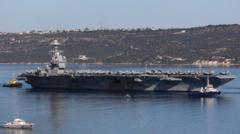
Souda Bay is a beautiful, jagged notch in the Cretan coastline. To a tourist, it is a gateway to turquoise waters and ancient ruins. To the United States Navy, it is a vital pit stop. It is the only port in the Mediterranean capable of accommodating a carrier of this magnitude, offering the deep-water piers and heavy-duty cranes required to cut into the steel skin of a titan and replace what the fire claimed.
Consider the hypothetical perspective of a technician waiting on that pier. You see the carrier appearing on the horizon—a gray silhouette that usually radiates power. But as it draws closer, you notice the lack of flight deck activity. The roar of the F/A-18 Super Hornets is absent. There is a heavy, somber silence to a wounded ship.
The mission doesn't stop, but it certainly pauses. And in the world of high-stakes geopolitics, a pause is a message. While the Truman sits in the shadow of the White Mountains of Crete, the "presence" it was meant to provide becomes a ghost.
The Invisible Stakes of Maintenance
We talk about carriers in terms of "power projection" and "strike groups," but we rarely talk about the copper and the gaskets. We ignore the fact that these machines are aging. The Truman was commissioned in the late nineties. It has spent decades being pounded by saltwater, vibrating under the force of catapult launches, and enduring the relentless heat of its own internal systems.
Maintenance is the unglamorous backbone of empire. When a ship of this scale suffers an onboard fire, it exposes the thin margin for error we operate under. The Navy’s repair backlog is not a secret; it is a chronic ache.
- The Nuclear Factor: While the fire was nowhere near the reactors, any incident on a nuclear vessel triggers a cascade of inspections that can last weeks.
- The Supply Chain: Replacing specialized naval electronics isn't like buying a part at a hardware store. Parts often have to be flown in from halfway across the globe.
- The Human Cost: Beyond the physical damage, there is the fatigue of a crew that was ready for mission and is now redirected to a repair pier.
The move to Crete is a strategic retreat to a safe harbor. It is a reminder that even the most sophisticated weapons systems in human history are ultimately beholden to the laws of thermodynamics and the corrosive reality of the salt air.
The Silence of the Hangar Bay
Walking through a carrier hangar bay during repairs is an eerie experience. Usually, it is a chaotic symphony of "yellow shirts" directing traffic, the hiss of hydraulics, and the shouting of crews. When the ship is "down" for repairs, the symphony stops. You see the planes tethered to the deck, their canopies covered, looking less like predators and more like museum exhibits.
The engineers will descend into the bowels of the ship. they will peel back the charred insulation. They will trace the fault lines of the fire, looking for the "why." Was it a component failure? A lapse in maintenance? Or simply the inevitable result of pushing a thirty-year-old machine to the edge of its endurance in a theater of war that doesn't allow for breaks?
The ship will be fixed. The steel will be welded, the cables re-run, and the smell of smoke will eventually be scrubbed from the bulkheads. The Truman will sail again, its flight deck once more a hive of controlled violence.
But for now, the giant sits quiet in the Mediterranean sun. The blue waters of Crete lap against its hull, indifferent to the nuclear fire within or the chemical fire that slowed it down. It is a reminder that we are never as invincible as our shadows suggest. We are always one spark, one short circuit, or one tired sailor away from the realization that even the kings of the ocean are made of nothing more than vulnerable, temporary atoms.
The smoke has cleared, but the lesson lingers in the quiet of the bay.