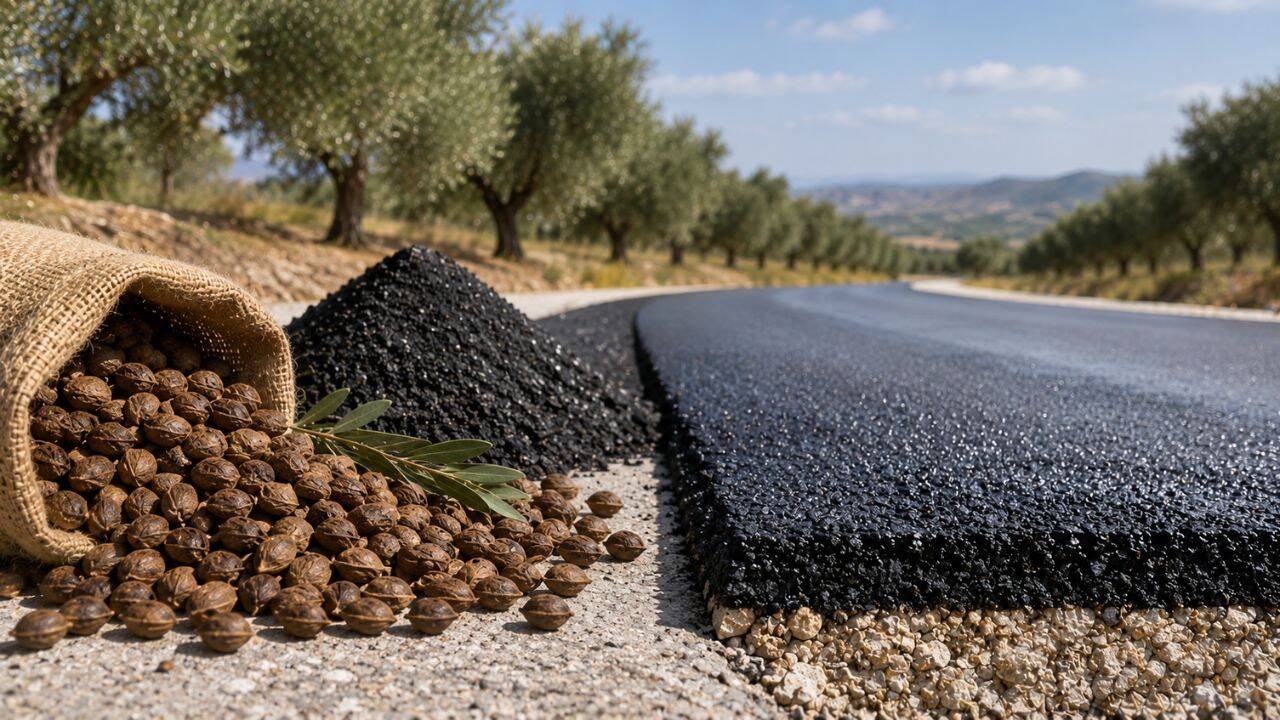
Spain is turning to its vast olive groves to solve a massive environmental problem on its highways. By replacing a portion of the traditional, carbon-heavy bitumen used in asphalt with processed olive pits, Spanish engineers are successfully cutting the carbon footprint of road construction. This agricultural byproduct acts as a natural binder and filler, trapping carbon inside the roadbed instead of allowing it to decompose or burn. The innovation directly tackles the road construction sector’s heavy reliance on fossil fuels. However, scaling this eco-friendly alternative from localized pilot programs to a standard global infrastructure practice reveals deep supply chain friction and rigid regulatory hurdles.
Road building is inherently dirty. Traditional asphalt relies heavily on bitumen, the sticky, black, petroleum-based residue left at the bottom of the refining barrel. Producing and laying this material requires immense heat, releasing vast amounts of carbon dioxide into the atmosphere. For a country like Spain, which manages the largest olive oil production network on earth, the agricultural waste piling up outside its pressing mills presented an obvious question. Why not put that waste to work on the tarmac?
The Chemistry Behind the Crust
To understand why an olive pit can replace a portion of a petroleum byproduct, you have to look at its structural makeup. Olive pits are not just hard seeds. They are dense composites of cellulose, hemicellulose, and lignin. This chemical trio gives the pits a structural rigidity that mirrors the heavy hydrocarbons found in crude oil residues.
When agricultural processors crush olives for oil, they are left with a wet, fibrous mass known as pomace, alongside millions of fractured pits.
Engineers dry these pits and grind them into a specific, microscopic aggregate size. In a standard asphalt mixing plant, workers blend this organic powder into the aggregate mix before introducing the liquid bitumen. The lignin within the olive pits behaves like a natural polymer. It cross-links with the petroleum binder, effectively extending the volume of the bitumen.
This means a road contractor can use less crude oil residue to achieve the same binding capability. The carbon that the olive tree pulled from the atmosphere during its growth cycle becomes permanently locked into the highway grid. It stays trapped under the tires of passing semi-trucks rather than rotting in a landfill or going up the smokestack of a biomass incinerator.
The Crushing Reality of Supply Chains
The math looks flawless on paper. Spain produces roughly half of the world's olive oil, yielding over four million metric tons of waste pomace and pits annually. It seems like an endless reservoir of raw material for the nation's road crews.
The reality on the ground is far more fragmented. Olive harvesting is a highly seasonal business, compressed into a few frantic winter months. Road construction, conversely, peaks during the dry, warm months of summer. This seasonal mismatch creates an immediate logistics bottleneck.
To keep an asphalt plant running smoothly in July, millions of tons of olive waste must be collected in January, transported to specialized processing facilities, ground to exact technical specifications, and stored in climate-controlled silos to prevent moisture absorption. If the olive powder gets damp, it ruins the asphalt mix.
Moisture causes steam pockets to form during the high-heat mixing process, leading to micro-fissures that can cause the road to crumble under heavy traffic.
Building this specialized storage and processing infrastructure requires significant capital. Most olive mills are small, family-run cooperatives scattered across Andalusia and Extremadura. They lack the financial strength to build high-capacity industrial drying and milling plants. Without a centralized supply chain to guarantee a uniform, year-round flow of standardized olive aggregate, major road contractors will hesitate to modify their asphalt plants.
Bureaucracy and the Weight of Rigid Standards
The technical challenge is only half the battle. The true gatekeeper of the highway system is the regulatory framework governed by state transportation ministries. Highway engineers are notoriously conservative. They have to be. A premature road failure costs millions of euros in repairs and creates massive gridlock.
European road standards require asphalt mixtures to withstand extreme temperature fluctuations without cracking in winter or rutting during scorching summer heatwaves.
Introducing an organic material into a certified asphalt recipe voids existing warranties. Testing a new road material requires years of closed-loop track testing and monitored public pilots.
Consider a hypothetical scenario where an engineering firm replaces 10% of the bitumen in a highway project with olive pit aggregate. If that road develops potholes three years into a ten-year contract, the legal and financial liability falls squarely on the contractor, not the innovation agency that recommended the material.
Until state procurement contracts explicitly mandate or financially subsidize the use of bio-based binders, contractors will choose the safety of traditional petroleum bitumen. They know exactly how it behaves over a thirty-year lifespan. They are not willing to gamble their profit margins on agricultural waste.
The Economics of the Barrel Versus the Pitted Grove
Green innovations do not scale on good intentions alone. They scale when the economics force the industry's hand. Currently, the price of traditional bitumen is tied directly to global crude oil markets. When oil prices drop, petroleum-based asphalt becomes incredibly cheap, wiping out the financial incentive to invest in bio-based alternatives.
Processing olive pits is not free. The energy required to dry the wet pomace, mechanically separate the pits from the pulp, and mill them into a fine powder requires significant electricity. With fluctuating energy grids, the cost per ton of processed olive aggregate can occasionally surpass the cost of standard stone aggregate or even rival cheap bitumen.
Furthermore, the road industry is not the only sector eyeing the olive grove. Biomass power plants have long used olive pits as a cheap, high-calorie fuel source to generate electricity.
Asphalt producers are competing directly with energy companies for the exact same waste product. This cross-industry competition drives up the raw material price, threatening to price the olive pit out of the very roads that lead to the groves.
The Long Road to Decarbonizing Infrastructure
If Spain wants to transform this localized pilot into a widespread industrial reality, the approach must shift from environmental novelty to industrial manufacturing. The future relies on creating pre-blended bio-bitumen products at the refinery level, rather than asking individual construction crews to mix agricultural powder into their onsite hoppers.
Major oil companies and chemical refiners must take the lead. By integrating processed bio-binders directly into the liquid bitumen before it ever reaches a construction site, they can deliver a standardized, drop-in replacement product that fits into existing infrastructure.
This approach eliminates the need for asphalt plants to buy new equipment or alter their mixing protocols. It shifts the burden of quality control away from small agricultural co-ops and places it into the hands of industrial chemists who can certify the product under existing European transport laws.
Only by removing the friction from the asphalt plant floor can agricultural waste transform from a regional experiment into the literal foundation of modern transportation networks. The technology works in the lab; the remaining challenge is mastering the grueling physics of the industrial supply chain.