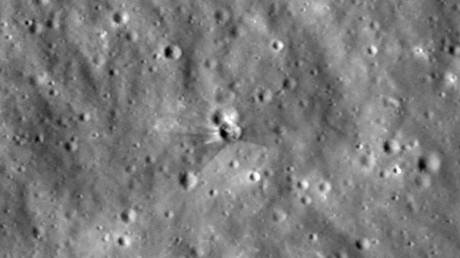
When a multi-ton rocket body slams into the Moon at 5,400 miles per hour, it doesn't just leave a dent. It creates a scientific goldmine. NASA’s Lunar Reconnaissance Orbiter (LRO) recently confirmed this by beaming back high-resolution images of a fresh 60-foot-wide crater, the result of a stray SpaceX Falcon 9 upper stage that met its end on the lunar surface on August 5, 2026.
People often talk about space debris as a distant problem for satellites in low Earth orbit. This impact proves that the issue has officially reached our doorstep at the Moon. The rocket stage involved wasn't some ancient relic; it was the remains of a January 2025 mission that successfully delivered the Firefly Blue Ghost lander to the lunar surface. After completing its primary job, the hardware didn't have enough fuel to return to Earth. It became a piece of wandering space junk, eventually nudged by gravitational forces and solar activity into a collision course.
What The Images Actually Tell Us
You’ve probably seen the headlines, but the imagery itself is what matters. The LRO captured these shots from 60 miles up while traveling at one mile per second. That kind of precision is ridiculous. If the team had missed their timing by just ten seconds, the camera would have been pointed at empty space.
The photos show a crater roughly 60 feet wide and less than 10 feet deep. But look closer at the "butterfly wing" patterns radiating from the center. The dark streaks are older lunar soil, kicked up from beneath the surface where it’s been shielded from cosmic rays and solar wind for eons. The bright rays are fresh, unweathered material excavated from deeper down. For geologists, this is like a natural core sample—except the drill was a four-ton rocket stage.
Why This Isn't Just A Junk Problem
Critics might call this littering, and honestly, they have a point. As we ramp up lunar exploration, we’re treating the Moon’s surface like an uncontrolled trash heap. But scientists are already using this "unplanned experiment" to better understand lunar soil mechanics.
We need to know how the lunar surface reacts to high-velocity impacts to protect future infrastructure. If we’re planning to build long-term habitats or landing pads, we need to understand how much dust gets kicked up and how far it travels. This crash provides real-world data that computer models simply can't match.
The Reality Of The Lunar Dumping Ground
This isn't the first time we’ve left things on the Moon, and it won't be the last. In 2022, a Chinese Long March 3C rocket stage left a distinctive double crater on the far side. During the Apollo era, NASA intentionally crashed spent Saturn V stages into the Moon to create seismic signals for their experiments. The difference now is the sheer volume of traffic.
We are moving from an era of rare, state-sponsored missions to a crowded landscape of private companies and international space agencies. Every rocket stage left in a "disposal orbit" is a potential projectile. While the Moon is effectively a dead world, it’s also an untouched historical record. Every time we crater it with abandoned hardware, we risk obscuring the very scientific data we’re trying to gather.
What Needs To Happen Now
We don't need more hand-wringing; we need better orbital management. Relying on "pure luck" to avoid hitting active science experiments or future landing sites is not a strategy.
- Mandatory De-orbit Planning: Companies need to prove they have enough fuel to de-orbit stages away from the Moon.
- Standardized Tracking: The international community needs to treat lunar-crossing orbits with the same intensity we track low-Earth orbit debris.
- Design for Disposal: Future lunar-bound rockets should be designed with secondary disposal in mind, not just "dumping" in a high-altitude gravity well.
The SpaceX crater is a wakeup call. It’s a spectacular bit of science, sure, but it’s also a sign that we need to grow up and manage our space environment before the Moon becomes a cluttered, hazardous mess. Stop thinking of space as a bottomless pit. It’s an environment, and we’re already changing it.