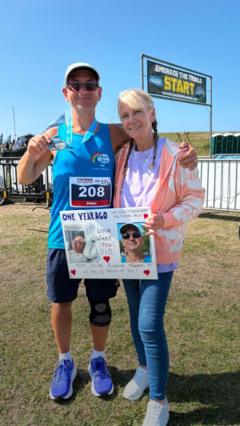
The chest does not break quietly. When the engine stutters, it sounds like a heavy fist against a locked door.
I remember the waiting room fluorescent lights humming with a sterile, hollow frequency. I remember the exact texture of the blue plastic chair beneath my palms. When you survive a cardiac arrest—let alone two—your body stops feeling like a vehicle and starts feeling like a glass house. Every pulse is a reminder of the fragility of the walls. Every quickened breath feels suspiciously like a warning.
Most people think recovery looks like sitting still. They picture a quiet porch, a restricted diet, a life shrunk down to the safe geometry of a living room rug. The medical charts agree, up to a point. They offer words like prognosis, stabilization, and limitation. They draw bright red boundaries around what a broken man is allowed to ask of his own ribs.
Except, biology is stubborn. And the human will is entirely unreasonable.
Consider what happens next when a runner is told to stop running.
To understand what it means to cross a half marathon finish line after two massive cardiac events, you have to understand the silence that follows a heart attack. It is not peaceful. It is deafening. In the aftermath of the second emergency, the hospital bed feels less like a sanctuary and more like a holding cell for a life that has already been judged too fragile. Doctors speak in percentages. Ejection fractions. Remnant tissue. Risk stratification.
(Note: For the sake of framing the physical reality, consider a hypothetical composite of endurance runners who have faced sudden cardiac arrest—men and women whose left ventricles have suffered scarring, yet whose minds refuse to accept the closing of the chapter.)
The medical consensus is clear: high-intensity endurance training places extraordinary stress on an already compromised myocardium. The heart is a muscle, yes, but unlike your biceps or your calves, it cannot afford a day off to ice a strain. Push it too hard, and the electrical grid fails.
So why do it?
Why lace up the worn-out carbon-plated shoes when the very organ inside your chest has twice tried to resign?
Because safety is not the same thing as living.
When you stare down the barrel of mortality, something shifts in the circuitry of desire. The fear of death is powerful, but the fear of a half-lived life is a slow poison. Training for 13.1 miles is not about medals or course records. It is a grueling, daily negotiation with fear.
Step one is terrifying. The first time the heart rate monitor ticks past 130 beats per minute post-infarction, panic claws at the throat. Is this the third time? Is this the one that sticks? The mind plays cruel tricks, turning every normal stitch in the side into a harbinger of doom.
This is where expertise meets raw endurance. Cardiologists specializing in sports cardiology do not just hand out blanket bans anymore. They map the electrical pathways. They test the stress limits under controlled laboratory conditions, watching the monitor spike while the treadmill climbs. They measure the collateral circulation—the miraculous way the body grows microscopic new bypasses around blocked arteries, desperately weaving detours to keep the lights on.
The body is a cartography of resilience.
Months of early morning miles blur together. Cold asphalt under freezing dawn skies. The rhythmic, metronomic slap of rubber on pavement. Each training run is a silent conversation between the brain and the ventricle. Trust me, the legs say. Hold together, the chest replies.
By race day, the starting line is a cathedral of nervous energy. Thousands of runners bounce on their toes, wrapped in foil blankets against the morning chill, breathing out clouds of steam. Among them stands someone who has cheated the grave twice.
There is no fanfare for him. No special bib marking him out as an anomaly. He is just another silhouette in the crowd, adjusting his watch, feeling the heavy, steady thud beneath his breastbone.
The gun goes off.
The herd surges forward. Mile one is always easy, fueled by adrenaline and the sheer momentum of the crowd. Mile four brings the first test of rhythm. Mile eight is where the mental demons arrive, whispering old fears about oxygen debts and electrical storms.
This is the invisible stakes of the endurance game. It is not about beating the clock. It is about proving that the scars do not define the limits of the map.
As the finish line approaches, the noise of the crowd swells into a roar. The digital clock overhead flashes in harsh, glowing red numbers. The legs are heavy, screaming with lactic acid. The lungs burn with that familiar, metallic taste of maximum effort.
He crosses the mat.
The medal is dropped over his head, heavy and cold against his collarbone. He doesn't collapse. He doesn't fall to his knees in dramatic fashion. He simply stops, bends forward with his hands on his thighs, and listens.
Inside his chest, the heart is hammering a frantic, triumphant rhythm. It is beating fast. It is beating hard. It is alive.