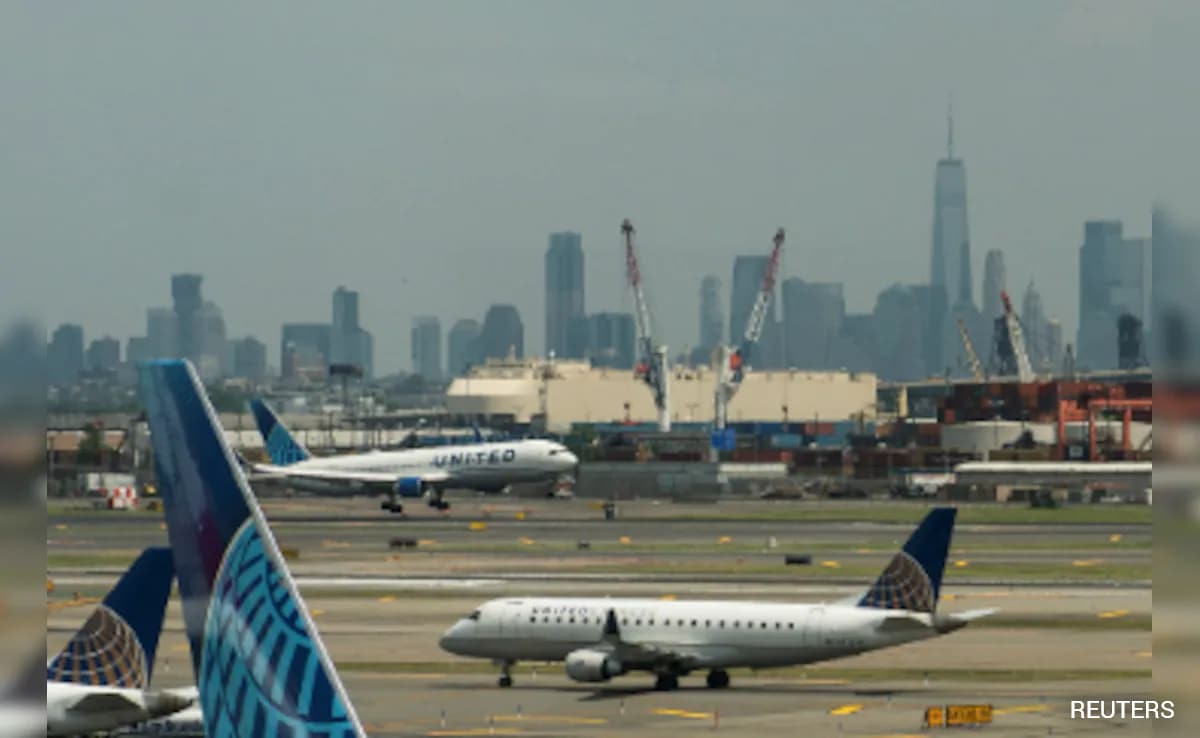
The air didn't just move; it shivered.
On a standard Tuesday afternoon, the kind where the sun bleaches the asphalt and the mundane rhythm of urban life hums at a predictable frequency, the residents of a quiet neighborhood near the airport learned exactly what thirty tons of hurtling aluminum sounds like when it’s out of place. It wasn't the distant, low-frequency rumble of a scheduled departure. It was a visceral, chest-thumping roar that suggested the sky was collapsing. Meanwhile, you can find related events here: The Hard Truth About Cruise Safety and the Zaandam Viral Outbreak.
In that heartbeat, the boundary between the heavens and the earth dissolved.
The Geometry of a Near Miss
Commercial aviation relies on a rigid, invisible architecture. Pilots navigate through corridors defined by altitude and GPS coordinates, maintaining a sanctified distance from the lives unfolding beneath them. When a United Airlines jet deviated from that geometry, it wasn't just a mechanical or navigational error. It was a breach of a social contract. To see the full picture, we recommend the detailed report by The Points Guy.
Witnesses on the ground didn't see a "flight path deviation." They saw a predator.
A street lamp, a sentinel of suburban safety designed to withstand wind and rain, stood no chance against the wingtip of a descending behemoth. The sound of the impact—a screech of metal on metal followed by the explosive shattering of glass—served as a terrifying punctuation mark to a descent that was never supposed to happen.
Consider the physics. A standard Boeing or Airbus narrow-body jet doesn't just "float." It is a creature of momentum. At the altitudes reported by horrified onlookers, the margin for recovery is measured in seconds, not minutes. To see the livery of a major carrier—the blue and white globe—low enough to read individual rivets is to look at the face of a catastrophe that blinked at the last possible moment.
The Human Cost of the Invisible Stake
We often talk about airline safety in terms of statistics. We cite the millions of successful landings and the infinitesimal probability of a hull loss. But statistics are cold comfort when the shadow of a jet crosses your kitchen window.
For the people on that street, the stakes weren't abstract. They were seated in car seats in the back of minivans. They were watering lawns. They were living the fragile, beautiful reality of a Tuesday.
The "invisible stakes" here aren't just about the lives of the passengers on board—who likely felt the sickening jolt of an unplanned maneuver—but the psychological sanctuary of the people below. When a jet hits a street lamp, it breaks more than a light bulb. It breaks the assumption of safety. It reminds us that we live beneath a river of fire and steel, and we trust the navigators of that river with every breath we take.
Why did it happen? The investigation will eventually yield a dry report filled with acronyms. It will speak of "approach glide paths," "instrumentation lag," or "spatial disorientation." It will translate a moment of pure, unadulterated terror into a series of data points.
But a data point can’t describe the way the ground vibrates. It can’t capture the silence that follows the roar—a silence so heavy it feels like it might never end.
The Anatomy of an Approach
To understand how a professional flight crew ends up skimming the treetops, you have to understand the cockpit's environment. It is a world of high-definition displays and synthetic vision, yet it is still prone to the oldest enemy of the scout: the trickery of the eyes.
Imagine a pilot—let’s call him Captain Miller—fatigued by a long rotation, staring through a windshield where the horizon is blurring. The instruments say one thing, but the gut says another. Perhaps there is a momentary lapse in communication. Perhaps the "automated" systems, which we trust to be infallible, provided a solution that didn't account for the sudden gust of a localized microburst.
In the dance of the landing, the transition from "active flight" to "controlled descent" is the most dangerous phase. You are shedding energy. You are fighting gravity. You are looking for a slab of concrete in a sea of lights. When that process is interrupted by a mechanical hiccup or a human miscalculation, the aircraft becomes a giant, ungainly glider.
The street lamp was a warning. It was a sacrificial marker.
Beyond the Investigation
The airline industry will respond with its usual cadence of "safety is our top priority" and "we are cooperating fully with authorities." These are necessary scripts, but they lack the blood and bone of the event.
We live in an age where we demand perfection from our machines and the people who operate them. We have engineered out almost every conceivable flaw. Yet, the street lamp remains a jagged reminder that the world is still physical. Gravity is not a suggestion. Momentum is a law that cannot be lobbied or litigated.
When we look up now, we don't just see a plane. We see the possibility of a descent that doesn't stop where it's supposed to. We see the thin line between a routine commute and a neighborhood transformed into a debris field.
The witnesses will tell their stories for years. They will talk about the day the sky came down to touch the pavement. They will remember the way the air smelled like burnt kerosene and ozone.
And every time they hear a rumble in the distance, they will look up. Not out of curiosity, but to ensure that the shadows staying where they belong—high above the lamps, tucked away in the clouds, keeping their distance from the fragile lives we lead on the ground.
The jet is gone. The lamp is replaced. But the shiver in the air remains.