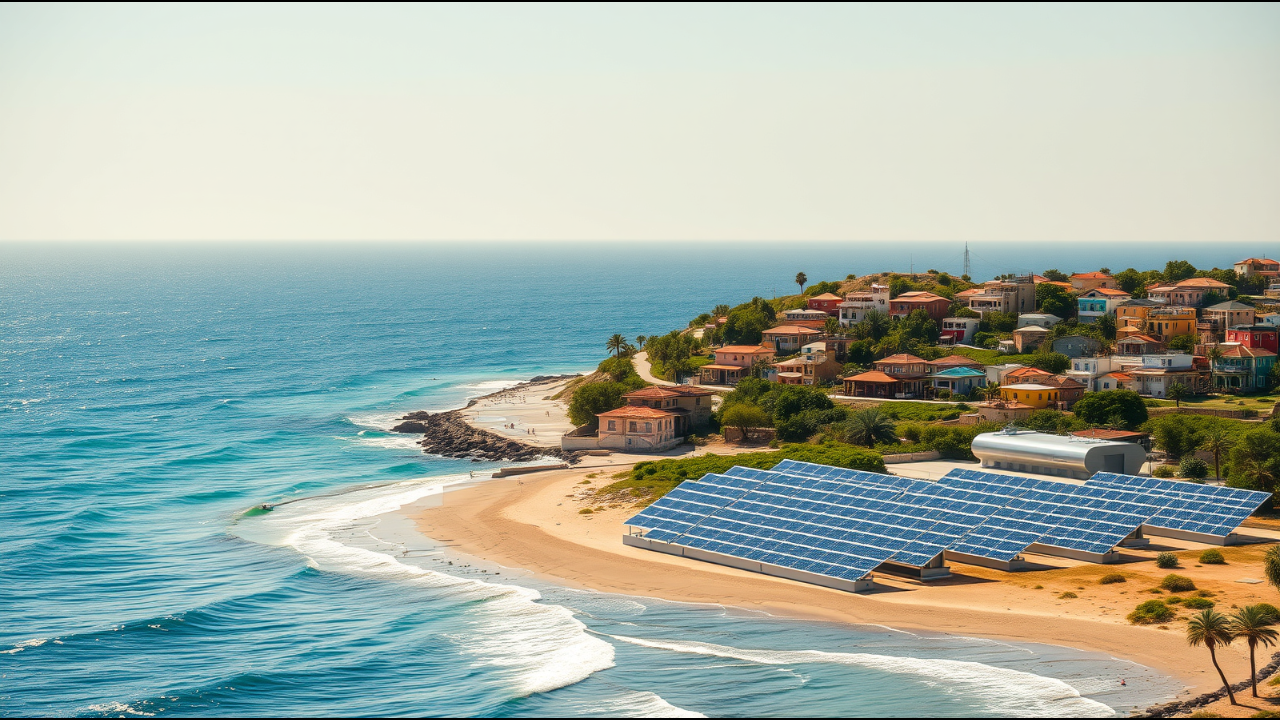
Every green tech conference features the exact same slide. A sun beating down on a shimmering ocean, a sleek filtration membrane, and a bullet point promising infinite drinking water powered entirely by free photons. It plays like a sermon for the climate choir. Desalination powered by the sun. Clean water for the parched masses, zero carbon emitted, ecological harmony restored.
It sounds wonderful. It is also an engineering pipe dream that ignores the basic physics of fluid dynamics, the brutal economics of municipal infrastructure, and the chemical reality of what lives in the sea.
I have watched venture capital funds and municipal water boards blow hundreds of millions of dollars chasing this exact mirage. They buy into the lazy consensus that because sunlight is free and seawater is abundant, turning one into the other using the first should be cheap and easy.
It is neither.
Here is what the cheerleaders refuse to admit. Solar-powered desalination is an exercise in scale mismatch. Sunlight is diffuse, weak, and intermittent. Desalination is energy-dense, relentless, and unforgiving. Trying to marry them at scale is like trying to run an aluminum smelter with a collection of handheld magnifying glasses.
The Energy Density Fallacy
Let us start with the core thermodynamic misunderstanding. The minimum theoretical energy required to separate pure water from standard seawater is about 0.8 kilowatt-hours per cubic meter. That is a law dictated by the second law of thermodynamics. You cannot engineer your way around it.
Real-world reverse osmosis plants do not run on theoretical minimums. They require between 3 and 4 kilowatt-hours per cubic meter once you factor in pump inefficiencies, energy recovery systems, and pre-treatment cycles.
Now, look at solar power. A standard photovoltaic panel delivers peak output for a fraction of the day. A utility-scale reverse osmosis plant cannot afford to turn off when a cloud rolls over or when the sun sets. Water treatment is a base-load industrial process. It demands continuous pressure. If you turn off the high-pressure pumps every time the sun dips, your membranes foul, your pressure vessels warp, and your equipment lifespan plummets by half.
To make solar desalination work around the clock, you need battery storage. Massive battery storage. The moment you introduce utility-scale lithium-ion or flow batteries to bridge the intermittency gap, your capital expenditure skyrockets. You have just taken free solar energy and strapped an expensive, chemically volatile anchor to it.
The Brine Monster in the Room
Ask any proponent of solar desalination what happens to the byproduct, and they will mumble something about coastal discharge or change the subject entirely.
Let us be precise. For every liter of fresh drinking water you extract from the ocean, you leave behind roughly one to one point five liters of brine. This is not just salty water. It is a concentrated witches' brew of hypersaline sludge laced with the anti-scalants, coagulants, and chlorine residues dumped into the intake system to keep marine growth from destroying the pipes.
Traditional mega-desalination plants dump this heavy, toxic brine back into the sea through deep ocean outfalls designed to mix it rapidly with ambient currents. Even then, marine biologists document dead zones stretching for miles around major discharge points.
Now scale down to distributed, solar-powered units scattered along vulnerable coastlines or remote islands. These localized units lack the capital for deep-sea outfall pipelines. They discharge their brine right at the shoreline in shallow, near-shore environments.
The result is a localized ecological catastrophe. The dense brine sinks immediately, hugging the ocean floor and suffocating seagrass meadows, coral polyps, and benthic filter feeders. We are trading human thirst for marine suffocation, and we are calling it sustainability because the pumps are hooked up to photovoltaic cells.
The Membrane Maintenance Myth
Another favorite talking point of the techno-optimist is the self-sustaining, off-grid solar still or direct membrane distillation unit. The pitch is alluringly simple. No moving parts, no grid connection, just set it and forget it in remote communities.
I have seen these units deployed in arid regions across North Africa and the Middle East. Within six months, ninety percent of them are silent monuments to maintenance neglect.
Seawater is not clean. It is a biological soup of phytoplankton, bacteria, organic colloids, and microscopic debris. When you push seawater through a reverse osmosis membrane or evaporate it via solar thermal collectors, that organic matter bakes onto the surface. It forms a biological slime layer known as biofouling.
In a modern industrial facility, automated clean-in-place systems flush the membranes with acid, caustic soda, and biocides every few weeks. Instrumentation monitors pressure drop down to the kilopascal.
A decentralized solar unit in a remote village does not have a resident chemical engineer. When the membranes foul, the output drops to zero. Without daily monitoring, fine-tuned pre-treatment filtration, and expensive replacement cartridges, the system becomes an expensive paperweight within a single season. The hardware is sound; the human and logistical reality is fatal.
The Economics of Scale Versus Decentralization
The entire thrust of the solar desalination movement is decentralized autonomy. The narrative goes that small villages and drought-stricken agricultural communes should own their water production rather than relying on centralized municipal grids.
Economically, this is madness.
Water treatment is a natural monopoly characterized by severe economies of scale. Large plants amortize the cost of intake tunnels, environmental impact assessments, high-pressure pumps, and distribution networks over millions of cubic meters.
When you fragment water production into thousands of micro-solar desalination pods, your capital cost per cubic meter produced explodes. You lose the efficiency of bulk chemical purchasing. You lose the redundancy of interconnected pipe networks. You create a logistical nightmare where spare parts must be shipped to remote outposts for dozens of different proprietary designs.
It is the classic trap of appropriate technology ideology. It feels virtuous to build small, localized, sun-powered water makers, but it locks poor communities into high-cost, high-failure-rate infrastructure while rich urban centers continue to benefit from large-scale, centralized engineering.
What People Also Ask
Is solar desalination cheaper than traditional desalination?
Only if you ignore the hidden costs of energy storage, frequent membrane replacements, and the inevitable premature replacement of the hardware. On a levelized cost of water basis, grid-tied reverse osmosis powered by a mix of natural gas or utility-scale wind and solar is vastly cheaper per gallon than standalone solar thermal or solar-photovoltaic RO units.
Can solar desalination solve global water scarcity?
No. Global water scarcity is rarely a localized lack of water volume; it is a failure of infrastructure, economics, governance, and energy access. Transporting water uphill or inland costs vastly more energy than desalinating it. If you cannot afford to pipe water thirty miles inland, a solar still on the beach does not solve your problem.
What is the best alternative to solar desalination?
Fixing the leaks in existing municipal distribution networks. In many developing and developed cities alike, between thirty and fifty percent of treated drinking water leaks out of crumbling, century-old pipes before it ever reaches a tap. Repairing infrastructure is boring, unphotogenic, and does not fit on a venture capital pitch deck, but saving water that has already been treated is five times cheaper than making new water from the ocean.
The Real Path Forward
We need to stop treating seawater as an infinite, consequence-free salvation machine activated by sunlight.
If we are going to use the ocean to slake our thirst, we need to do it like industrial adults. We need massive, hyper-efficient, centralized facilities powered by the cleanest available grid electricity—whether that is nuclear, geothermal, or large-scale wind and solar farms with proper transmission backing. We need deep-sea brine diffusers that protect coastal ecosystems. We need rigorous pre-treatment that keeps biological slime at bay.
Stop looking for the magic solar bullet. Water treatment is not a lifestyle brand. It is heavy industry. Treat it like one or stay thirsty.