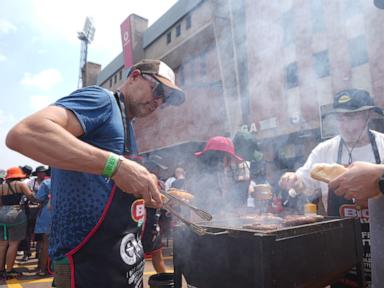
Dawn in South Africa smells of dry acacia wood, wet grass, and the unmistakable, sharp promise of fat rendering over glowing embers.
Long before the sun cleared the jagged spine of the mountains, Oupa stood by his brick braai in Soweto, rolling a piece of boerewors between his palms. He wasn't just cooking breakfast. He was tending to an institution. Around him, the neighborhood was already humming. Across the fence, his neighbor was unrolling a massive grid, scraping away the residue of last weekend’s gathering with a scarred wire brush. Down the street, the rhythmic chopping of onions and tomatoes for a fresh chakalaka beat a steady morning percussion.
Multiply that scene by thousands. Stretch it from the breezy coast of Durban to the sprawling townships of Johannesburg, past vineyard-draped valleys in the Cape, all the way to quiet rural outposts where the dirt roads kick up red dust under the weight of loaded coolers.
This was the day South Africa decided to smoke out its differences.
On this particular afternoon, crowds converged with a singular, smoky mission: to shatter a record and, in doing so, claim a shared heritage over an open fire. Thousands of South Africans, armed with tongs, folding chairs, charcoal, and an unyielding national obsession, gathered to host the biggest cookout the country had ever witnessed.
To an outsider, it looked like a logistical marvel of meat and heat. To anyone who has ever lived beneath the Southern Cross, it was something entirely different. It was an involuntary heartbeat.
The Fire That Binds Us
We need to talk about the braai.
In most parts of the world, outdoor cooking is a seasonal hobby. It belongs to July weekends in American suburbs or summer holidays on Mediterranean terraces. It is something you do when the weather permits, wrapped in the casual leisure of a day off.
In South Africa, the braai is a cultural anchor. It is the social glue holding together a society that has spent decades stitching itself back together after the profound, jagged tears of apartheid.
Consider the mechanics of it. You do not rush a braai. Gas is viewed with deep, almost theological suspicion—an artificial shortcut that robs the ritual of its soul. Real cooking requires wood. It requires patience. You have to wait for the roaring flames to die down, watching the timber collapse into a bed of white-hot embers, known locally as blikasem coals. That waiting period forces people to stand together. You hold a drink. You talk about rugby, politics, the price of fuel, childhood memories, and local gossip. The fire dictates the pace of human connection.
When thousands of participants synchronized their grills for this record-breaking attempt, they weren't just chasing a line in a ledger book. They were performing an ancient social choreography.
Picture a hypothetical family in Pretoria standing around their circle of smoke. Oupa, whose hands bear the faint, speckled burn scars of forty years of weekend cooking, turns to his grandson. The boy holds a pair of heavy metal tongs like a sword, eyes watering slightly from the wind-driven smoke.
"You don't rush the meat," Oupa says, his voice a low gravel rumble over the crackle of the wood. "The meat tells you when it’s ready. The fire teaches you patience."
That simple transmission of generational knowledge is happening in a million backyards every single heritage day. But scaling it up to a national spectacle transforms a backyard habit into a collective cultural mirror.
Smoke Without Borders
History in this part of the world is heavy. It carries the weight of forced separations, linguistic divides, and stark economic inequalities. For generations, the spaces where South Africans could gather were strictly regulated, policed, and divided by law.
The braai, however, became the great equalizer.
No matter your background—whether you grew up speaking Zulu, Afrikaans, Xhosa, English, or Sotho—the language of the grid is universally understood. The sizzling sound of a lamb chop hitting hot steel translates across every linguistic boundary.
When the official tally of participants began climbing during the mass cookout, the sociological reality of the event eclipsed the numbers. You had corporate executives in tailored shirts standing shoulder-to-shoulder with mechanics and students, all squinting through the same stinging haze of hardwood smoke. In that shared cloud, titles vanished. Bank accounts didn't matter. Political affiliations dissolved into the ether. There were only those tending the fire and those waiting for the meat.
It is easy to be cynical about mass events designed to break records. Critics often dismiss them as corporate stunts or fleeting marketing ploys designed to sell more wors and beer. And undoubtedly, the commercial engines behind the scenes were turning a profit.
Yet, cynicism misses the human truth on the ground.
People crave rituals that anchor them to something larger than themselves. In a world increasingly fractured by digital isolation and endless political anxiety, there is profound, radical comfort in standing shoulder-to-shoulder with strangers, smelling woodsmoke, and sharing a meal cooked over raw heat. It is visceral. It pulls you out of your head and drops you squarely into your senses.
The Chemistry of Belonging
Let’s look at the science for a moment, because the braai works on principles as old as human civilization itself.
Cooking meat over an open fire triggers the Maillard reaction—a complex chemical dance between amino acids and reducing sugars that gives browned food its distinctive, craveable flavor profile. But the human brain experiences something even more powerful when exposed to wood smoke.
Anthropologists suggest that the control of fire was the primary catalyst for human socialization. Around the campfire, early humans shared stories, forged alliances, and built communities that stretched beyond immediate family units. When we gather around a grill today, our nervous systems recognize the ancient cue. The flicker of flames lowers blood pressure. The shared aroma signals safety, abundance, and communal survival.
When thousands of South Africans lit their fires simultaneously, they were tapping into that primal wiring on a national scale.
The air above the cities and towns turned a hazy, pale blue. From high above, satellites could likely trace the faint, smoky signature of a nation gathered at the hearth. Down below, the noise was deafening and joyful: children chasing soccer balls across sun-baked lawns, the sharp clink of bottle caps hitting ice chests, the laughter cutting through the heavy afternoon air, and always, the rhythmic sizzle of fat dripping onto glowing coals.
The Lingering Embers
Long after the official record was logged and the news crews packed up their cameras, the fires didn't simply go out.
That is the thing about a braai. It refuses to be rushed.
Even when the meat is gone, the salads eaten, and the children tucked into bed, people linger. They pull their chairs a little closer to the fading warmth as the evening air turns crisp. The glowing embers transition from a blinding white to a deep, smoldering red, radiating a gentle heat that defies the growing chill of the night.
In those quiet hours, the true spirit of the day reveals itself. It isn't found in the statistics or the certified certificates of participation. It lives in the quiet conversations held in the dark, the lingering scent of woodsmoke clinging stubbornly to clothing and hair, and the quiet, stubborn belief that a country split by its history can still find common ground over an open flame.
The smoke eventually cleared. The grills cooled down. But somewhere across the vast, beautiful expanse of South Africa, someone is already planning the next fire.