The scent of wet wax and damp wool clings to the back of your throat long after you step out of a Hong Kong church in November. It is a heavy, subterranean smell, the kind that settles into the lining of a winter coat and stays there for weeks. Outside, the New Territories air is crisp, carrying the faint metallic tang of the Tolo Harbour tide and the distant hum of the East Rail Line. Inside, hundreds of people sit shoulder to shoulder on wooden pews that have absorbed the weight of generations of quiet desperation.
They are here because a building burned in Tai Po. You might also find this similar story interesting: Asymmetric Leverage in Diplomatic Bargaining: Quantifying the Biden-Netanyahu Commitment Breakdown.
If you read the standard wire reports, the story is clean, sanitized, and quickly filed away under municipal tragedy. A fire broke out. Lives were lost. Hundreds gathered for a memorial mass. A bishop stood at the altar and dismissed whispers of political pressure. End of dispatch. Next story.
That version of events is a lie of omission. It treats a community’s raw, unhealed wound like a line item on a city ledger. When you strip away the bureaucracy and the carefully curated press releases, what remains in that church is something far more volatile than grief. It is the collision between a city’s demand for answers and an institution’s desperate attempt to keep the peace without losing its soul. As extensively documented in recent reports by The Washington Post, the implications are widespread.
To understand why three hundred people packed themselves into those pews, you have to understand what a fire actually does to a neighborhood like Tai Po. It does not just consume concrete, bamboo scaffolding, and cheap electrical wiring. It burns away the illusion that anyone is coming to save you.
The Anatomy of a Tuesday Night
Consider a hypothetical resident—let’s call him Mr. Chan, though his face belongs to dozens of men standing in the back aisle of the church, clutching creased paper programs until their knuckles turn white. Mr. Chan has lived in Tai Po for forty years. He knows the rhythm of the district: the morning rush toward the wet market, the clatter of mahjong tiles behind half-shuttered doors, the cramped verticality of residential blocks where three generations share six hundred square feet and a single window overlooking an air shaft.
In buildings like these, fire is not an abstract hazard. It is a constant, breathing neighbor.
You see it in the subdivided flats where illegal partitions turn hallways into labyrinths. You see it in the rusted fire doors propped open with bricks for ventilation, and the expired extinguishers gathering dust beside piles of cardboard. Everyone knows the risks. Everyone also knows that complaining means risking eviction, and in a city where the median flat costs twenty times a worker’s annual salary, you learn to live with the smell of overloaded circuits.
When the flames finally took hold in Tai Po, they moved with the terrifying speed that only high-density urban architecture allows. Smoke travels upward through stairwells like water through a pipe. Within minutes, exits vanish. Visibility drops to zero. Panic becomes a physical wall that crushes people against locked gates.
By the time the sirens faded and the blackened skeleton of the building stood steaming against the morning sky, the numbers were already being tallied. Dead. Injured. Displaced. The machinery of official response kicked into gear with practiced efficiency—condolence statements from government bureaus, temporary shelters opened in community halls, promises of thorough investigations that everyone in the room knew would take years to produce a single page of accountability.
And then came the mass.
The Weight of the Incense
Walk into a memorial service in Hong Kong right now, and you immediately feel the tension between what is spoken and what is swallowed.
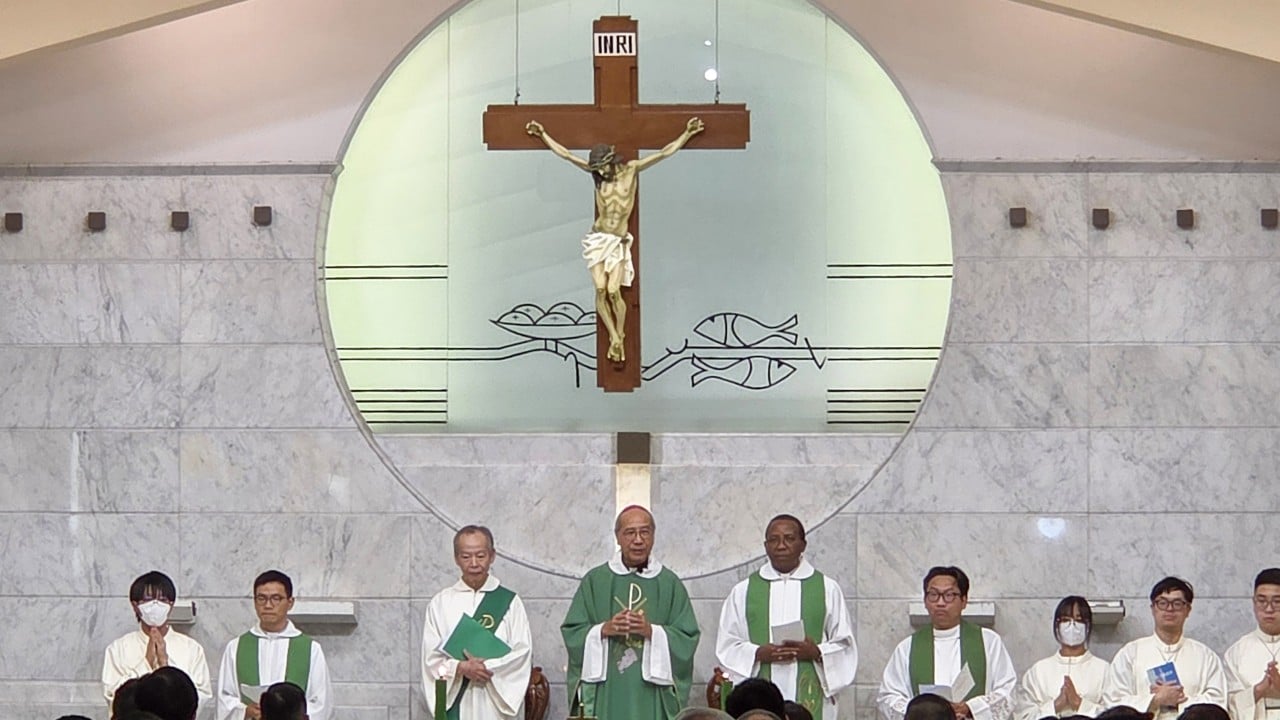
The church in Tai Po was not merely full; it was pressurized. Mourners arrived early, filling the main nave and spilling into the side chapels, their faces drawn tight beneath surgical masks and dark collars. Some carried white chrysanthemums wrapped in brown paper. Others brought nothing at all, their hands tucked deep into their pockets as if bracing against a sudden chill.
At the front stood the clergy, dressed in vestments that seemed almost blindingly bright against the sea of charcoal coats. When the bishop stepped forward to address the congregation, the silence in the room was absolute. You could hear the faint hiss of the overhead fans and the muffled sob of a woman near the third row.
In recent years, public gatherings in Hong Kong have carried an unspoken electricity. Every assembly, no matter how solemn or strictly religious, exists under the long shadow of tightened security laws and a political climate where collective grief can easily be misread as collective dissent. People watch who shows up. They watch who speaks. They watch which reporters are taking notes by the back doors.
Before the service even began, rumors had circulated through messaging groups and local forums. Had the diocese been warned to keep the ceremony quiet? Had officials leaned on church leadership to ensure the memorial did not turn into a platform for criticizing housing safety failures or government oversight? Was the bishop walking a tightrope between pastoral duty and state scrutiny?
The bishop did not dodge the question. Standing beneath the cross, his voice steady and deliberate, he dismissed the talk of pressure outright. There had been no interference, he insisted. No demands from outside authorities. The church was doing what it has always done: praying for the dead, comforting the broken, and standing beside a community in its darkest hour.
Listen closely to that denial, and you hear the exact sound of modern Hong Kong.
What Silence Actually Costs
It is tempting to take the bishop at his word and move on. Perhaps no official ever picked up a phone. Perhaps no bureaucrat sent a thinly veiled memo advising caution. In a mature system of self-censorship, direct orders are rarely necessary. Everyone already knows where the lines are drawn.
Think of it like walking across a frozen lake you have crossed a hundred times before. Nobody has to stand on the shore shouting warnings about where the ice is thin. You feel the temperature drop. You hear the faint groan beneath your boots. You adjust your stride automatically, keeping your weight low and your steps small, praying the surface holds until you reach the other side.
That is the invisible stake inside that Tai Po church.
When a community loses neighbors to a preventable disaster—a fire fueled by substandard conditions, lax enforcement, or the quiet desperation of an unaffordable city—grief naturally seeks a target. People want to know why. They want to know why inspections failed, why alarms didn't ring, why the poorest residents always seem to live in the most flammable rooms.
In a healthy civic space, a memorial is the beginning of that reckoning. Grief transforms into anger, anger transforms into scrutiny, and scrutiny forces change.
But when the atmosphere is thick with unspoken boundaries, grief gets trapped indoors. It turns inward. Instead of demanding systemic reform, mourners are nudged toward private endurance. Pray for the souls. Donate to the relief fund. Trust the authorities to handle the inquiry. Keep your voice down.
This is not an indictment of the church or the bishop. Religious institutions in Hong Kong occupy an increasingly narrow corridor, trying to preserve their schools, their social welfare networks, and their right to gather without triggering an existential confrontation with the state. Survival requires prudence. A bishop who turns a funeral into a political rally risks bringing down the roof on the very parishes trying to feed and shelter the survivors.
Yet prudence has a price. Every time public tragedy is smoothed over into purely spiritual comfort, the structural failures that caused the fire recede a little further into the dark.
The Architecture of Accountability
If you have ever stood inside a burned-out apartment building after the fire department packs up its hoses, you know that fire leaves behind a very specific kind of ruin. Metal bedframes twist like melted wax. Concrete walls are scorched black up to waist height, where the smoke bank hovered before finally venting through shattered windows. You can trace the exact path of the heat by looking at what survived and what turned to ash.
Disasters are forensic records. They tell the truth even when people cannot.
Across Hong Kong, the pattern of fatal residential fires over the past two decades reads like a blueprint of urban inequality. Time and again, the worst casualties occur in older composite buildings—structures built during the post-war boom of the 1950s and 1960s, before modern fire codes existed, now carved up into dozens of cramped cubicles to maximize rental yields.
Look at the mechanics of these tragedies:
- Single-staircase designs where one blocked landing traps dozens of families on upper floors with nowhere to climb except the roof—often behind a padlocked door.
- Unregulated renovations that strip away fire-resistant walls and replace them with cheap plywood and foam insulation that releases cyanide gas when burned.
- Fragmented ownership that paralyzes building management committees, leaving broken sprinkler systems and faulty wiring unrepaired for years because owners cannot agree on who pays the bill.
None of this is a secret. Housing advocates, firefighters, and urban planners have mapped these vulnerabilities down to the street address. After every major blaze, the cycle repeats with clockwork precision. Flags fly at half-mast. Task forces are formed. Proposals for stricter penalties and mandatory retrofits make the front pages for seventy-two hours.
Then the news cycle shifts. The survivors are relocated to transitional housing miles away from their jobs and their children’s schools. The burned building is wrapped in green netting, scrubbed clean, and eventually reoccupied. And three streets over, another landlord quietly puts up another drywall partition.
Why Three Hundred People Still Showed Up
Knowing all of this, you might wonder why anyone bothered going to that church in Tai Po. If the mass could not bring back the dead, if it could not dismantle the housing crisis, and if the bishop himself insisted that everything was proceeding smoothly without interference, what was the point of sitting on a cold wooden pew for ninety minutes?
Watch the faces in the crowd as the service ends, and you get your answer.
People did not come to hear a political speech. They came because isolation is unbearable.
In a city where public squares have gone quiet and neighborhood associations have fractured, a church pew is one of the last places left where strangers can sit together and acknowledge that something terrible happened. When three hundred people bow their heads at the exact same moment, they are performing an act of quiet defiance against erasure. They are refusing to let the victims become mere statistics in a quarterly safety report.
Consider a hypothetical mother sitting near the back—let’s call her Mrs. Wong—who worked alongside one of the victims at a local restaurant near Tai Po Market. She does not care about press conferences or diplomatic phrasing. She cares that her friend’s name was read aloud under a vaulted ceiling, echoed by hundreds of voices, witnessed by a room full of people who refused to look away.
There is power in that witness, even when it wears the cloak of silence.
For decades, Hong Kong’s resilience has been misunderstood by outsiders as mere pragmatism—a relentless focus on commerce, efficiency, and getting on with business. Those who have lived through its storms know better. Beneath the transactional surface lies a fierce, stubborn loyalty to the people standing next to you on the crowded platform. You see it when neighbors pass buckets of water down a smoky hallway before the fire trucks arrive. You see it when strangers drop off boxes of winter clothes and hot soup at a community center within an hour of a crisis. And you see it in a packed parish hall on a gray November morning, where hundreds of ordinary residents give up their time simply to prove that the dead were loved.
The Question Hanging in the Air
The bishop was right about one thing: you do not need external pressure to feel the weight of what is happening in Hong Kong today. The pressure is atmospheric. It lives in the careful pauses before someone answers a reporter’s question. It lives in the way mourners glance over their shoulders before speaking to a stranger outside the church gates.
When the final hymn faded and the heavy wooden doors swung open, the congregation filed out into the pale morning light. For a few minutes, they lingered on the stone steps, talking in low voices, adjusting scarves, checking their phones. No slogans were shouted. No banners were unfurled. Everything was orderly, respectful, and entirely within the bounds of propriety.
Then the crowd dispersed down the narrow streets toward the bus stops and the train station, swallowed once more by the daily machinery of the city.
Behind them, the incense inside the church slowly thinned, though the smell of smoke never quite leaves the rafters. Somewhere across town, inside a stairwell lit by a single flickering bulb, a brick still holds open a rusted fire door, waiting for the next spark.


