The wind carries a particular kind of gray dust across the townships of Gauteng, a fine particulate that sticks to the back of the throat and tastes faintly of burning rubber and dry earth. It is an old smell, familiar to anyone who has walked these streets during moments of economic rupture.
To understand what happened when the storefronts began to shutter and the barricades went up, you have to look past the smoke. You have to look at a ledger. Expanding on this idea, you can find more in: Inside the Federal Torture Indictment That Shatters Maduro S Immunity Defense.
Every society has a breaking point, a precise threshold where the weight of daily survival turns neighbors into strangers, and strangers into targets. In South Africa, that threshold is often measured in rands and cents, in hours spent waiting at a clinic that has run out of medicine, and in the quiet, gnawing desperation of an unemployment rate that defies political promises. When the jobs vanish, the search for a villain begins. And in the crowded alleyways of Johannesburg and Durban, that search frequently finds a convenient scapegoat across an artificial border.
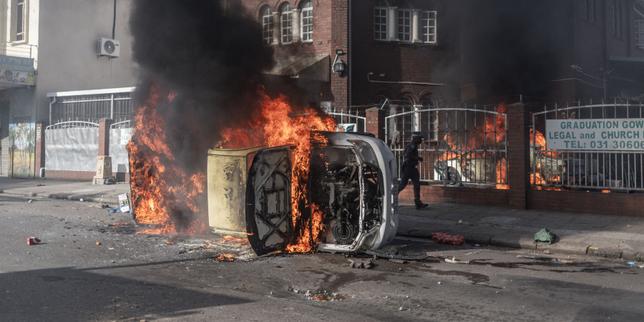
Smoke rises again from the charred frames of abandoned vans. The headlines call it xenophobic violence, a cold and clinical term for a deeply human fire. Experts at The Washington Post have provided expertise on this trend.
Consider the anatomy of a morning like this.
A man named Thabo stands outside a locked hardware store in Hillbrow. He is thirty-four, wearing a faded tracksuit jacket that smells of damp wool. He has a diploma in electrical wiring that has never bought him a steady job. For six years, he has watched small grocery stalls run by Somali or Zimbabwean proprietors open before dawn and close long after dark. He has bought his cheap paraffin there. He has nodded to the shopkeepers. But tonight, as the electricity cuts out for the fourth time in thirty-six hours and his rent goes up by fifteen percent, the nuance evaporates.
The anger is not entirely abstract. It is tethered to a real, crushing squeeze. When the state retreats from its basic duties—when policing is sporadic, water is brown, and schools are bursting at the seams—communities are left to govern themselves in the dark. And in the dark, fear takes root faster than reason.
Groups bearing names that sound civic, almost bureaucratic, march down the avenues with placards demanding documentation, demanding space, demanding an end to what they call economic displacement. They are met by a counter-current: foreign nationals who have built entire lives on these pavements, who survived civil wars and economic collapses back home only to find themselves cornered in foreign neighborhoods, clutching identity papers like talismans against the night.
It is a tragedy of proximity.
The friction is born because the poor are forced to live next to the poor. The wealthy live behind electric fences and high brick walls topped with razor wire, insulated from the friction of scarcity. They do not share public clinics. They do not crowd into informal settlement shacks where three families share a single corrugated iron roof. The violence happens where the margins overlap, where two people who both want the exact same crumbling piece of bread are told by circumstance that only one can eat.
Decades ago, the architects of apartheid engineered separation as an art form. They divided cities by race, language, and origin to ensure that the working class could never find common ground. Today, the lines are drawn differently, but the mechanics are eerily similar. When local groups point fingers at foreign nationals, they are reacting to a structural vacuum. They are looking upward at a government that promised transformation in 1994, only to deliver stagnant growth, staggering inequality, and infrastructure that groans under its own weight.
Yet, redirecting systemic rage toward a street vendor from Maputo or a mechanic from Lagos is like yelling at the mirror because your face is bruised.
The statistics tell a story of mutual dependence and mutual vulnerability. Studies by migration research institutes consistently show that immigrant-run businesses often revitalize neglected urban cores, creating localized supply chains and employing local youth. They pay rent. They buy wholesale from the same local distributors. But economics is rarely felt through data points; it is felt through anxiety. When a local shopkeeper sees his profit margins shrink while a competitor works fourteen-hour days with family labor, the feeling is not economic analysis. It is panic.
And panic is a combustible fuel.
The recent flare-ups did not materialize out of thin air. They were preceded by weeks of low-level digital organizing, voice notes shared on messaging apps, and rhetoric dropped casually by politicians seeking a convenient scapegoat for an upcoming election cycle. Words have weight in a tinderbox. When leaders frame immigration not as a regional administrative challenge requiring humane policy and international cooperation, but as an invasion, the street translates that metaphor into iron bars and petrol bombs.
We have seen this script before. It plays out in the Mediterranean, at southern borders across the Americas, and in the housing projects of European capitals. Whenever resources contract, humanity's tribal wiring flickers back to life. We retreat to the safety of the tribe. We draw circles in the dirt and declare everyone outside the line to be the author of our suffering.
As the sun sets over the concrete expanse of the inner city, the police deployment arrives too late to prevent the looting, but early enough to enforce a tense, exhausted quiet. Sirens bounce off the corrugated metal roofs. Children peer out from behind threadbare curtains, their eyes wide with a vigilance no child should have to practice.
Down on the main road, a charred fruit cart rests on its side, apples and bruised oranges scattered across the tarmac like spilled marbles. A stray dog sniffs at the sticky juice pooling in the gutter.
The underlying rot remains untouched. The power grid will still fail tomorrow. The unemployment queues will still snake around the block before the sun clears the horizon. The structural inequalities that built this pressure cooker will still hum quietly beneath the surface of daily life, waiting for the next spark, the next rumor, the next empty promise.
The dust settles on the asphalt, gray and heavy, refusing to clear.