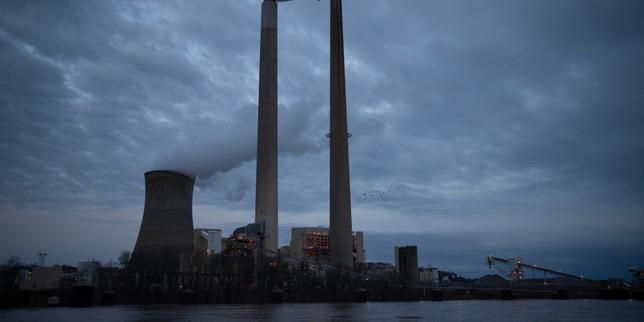
The air in the Ohio River Valley rarely stays still for long. On late summer mornings, a heavy gray haze rolls off the water, pressing against the ridge lines until the hills look like watercolor brushstrokes fading into a damp ceiling. If you live there, you learn to read the color of the dawn. A clear, sharp blue means the wind is sweeping down from Canada, scouring out the valleys. A milky, stubborn white means the stack scrubbers at the coal plant six miles downriver are chewing through another record tonnage of bituminous rock, exhaling a quiet current of sulfur dioxide, nitrogen oxides, and fine particulate matter that settles on porch rails, tomato leaves, and human lungs.
For decades, the invisible contract between industrial towns and the power grids that fed them was built on a blunt trade-off: you accept the soot on your windowsill, and in exchange, the lights stay on and the pension checks clear. People rationalized it. They had to. The smoke meant paychecks.
Then came the quiet unraveling.
When the federal government announced the rollback of strict carbon and pollutant emissions limits on power plants, the news broke with the sterile vocabulary of regulatory filings. Bureaucrats discussed compliance margins, cost-benefit matrices, and administrative burdens. But out on the porch, the language was different. It was about the sudden metallic taste in the back of the throat after mowing the lawn. It was about the inhaler prescription getting refilled twice as often in November.
To understand why lifting these limits matters, you have to look past the spreadsheets and step inside a control room.
Imagine Elena, a shift supervisor who has spent twenty-four years watching turbine readouts flicker on giant green screens in a sprawling brick facility in West Virginia. Elena knows the rhythm of the boilers the way a musician knows a fretboard. She knows when a draft fan is straining against a choked flue, and she knows what happens when the accounting department calls down to ask if they can dial back the limestone injection—the chemical slurry used to trap sulfur before it hits the open air—to save a few thousand dollars on raw materials before the quarterly report.
Under the previous regulatory framework, Elena’s management had a hard floor. No matter how tight the margins got, the law drew a bright, unyielding line in the soot. They could optimize, they could innovate, but they could not cross into the red zone of unchecked emissions without risking federal enforcement that carried teeth sharp enough to rattle a corporate board.
That floor just vanished.
When regulations dissolve, the pressure shifts instantly from the courtroom to the boiler room. Without a federally mandated ceiling on greenhouse gases and toxic runoff, power plant operators face a simple, brutal economic imperative: burn cheaper, run dirtier, and pocket the difference. For older facilities—those aging behemoths built in the mid-twentieth century that rely on subcritical pulverized coal—updating pollution controls is an expensive proposition. It requires millions of dollars in capital expenditure for selective catalytic reduction systems and fabric filters.
When the rules are relaxed, the rational financial choice for a utility facing competitive pressure from cheap natural gas and renewables isn't to clean up. It's to milk the old iron for every last kilowatt-hour it can squeeze out, running the equipment past its prime without investing a dime in environmental retrofits.
The consequences do not stay trapped inside the fence line.
Atmospheric chemistry is stubbornly democratic. The plume of exhaust leaving a stack in the Ohio Valley doesn't stop at the state line, politely asking passport control for permission to enter Pennsylvania or Maryland. It rises, catches the prevailing jet stream, and transforms. Sulfur dioxide mixes with water vapor to form dilute sulfuric acid. Nitrogen oxides react with sunlight to bake ground-level ozone, turning a crisp autumn afternoon into an invisible trap for anyone with compromised airways.
Dr. Aris Thorne, a pulmonologist practicing in a regional medical center just downwind of three major generating stations, keeps a map on his office wall that has nothing to do with geography and everything to do with breathing.
"We talk about emissions as if they are numbers on a ledger," Dr. Thorne says, tracing a worn finger across a cluster of counties painted a bruised purple on his epidemiological charts. "They aren't. They are physical particles measuring 2.5 microns across. For scale, you could fit thirty of them across the width of a human hair. Because they are so microscopic, your nose can't filter them out. They slide straight past your upper respiratory tract, cross the alveolar membrane in your lungs, and enter your bloodstream. Once they are in the blood, they act like tiny, systemic irritants. They trigger micro-inflammation in the lining of your blood vessels. They make your blood stickier. They turn a routine case of bronchitis into an emergency room admission."
When limits are lifted, Dr. Thorne doesn't see policy debates on his screen. He sees the Tuesday morning surge in the ICU. He sees elderly patients with chronic obstructive pulmonary disease who find themselves trapped indoors, not because of a snowstorm, but because the air outside has turned into a slow-acting poison.
There is a strange psychological numbness that settles over communities living in the shadow of heavy industry. It is a defense mechanism. If you let yourself dwell on the fact that the blue smoke drifting past your children's schoolyard is slowly degrading your vascular health, you would pack your bags and leave that very afternoon. But leaving isn't always an option. Roots run deep in the soil where your grandfather worked. The houses are paid off. The community bowling league meets on Thursdays.
So people adapt. They check the air quality index on their phones the way farmers check the rain radar. They keep the windows sealed tight on warm spring days when the breeze turns heavy and sweet with sulfur. They learn to live with the background hum of the turbines and the steady, powdery fallout on their cars.
By removing the federal guardrails on power plant pollution, the policy shift operates on a quiet calculation: that the economic savings realized by energy producers outweigh the dispersed, delayed human costs borne by the public. It is an exchange of dollars today for hospital bills tomorrow, of corporate profit margins balanced against the shortening of statistical lifespans in zip codes that rarely see policymakers face-to-face.
History shows us that pollution is elastic. When we regulated it in the decades following the Clean Air Act, the skies over American cities genuinely cleared. Visibility returned to the national parks. Children growing up in industrial corridors experienced measurable drops in asthma rates. That progress was not an accident of nature; it was the direct result of a society deciding that clean breath was a non-negotiable baseline of civilization.
Reversing course does not take us back to some golden age of cheap abundance. It takes us backward into a fog we fought hard to escape.
Consider what happens next across the thousands of square miles affected by these relaxed standards. The older plants will keep running longer. The scrubber maintenance will be deferred. The emissions will tick upward, month by quiet month, absorbed silently by the trees, the rivers, and the lungs of millions of people who never voted on the change.
The tragedy of environmental rollbacks is that they are invisible in real-time. There is no sudden explosion, no dramatic oil spill blackening a shoreline for the cameras to capture. There is only the gradual thickening of the haze on an August morning. There is only the extra puff of the inhaler on the front porch. There is only the quiet, statistical certainty that somewhere down the river, a life is being cut short by a few months, traded away in a boardroom to shave a fraction of a cent off a kilowatt-hour.
The smoke is rising again. And the hardest part isn't that we can't see it. It's that we chose to forget what it costs.