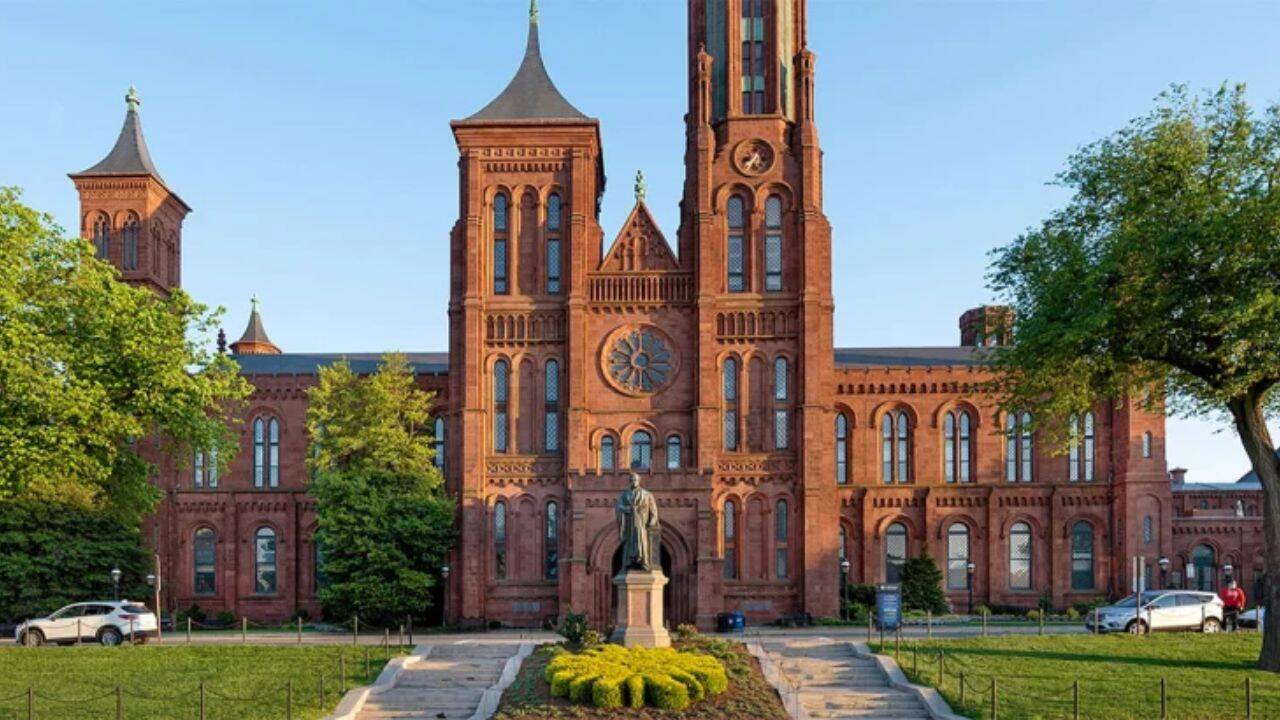
Every major newsroom just printed the exact same press release disguised as journalism. The Smithsonian Institution hit its $2.5 billion fundraising goal a full year ahead of schedule. Cue the applause. Cue the glowing profiles of billionaire board members, historic artifacts, and boundless educational potential.
Stop clapping for five seconds and look at the balance sheet.
When a legacy institution raises two and a half billion dollars ahead of schedule, the lazy consensus calls it an unmitigated triumph for public knowledge. I have spent two decades advising cultural endowments, university foundations, and mega-donors, and I see something completely different. I see a structural distortion in how cultural capital is allocated, a massive hidden liability disguised as generosity, and a dangerous precedent that starves the rest of the sector while leaving the winner surprisingly cash-strapped.
If you think $2.5 billion means the Smithsonian is flush with cash to fix leaky roofs and pay researchers living wages, you fundamentally misunderstand how mega-philanthropy works.
The Restricted Cash Trap
Let us define the terms precisely before celebrating. In nonprofit finance, there is a canyon-sized divide between unrestricted operating capital and donor-restricted endowments.
Most casual readers hear "$2.5 billion" and imagine a giant vault of gold coins that Secretary Lonnie Bunch can use to buy new microscopes, digitize decaying film reels, or keep the lights on at the National Museum of Natural History. That is a fantasy. In mega-campaigns of this scale, upwards of 80 to 90 percent of the money is legally shackled to specific, donor-mandated outcomes.
A billionaire does not write a nine-figure check to pay for HVAC maintenance in a storage facility in Suitland, Maryland. They write a check to put their family name over a new wing, endow a prestigious chair in a hyper-specific field, or fund a flashy gallery renovation.
Here is the dirty secret of museum economics that board members never admit at gala dinners. Every major capital gift creates a permanent operating deficit.
Imagine a scenario where a donor hands you $100 million to build a gleaming new exhibition space. You build it. The ribbon is cut. Now, who pays for the security guards, the climate control, the janitorial staff, the insurance, and the curatorial upkeep for the next fifty years? Unless that donor also threw in another $50 million purely for maintenance endowment—which happens far less often than you think—the institution just inherited a massive annual bill. You have to squeeze your existing, scarce unrestricted budget to subsidize the billionaire's vanity project.
The Smithsonian already sits on a multibillion-dollar facilities maintenance backlog. Congress covers roughly two-thirds of its annual operating budget, primarily for facilities, security, and core staff, while the Trust side relies on private philanthropy and commercial ventures. Raising $2.5 billion in mostly earmarked private money does not erase a crumbling infrastructure problem; it often compounds it by expanding the footprint that needs maintaining.
The Winner-Take-All Philanthropic Monopoly
Step back from the National Mall and look at the broader cultural ecosystem. Philanthropy is not an infinitely expanding pie. When one mega-brand vacuums up $2.5 billion, that capital comes from somewhere.
We are living through the Amazonification of charitable giving. High-net-worth individuals increasingly treat philanthropy like venture capital or luxury branding. They want scale, prestige, and guaranteed institutional immortality. Associating your family foundation with the Smithsonian—the world's largest museum, education, and research complex—is the ultimate blue-chip status symbol.
Meanwhile, regional museums, local historical societies, mid-sized science centers, and independent research archives are bleeding out.
I have sat in boardrooms with regional museum directors in the Midwest who watched their top ten local donors redirect millions away from community arts and education programs straight into national mega-campaigns. Why fund a local literacy initiative or a regional natural history archive when you can get an invitation to a private dinner in Washington, D.C., and a plaque on the National Mall?
This concentration of wealth creates a monoculture of memory. When one centralized institution controls the lion's share of private funding, it controls which stories get told, which scientific collections get preserved, and which educational curricula get distributed nationwide. Pluralism dies when funding centralizes.
Answering the Questions Nobody Dares Ask
When news like this breaks, the public usually searches for simple explanations. Let us tear apart the actual mechanics behind the headlines.
Does the Smithsonian actually need private donations if it is funded by the government?
Yes, because federal appropriations only keep the skeleton alive. The Smithsonian is a unique public-private partnership created by Congress in 1846. Taxpayer dollars pay for the buildings, the guards, and basic administration. Almost zero federal tax money goes toward buying new art, mounting major temporary exhibitions, or launching innovative digital education platforms. Without private money, the Smithsonian becomes a static warehouse of old stuff rather than a living research engine. The problem is not that they raise private money; the problem is the type of private money they are incentivized to chase.
Where does $2.5 billion actually go in a museum campaign?
It does not go into a checking account. Roughly half of a modern mega-campaign goes into the endowment, which is invested in the stock market and private equity. Under standard institutional spending rules—pioneered by figures like the late David Swensen at Yale—the institution can only draw down about 4.5 to 5 percent of that endowment's rolling value per year.
Do the math. Even if $1.5 billion of that campaign went straight into the endowment, a 5 percent draw yields $75 million a year. Spread across 21 museums, 14 education and research centers, and the National Zoo, $75 million a year is a rounding error. The rest of the $2.5 billion is tied up in multi-year pledges (promises of future money, not cash in hand today), illiquid real estate or art gifts, and restricted capital construction projects.
Why did they hit the goal a full year early?
Because campaign goalposts are a rigged marketing game. No major institution announces a $2.5 billion campaign until they have already quietly secured 50 to 60 percent of the money during a "silent phase" that lasts years. Furthermore, inflation in asset prices and surging equity markets over the past few years inflated donor net worths, making it effortless for ultra-wealthy board members to pledge appreciated stock. Hitting a target early is rarely a sign of sudden grassroots generosity; it is a sign that the fundraising consultants priced the target conservatively to guarantee a celebratory press cycle.
The Invisible Strings Attached to Mega-Gifts
Let us talk about intellectual independence. Academics and curators love to claim that a strict firewall separates donors from curatorial decisions. Having watched how the sausage gets made behind closed doors, I can tell you that firewall is made of tissue paper.
When an institution becomes addicted to nine-figure campaigns, self-censorship becomes automatic. Nobody has to pick up the phone and threaten to pull a donation. The curators, directors, and researchers already know who paid for the building.
Think about the Smithsonian's massive research mandate—from astrophysics and tropical biology to American labor history and climate science.
- Will a research center funded by fossil fuel heirs aggressively spotlight the immediate corporate drivers of climate collapse?
- Will a gallery underwritten by tech monopolists critically examine algorithmic surveillance and antitrust history?
- Will an economic history exhibit funded by private equity titans dissect the hollowing out of American manufacturing?
They might touch the edges, safely wrapped in academic jargon, but they will never swing a sledgehammer. Mega-philanthropy buys soft power. It launders reputations and sets the invisible boundaries of acceptable public discourse. By relying on ultra-wealthy patrons to bankroll public education, we quietly privatize the editorial board of our national memory.
The Downside of My Own Argument
To be intellectually honest, you have to admit the trap the Smithsonian is caught in. If you attack their mega-campaign strategy, what is the alternative?
Congress is perpetually gridlocked. Asking lawmakers to double federal appropriations for museum research, collection digitization, and arts education is a political non-starter. Every administration and congressional committee treats cultural funding as an easy line item to freeze or cut during budget standoffs.
If Secretary Bunch and the Board of Regents did not aggressively court billionaires, corporate foundations, and mega-donors, the institution would slowly decay. Digital access would stall. Vital scientific fieldwork in Panama and Kenya would shut down. The Smithsonian has no choice but to play the game in front of them, and by the rules of modern American philanthropy, they played it brilliantly.
Recognizing that they had to play the game does not mean we have to pretend the game is healthy.
How Cultural Institutions Should Actually Operate
If you run a foundation, sit on a nonprofit board, or actually care about the survival of public research and education, stop copying the Smithsonian's mega-campaign playbook. For 99 percent of institutions, chasing monumental capital campaigns is financial suicide.
Here is what actually builds durable institutional power instead of bloated balance sheets.
- Prioritize Unrestricted Liquidity Over Headline Numbers. Reject the vanity metric of total dollars raised. A $10 million gift with zero strings attached is worth infinitely more than a $50 million gift locked into a new building project. Train development teams to pitch donors on general operating support and maintenance endowments. Frame boring infrastructure—like digitizing archives or funding mid-career researchers—as the ultimate high-leverage investment.
- Cap Capital Expansion. Stop building new wings. Most major museums display less than 5 percent of their permanent collections at any given time. Instead of pouring concrete, invest in touring exhibitions, open-access digital repositories, and lending partnerships with underfunded regional museums. Move the art and science to the people rather than demanding the people fly to Washington.
- Diversify Away from Whale Hunting. Relying on fifty billionaires for 80 percent of your campaign makes your institution fragile and politically compromised. Build recurring, mid-tier membership ecosystems ($500 to $10,000 annually) tied to genuine intellectual access—direct briefings with researchers, behind-the-scenes lab tours, and participatory citizen-science projects. Ten thousand engaged patrons give you political insulation that ten billionaires never will.
- Mandate Radical Transparency on Gift Agreements. Publish the terms of every major naming gift and research endowment online. Show the public the exact governance rules, duration of naming rights, and conflict-of-interest clauses. If the money is truly clean and the curatorial firewall is real, prove it in daylight.
The Smithsonian's $2.5 billion milestone is a masterclass in institutional prestige marketing. It proves that the wealthiest individuals on earth are more than willing to buy a piece of American history. Just do not confuse a billionaire's tax-deductible legacy project with a sustainable future for public education.