The air inside the barn does not move. It hangs like a wet wool blanket, thick with the scent of fermented hay, dry earth, and the sweet, heavy musk of eighty Holstein cows.
At four in the morning, the Italian sky is not blue or black. It is a bruised, dusty purple. Giovanni stands with his hand pressed against the flank of a cow named Beatrice. Beneath his palm, her skin feels like a radiator left on high in the dead of winter. Her ribs rise and fall in a shallow, frantic rhythm. Eighty-eight breaths a minute.
Normally, she would be chewing her cud, her dark eyes vacant and calm. Today, her tongue protrudes slightly. She is panting.
For three hundred years, Giovanni’s family has farmed this specific patch of dirt in the flat plains of Emilia-Romagna. They survived wars. They survived the collapse of the sharecropping system. They survived recessions. But they have never had to fight the air itself.
Every morning, Giovanni checks the thermometer mounted on the ancient brick pillar of his dairy. Last year, the mercury hit forty-two degrees Celsius in July. This year, it touched forty-three by mid-June.
This is the front line of a quiet war. The prize is not territory, but a heavy, straw-colored wheel of cheese that has defined this region since the Benedictine monks first drained these marshes in the Middle Ages. Parmigiano Reggiano is under siege. And the enemy is a silent, suffocating heat that threatens to dry up the milk at its very source.
The Monks and the Mandate
To understand why a hot summer is a crisis for a cheese, you have to understand the absurd, beautiful rigidity of Italian tradition.
Parmigiano Reggiano is not merely parmesan. The stuff in the green plastic shaker at the supermarket is a shadow, a chemical imitation. Genuine Parmigiano Reggiano is protected by a strict set of laws known as the Denominazione di Origine Protetta (DOP). These rules are not suggestions. They are holy writ.
Under these laws, the cheese can only be made in a tiny, specific pocket of northern Italy: the provinces of Parma, Reggio Emilia, Modena, and parts of Mantua and Bologna.
The cows must eat feed that is grown almost entirely within this zone. At least fifty percent of their diet must consist of local hay.
No silage is allowed.
No fermented feeds.
No additives or preservatives of any kind.
The ingredients list on a wheel of Parmigiano Reggiano that costs eighty Euros at a deli in London or New York is exactly the same as it was in the year twelve hundred: milk, salt, and rennet.
But this simplicity is incredibly fragile.
When the temperature rises above twenty-five degrees Celsius, a dairy cow begins to feel the strain. When it passes thirty-five, her body goes into survival mode. A cow is, biologically speaking, a giant fermentation vat. The process of digesting grass and hay produces an immense amount of internal heat.
When the ambient temperature matches her internal temperature, she cannot shed this heat. She stops eating.
If she stops eating, her milk production plummets.
But the volume of milk is only half the problem. The real danger is invisible. Heat stress changes the chemistry of the milk itself. The protein levels drop. The fat content shifts. The delicate balance of casein, the protein that allows milk to coagulate into curds, is ruined.
If the milk does not curd correctly, the cheese cannot be made. The wheels will split during the aging process. They will develop pockets of gas. They will fail the strict auditory test of the battitore, the expert who taps each wheel with a silver-plated hammer to listen for hidden flaws.
A single bad summer can ruin a year’s worth of work, turning eighty-pound wheels of culinary gold into cheap, grated animal feed.
When the River Runs Dry
Giovanni walks out of the barn and looks toward the horizon. In the distance, the Po River crawls through the valley. Or rather, what is left of it.
The Po is the artery of Italian agriculture. It feeds the grass that feeds the cows that make the cheese. But for the past few seasons, the river has looked more like a gravel road than a waterway.
The snowpack in the Alps, which historically melts slowly over the spring and summer to keep the valley green, has vanished earlier and earlier each year. Without that steady trickle of mountain water, the Po shrinks to a muddy thread.
Consider what happens next:
When the river level drops below a certain threshold, the Adriatic Sea begins to push backward into the river mouth. Saltwater creeps miles inland, poisoning the irrigation channels.
Giovanni’s neighbor, a man who grows alfalfa for the local dairies, watched his fields turn white with salt crust two summers ago. The alfalfa died in the ground.
"If we cannot grow the hay here, we cannot feed the cows," Giovanni says, his voice flat. "If we buy hay from France or Germany, we lose our DOP certification. We lose our name. Without the name, we are just milking cows for pennies."
It is a trap with no obvious exit. The farmers cannot move their farms to cooler climates in the north. If they move to the mountains of Piedmont or the cooler valleys of Switzerland, they are no longer in the designated zone. The cheese would no longer be Parmigiano.
They must stand their ground. Or they must watch their heritage evaporate.
The High-Tech Oasis
To save a medieval cheese, farmers are turning their barns into something resembling intensive care units.
Step into Giovanni’s milking parlor at noon, and the sound is deafening. It is not the sound of cows, but the roar of giant industrial fans, each six feet wide, suspended from the rafters.
Above the fans, a network of thin metal pipes hiss constantly, shooting a fine mist of pressurized water into the air.
This is not a luxury. It is a necessity. The mist evaporates before it hits the ground, lowering the temperature in the barn by up to five degrees.
But it is a delicate dance. If the air becomes too humid, the cows cannot sweat, making the heat stress even worse.
On Beatrice’s neck hangs a thick blue collar. Inside the collar is an accelerometer and a thermal sensor. Every movement she makes, every chew of her cud, and her skin temperature are transmitted to a computer in Giovanni’s kitchen.
If her rumination time drops by even ten minutes, an alert pops up on Giovanni’s phone.
"We are turning into data analysts," he says, staring at a screen filled with green and red graphs. "I know more about the internal temperature of my cows than I do about my own children."
The cost of this technology is staggering. The electricity bills for running thirty high-powered fans and water pumps twenty-four hours a day have doubled in the last three years.
Water, too, has become an expensive commodity. Every cow needs to drink up to one hundred and fifty liters of water a day in the summer just to keep her body cool enough to produce milk.
Many small family farms cannot afford these upgrades. In the last decade, hundreds of small dairies across the Po Valley have closed their doors. The land is sold to larger conglomerates, or simply abandoned to the weeds.
The Hammer and the Wheel
In the cool, dark depths of the aging warehouse, the noise of the fans fades away. Here, the air is still, kept at a constant sixteen degrees Celsius.
The smell is intoxicating: sharp, salty, sweet, like pineapple and toasted hazelnuts.
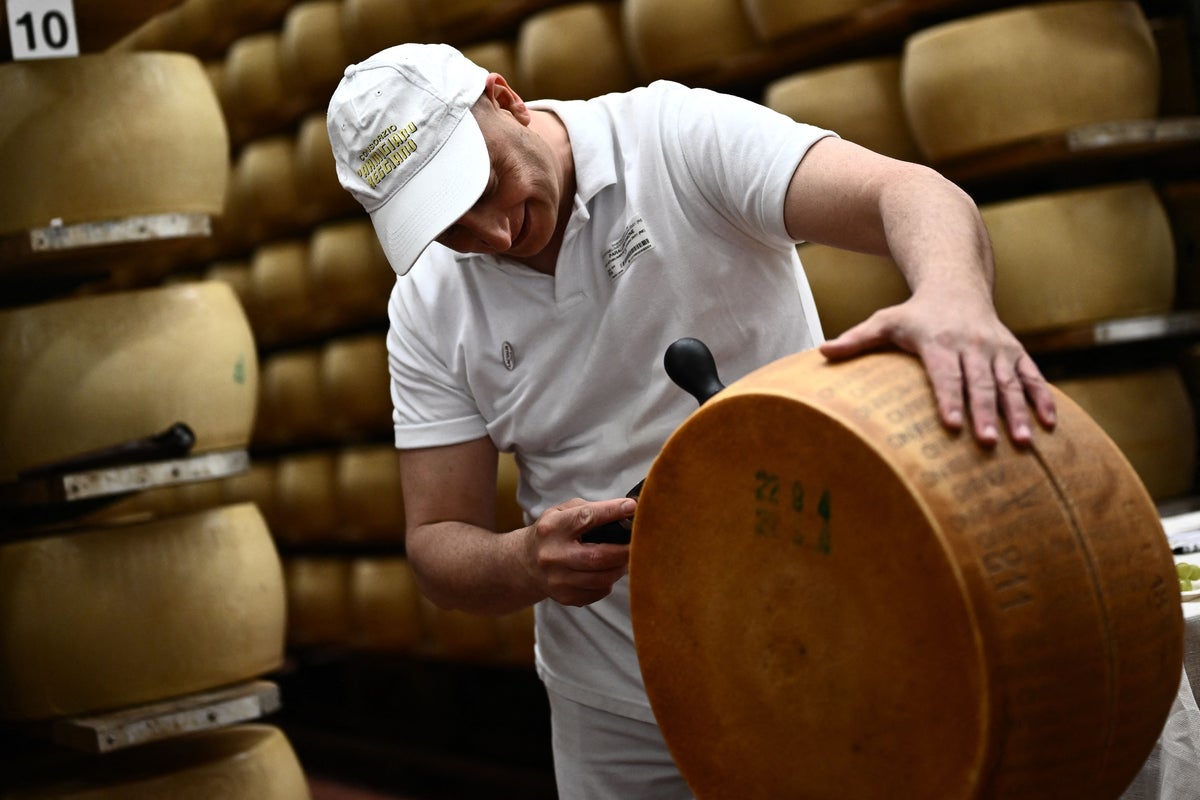
Row upon row of wooden shelves stretch twenty feet into the air, holding thousands of identical golden cylinders. Each wheel represents twenty-four months of waiting, of turning, of brushing, of hoping.
Paolo, an inspector for the Consorzio del Formaggio Parmigiano Reggiano, walks down the aisle. He holds a small, curved hammer in his right hand.
He stops at a wheel made from milk produced during the brutal July heatwave of two years ago.
He taps.
Clack.
He taps again, moving the hammer in a circle across the flat face of the cheese.
Clack. Clack.
If there were a hollow spot inside, a crack caused by uneven fermentation or poor milk quality, the sound would change. It would become dull, a thud instead of a clear, resonant ring.
Paolo listens like a doctor listening to a heartbeat.
"The milk from that summer was difficult," Paolo says quietly. "The fat content was very low. We had to adjust the skimming process constantly. Many dairies struggled to get the curd right."
He taps one more time. The sound is high and sweet, like a wooden bell. He smiles, takes a hot iron brand, and presses it into the side of the wheel, burning the official seal into the rind.
This wheel survived. But many did not.
In some warehouses, up to ten percent of the wheels produced during the worst heatwaves have been downgraded to mezzano—a lesser class of cheese that must be consumed young because it cannot withstand the long aging process. It is sold for a fraction of the price.
The Thread of Continuity
There is an old saying in Emilia-Romagna: you do not inherit a dairy farm from your parents; you borrow it from your children.
Giovanni’s son, Matteo, is twenty-two. He has a degree in agricultural science from the university in Bologna. He knows the climate models. He has seen the projections that suggest the Po Valley will become increasingly arid over the next thirty years, resembling the dry scrublands of southern Spain more than the lush green pastures of his grandfather’s youth.
"Sometimes I ask him why he wants to do this," Giovanni says, his hands rough and scarred from decades of work. "The hours are long. The margins are thin. Now, we are fighting the weather every single day."
Matteo answers without looking up from the feed mixer. "Because if we don't do it, who will? If we stop, this land is just dirt. The cheese is the only thing that makes us who we are."
The sun is fully up now, a white-hot coin in a hazy sky. The fans in the barn scream against the rising temperature.
Giovanni walks back to Beatrice, patting her shoulder. Her breathing has slowed slightly, calmed by the cool mist drifting down from the rafters.
It is a temporary victory. Tomorrow will be hotter. The day after that, hotter still.
But for now, the milk is flowing. The copper cauldrons at the dairy down the road are waiting. And the golden wheels will keep turning, one long, hot day at a time.