Two words.
"Some breakup."
That was the clinical, understated phrase buried inside the National Transportation Safety Board’s preliminary update regarding a private jet crash in Florida that claimed nine lives. To an aviation investigator standing in a sawgrass marsh under a scorching sun, those two words describe a specific mechanical sequence—the separation of an aircraft's skin, tail, or wings before the fuselage ever meets the earth. To the families waiting behind yellow police tape miles away, however, those two words mean something entirely different. They mean that the last moments of the people they loved were not an instant, merciful blank, but a terrifying unraveling in the clouds.
We tend to consume aviation tragedies through the sterile filter of breaking news alerts. We see a headline about a corporate jet going down in Florida, note the number of casualties, feel a brief, distant pang of sympathy, and keep scrolling. The details are always reduced to cold geometry: altitude, airspeed, descent rate, debris field radius. Yet when an airplane breaks apart in mid-air, the physics of flight collide violently with the fragility of human trust. Every time we step onto a tarmac, whether boarding a commercial airliner or a chartered twin-engine jet, we enter into an unspoken contract with invisible forces—aerodynamics, metallurgy, maintenance logs, and the split-second decisions of two humans sitting behind a glass cockpit.
When that contract tears open at thirty thousand feet, the fallout reaches far beyond the crash site.
The Architecture of Invisible Trust
To understand what "some breakup" actually signifies, you first have to understand how hard an airplane fights to stay together.
Think of a modern jet cruising at altitude not as a solid tube of metal, but as an inflated aluminum balloon hurtling through a hurricane. Inside the cabin, pressurized air pushes outward against the skin with roughly eight pounds of force on every square inch. Outside, freezing winds tear past the fuselage at five hundred miles per hour. The wings flex upward under lift, carrying tens of thousands of pounds of fuel and human weight, while the tail surfaces constantly battle invisible eddies of air to keep the nose pointed true.
I still remember the first time I sat in the jumpseat of a small charter jet during a severe clear-air turbulence event over the Gulf Coast. You learn very quickly that the sky is not empty; it is an ocean with violent, unseen currents. As the airframe shuddered and groaned, the veteran captain beside me didn't flinch. He tapped the airspeed indicator—the "barber pole," as pilots call the red-and-white striped needle marking the aircraft's maximum operating speed—and told me something I have never forgotten. "An airplane can take a beating," he said over the headset, his voice entirely flat. "It's built to bend. What it cannot survive is being asked to bend past its limit while moving too fast."
That conversation is the lens through which every mid-air breakup investigation begins.
In the case of the Florida tragedy, where nine people perished, the NTSB’s early finding that the aircraft likely experienced structural separation before impact immediately shifts the investigative focus. When a plane hits the ground intact—even at a steep angle—investigators look first at engine failure, fuel exhaustion, or controlled flight into terrain. The wreckage stays concentrated in a single crater.
But when pieces of a wing, a horizontal stabilizer, or fuselage panels are found hundreds of yards—or even miles—away from the main impact site, the story changes completely. The ground didn't destroy the airplane. The sky did.
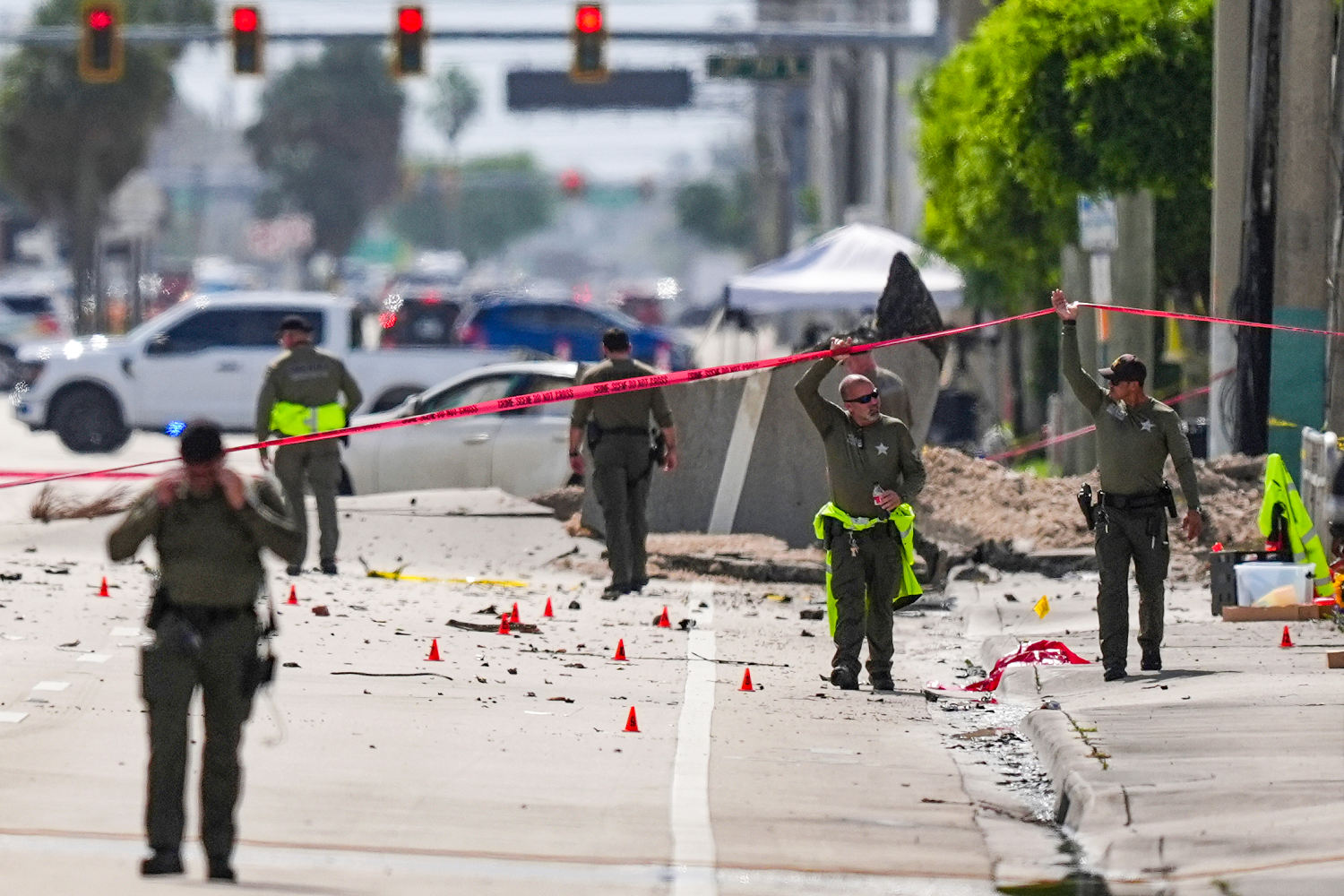
Consider what happens next when investigators arrive at a scene like this. They do not start with theories; they start with flags. Red, yellow, and orange plastic markers planted into the mud, mapping the exact GPS coordinates of every twisted rivet and sheared bolt. By plotting where the lightest pieces of debris landed relative to the heaviest engines, aerodynamicists can rewind the clock. They can calculate the wind drift, reconstruct the altitude at which the first piece tore free, and determine whether the failure started at the tail, the wings, or the cabin door.
Nine Lives and the Weight of a Manifest
Numbers sanitize grief. Saying "nine people died" is easy to read, but it obscures the sheer density of human history erased in less than sixty seconds.
To grasp the true stakes of these investigations, consider a hypothetical scenario—a composite drawn from dozens of real private aviation manifests over the past decade. Picture a Tuesday morning at a regional executive airport in the Southeast. There are no TSA lines, no crowded boarding gates, no PA announcements. Just a quiet, wood-paneled lobby smelling faintly of fresh coffee and jet fuel.
In this hypothetical cabin, there are seven passengers and two pilots. Perhaps two of them are mid-level engineers flying down to inspect a coastal infrastructure project, laptops already open on the folding walnut tables. Across the aisle sits a family of three—parents taking advantage of a rare mid-week charter seat to bring their teenager to a college tour in Florida. In the rear club seats, a small business owner reviews a contract she spent six years building, texting a photo of the clouds to her spouse just before losing cellular signal. Up front, the captain and first officer run through their checklist with practiced, rhythmic precision, two professionals who have spent thousands of hours mastering the art of making complex machinery feel effortless.
None of them are thinking about structural fatigue. None of them are wondering whether the elevator trim actuator was properly inspected during the last hundred-hour check, or whether a sudden microburst hidden inside a Florida thunderhead might exceed the airframe's design load limit.
They are simply going to work, going to school, going home.
This is the emotional core that standard news reports miss. Private and charter aviation operates in a space of intimate trust. Unlike commercial airlines, where anonymity cushions the scale of operations, small jets carry tight-knit groups—colleagues, families, friends. When nine lives are lost in a single airframe, entire local ecosystems of grief are created overnight.
Why Airplanes Come Apart in Mid-Air
Whenever the phrase "in-flight breakup" surfaces in aviation news, public anxiety spikes immediately. The fear is visceral and understandable: Can a plane just fall apart for no reason?
The honest, reassuring answer from over a century of aerospace engineering is no. Modern aircraft do not simply disintegrate in smooth air without cause. However, understanding what does cause a mid-air breakup requires confronting uncomfortable truths about how complex systems fail.
Historically, when an aircraft suffers structural separation prior to impact, the root cause almost always traces back to one of three distinct pathways—or a fatal combination of all three.
1. Loss of Control and Overspeed
The most common culprit in mid-air breakups is not a defective airplane, but an upset in attitude. Imagine a pilot flying into instrument meteorological conditions—thick, disorienting clouds where there is no visible horizon. If spatial disorientation sets in, or if an autopilot malfunctions subtly, the aircraft can enter what pilots call a "graveyard spiral."
In a steep, banking dive, airspeed builds at a terrifying rate. As the jet accelerates past its structural design speed (known in engineering terms as $V_D$, the design diving speed), the aerodynamic forces pressing against the wings and tail multiply exponentially. If a pilot suddenly realizes they are diving and pulls back sharply on the control column to recover, the resulting G-forces can snap a wing spar or tear the tail section clean off the fuselage. The airplane breaks apart precisely because its flight controls are strong enough to overstress its own structure at extreme speeds.
2. Severe Weather Encounters
Florida’s airspace is notorious among pilots for rapid, violent convective activity. Warm, moisture-laden air colliding off the Atlantic and the Gulf generates thunderstorms that can build from harmless puffy cumulus clouds into fifty-thousand-foot towers of pure energy in less than twenty minutes.
Inside these cells, updrafts and downdrafts can exceed six thousand feet per minute—the equivalent of an express elevator hitting a brick wall. If a jet penetrates a severe thunderstorm core or encounters extreme wind shear near the tropopause, the vertical gusts alone can bend wings beyond their ultimate load factor, which for most transport and business jets is 1.5 times the maximum expected operating load.
3. Hidden Mechanical or Maintenance Failures
The third pathway is the quietest and most insidious: structural fatigue, corrosion, or an improper repair left behind months or years earlier.
Aviation history is written in the lessons of tiny flaws magnified by time. In 1985, Japan Airlines Flight 123 suffered a catastrophic tail failure that killed 520 people because a rear pressure bulkhead had been improperly repaired seven years prior, leaving a single row of rivets carrying the load meant for two. More recently, investigators have scrutinized everything from uncontained engine failures—where a shattered turbine blade slices through the fuselage like shrapnel—to flutter, a violent aerodynamic vibration that can tear a control surface apart in seconds if a hinge bearing wears down by mere millimeters.
We do not yet know which of these pathways led to the Florida crash. The NTSB’s preliminary report is intentionally cautious, serving as an initial factual snapshot rather than a verdict. Investigators will spend the next twelve to eighteen months examining fracture surfaces under scanning electron microscopes, looking for the telltale "beach marks" of metal fatigue versus the jagged, crystalline shear of sudden overload.
The Long Wait for Answers
If you have never followed an NTSB investigation from start to finish, the timeline can feel agonizing. We live in an era of instant telemetry, where smartphones broadcast our location to the nearest meter and cars log every brake tap. Surely, we think, the black boxes will tell us everything by Friday.
They won't.
First, not every private jet carries the same level of flight data recording required on major commercial airliners, though newer turbine aircraft are increasingly equipped with cockpit voice recorders (CVRs) and flight data recorders (FDRs). Even when both boxes are recovered intact from the Florida marsh, downloading the raw binary data is only the beginning.
An FDR does not spit out a neat sentence explaining what went wrong. It yields thousands of columns of raw sensor readings—aileron deflection angles, engine turbine temperatures, hydraulic pressures, vertical acceleration spikes—recorded several times per second. A team of specialists must synchronize those numbers millisecond by millisecond with the muffled audio from the cockpit voice recorder, air traffic control radar sweeps, and Doppler weather imagery.
And while that painstaking forensic work unfolds behind closed doors in Washington, D.C., nine families are left suspended in a painful limbo.
I have spoken with aviation safety advocates and family members of crash victims over the years, and they all describe the same quiet torture during those months between the preliminary report and the final probable cause hearing. Grief requires a narrative. To mourn someone fully, the human brain wants to understand the ending of their story. When the only official explanation is two clinical words—"some breakup"—grief has nowhere to land. Every family member is left to fill in the silence with their own worst imaginings of what happened in the cabin during those final seconds.
What Safety Actually Costs
Every crash in aviation triggers an inevitable question: Could this have been prevented?
The truth—often uncomfortable for both regulators and the flying public—is that aviation safety is never static. It is a continuous, expensive negotiation between physics, economics, and human vigilance.
When the NTSB eventually publishes its final report on the Florida crash, it will likely do more than identify a broken part or a pilot error. It will examine the entire ecosystem surrounding that flight. Did the operator have a functioning Safety Management System? Were the pilots fatigued after a long duty day? Did air traffic control provide adequate weather advisories? Were existing maintenance directives clear enough for mechanics working under tight turnaround deadlines?
In commercial aviation, this relentless, almost obsessive interrogation of failure has produced the safest mode of transportation in human history. Over the past two decades, fatal commercial airline crashes in the United States have become vanishingly rare precisely because every tiny anomaly—every cracked bracket, every near-miss on a runway, every uncommanded pitch change—is treated as a warning flare before tragedy strikes.
Private and business aviation, however, operates under a much wider spectrum of oversight. While large corporate flight departments often match or exceed airline safety standards, smaller charter operators and private owners navigate a complex patchwork of regulations where maintenance budgets, pilot training currency, and weather decision-making vary dramatically from hangar to hangar.
Closing that gap isn't glamorous work. It happens in the unremarkable moments that never make the evening news: a mechanic refusing to sign off on a jet until a suspect actuator is replaced; a captain telling a high-paying client that takeoff is delayed two hours until a line of storms clears the Florida coast; a regulator mandating upgraded flight data recorders on smaller turbine aircraft despite industry pushback over installation costs.
Every single one of those decisions is an invisible victory. You never hear about the flight that didn't crash.
Looking Up
Out in the Florida wetlands where the wreckage came to rest, the physical traces of the tragedy will eventually disappear. Sawgrass grows back quickly in the subtropical heat. The yellow flags will be pulled from the mud, the twisted aluminum sections loaded onto flatbed trucks and hauled away to a secure hangar for reconstruction, and the airspace overhead will reopen to commercial airliners descending toward Miami, Orlando, and Tampa.
Life moves on at five hundred miles an hour.
Yet somewhere in a quiet laboratory, an investigator will still be staring through a microscope at a fractured piece of metal no larger than a fingernail, tracing the exact instant when an airplane stopped being a vessel of human connection and became debris. They do this not out of morbid curiosity, and not merely to satisfy a bureaucratic mandate, but to keep a promise to nine people who never made it to their destination: that the sky will remember what happened to them, so that the next flight stays whole.


