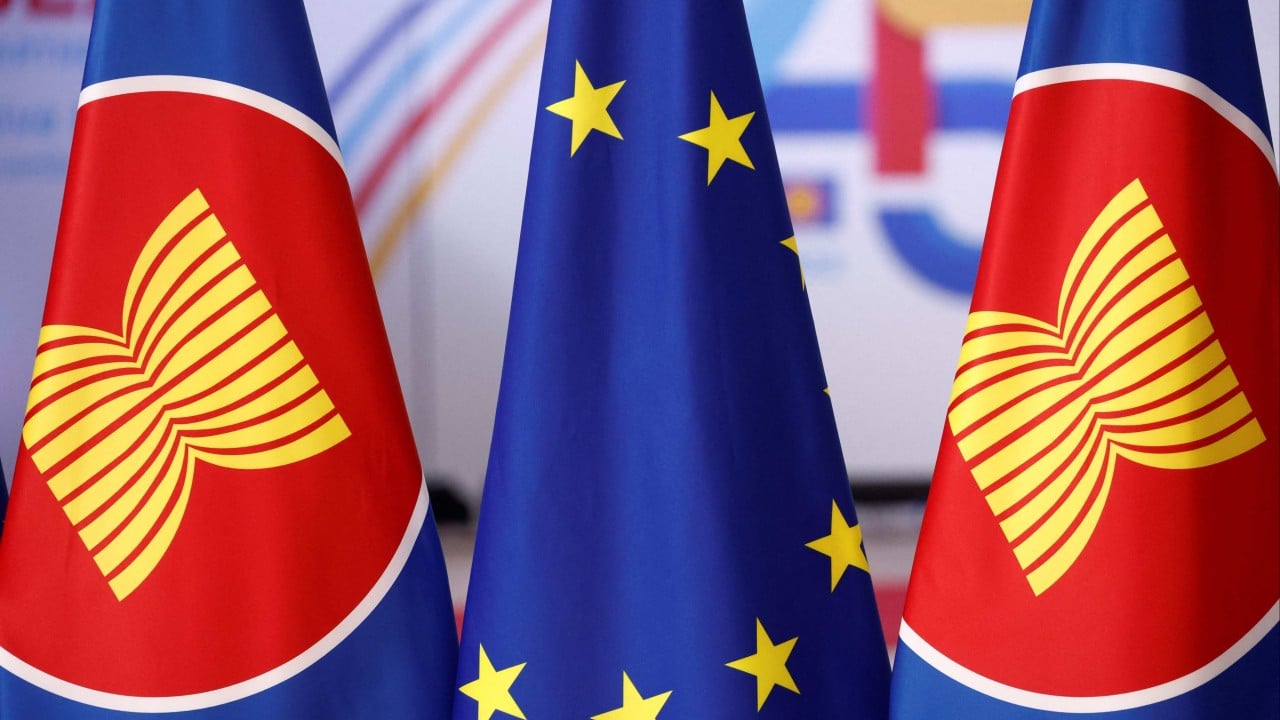
The narrative surrounding the stalled European Union-ASEAN Free Trade Agreement is as predictable as it is lazy. Western analysts and diplomatic observers point their fingers at Myanmar’s military junta, claiming human rights violations and political instability are the single roadblock standing between two massive economic blocs and a historic bilateral trade agreement.
That story is comfortable. It gives Brussels a moral high ground and gives ASEAN a diplomatic chore.
It is also fundamentally wrong.
Singapore is routinely framed as the pragmatic, free-market savior capable of brokering peace, navigating diplomatic minefields, and ushering the deal across the finish line. But betting on Singapore to resolve the "Myanmar hurdle" misunderstands both Singaporean foreign policy and the economic realities of European protectionism.
Myanmar is not the hurdle. It is the scapegoat.
The Myth of the Myanmar Roadblock
Blaming Myanmar for the failure of a region-to-region FTA allows both European and Southeast Asian negotiators to avoid admitting a fundamental truth: a comprehensive EU-ASEAN FTA was dead in the water long before the 2021 coup in Naypyidaw.
Region-to-region trade agreements require structural alignment. The European Union operates as a single market with unified regulatory standards, binding legal frameworks, and supranational enforcement mechanisms. ASEAN operates on the "ASEAN Way"—a model built on strict non-interference, non-binding consensus, and vast economic disparity.
Putting Singapore, a high-income financial hub with zero tariffs on most goods, in the same economic bucket as Laos, Cambodia, or Myanmar creates an impossible baseline for trade negotiators in Brussels.
EU negotiators demand strict labor rights, environmental enforcement, intellectual property protections, and public procurement rules. For developing ASEAN economies, agreeing to these terms is not just politically unviable—it is economically suicidal.
When European leaders cite Myanmar’s political crisis as the barrier to trade, they are leveraging moral clarity to hide structural incompatibility. If Myanmar restored democratic rule tomorrow, the fundamental disagreements over palm oil, agricultural subsidies, state-owned enterprises, and procurement laws would remain entirely untouched.
Singapore Is a Bridge to Nowhere
Diplomatic commentary often suggests Singapore can act as the neutral broker that brings Brussels and Southeast Asia together. This assumes Singapore wants to spend its political capital solving ASEAN’s structural problems.
It does not.
Singapore’s economic strategy has never relied on ASEAN consensus. When region-to-region negotiations stalled in 2007, Singapore did not wait around to fix the group dynamic. It pivoted immediately to bilateral deals. The EU-Singapore Free Trade Agreement (EUSFTA) was inked years ago and entered into force in 2019.
Singapore already has what it wants:
- Duty-free access for its high-value exports to Europe.
- Protected intellectual property frameworks for its pharmaceutical and tech sectors.
- Robust legal mechanisms for European multinational headquarters located on the island.
Why would Singapore burn diplomatic leverage to pull less developed neighbors up to European compliance standards? Doing so yields almost no economic upside for Singapore while dragging it into multi-lateral quicksand.
Expecting Singapore to engineer a solution for Myanmar that satisfies European moral criteria while respecting ASEAN's non-interference protocol is wishful thinking. Singapore is an island of hyper-capitalism in a region of diverse economic models. It acts in its self-interest, and right now, its self-interest means maintaining its own bilateral channels rather than repairing broken regional frameworks.
The Real Obstacle: European Protectionism and ASEAN Disunity
If you want to understand why a region-to-region FTA does not exist, look at palm oil and agriculture, not political unrest in Yangon.
For years, France and Indonesia have been locked in economic friction over agricultural standards and biofuel mandates. Malaysia and the EU routinely butt heads over deforestation regulations and ESG mandates that Southeast Asian producers view as veiled protectionism designed to shelter European oilseed farmers.
Consider the reality of how these trade dynamics function:
- European agricultural lobbies push for stringent environmental metrics that effectively price out Southeast Asian exports.
- ASEAN member states view these metrics as unilateral trade barriers disguised as green policy.
- European politicians cannot back down without alienating domestic farming constituencies.
- ASEAN leaders cannot comply without crashing primary export industries that support millions of rural livelihoods.
This is a structural deadlock. It has nothing to do with Myanmar, democracy, or diplomatic finesse. Even if Myanmar vanished from the map, the deadlock over commodities, tariffs, and regulatory sovereignty would freeze negotiations within weeks.
Bilateralism Has Already Won
The media's obsession with a single, sweeping EU-ASEAN FTA ignores what is happening on the ground. The region-to-region model is obsolete. Bilateralism won years ago, and everyone in the room knows it.
The EU has already signed bilateral trade agreements with Singapore and Vietnam. It is actively negotiating with Indonesia, the Philippines, and Thailand.
This piece-by-piece approach is not a backup plan; it is the deliberate strategy of pragmatic nations. Bilateral deals allow the EU to cherry-pick economies that meet its regulatory tolerances while ignoring the complex political realities of the less-developed ASEAN members. For ASEAN nations, bilateral trade allows them to negotiate terms tailored to their specific export profiles without carrying the baggage of their neighbors.
Continuing to debate whether Singapore can clear the "Myanmar hurdle" for a mega-deal is an exercise in distraction. It focuses attention on a dramatic political narrative while ignoring the cold, calculated shift toward bilateral economic arrangements.
Stop Asking the Wrong Question
Policy analysts keep asking: How can ASEAN and the EU overcome political hurdles to sign a unified trade deal?
The correct question is: Why are we still pretending a unified trade deal makes sense for either side?
A region-to-region deal between two completely different economic structures was an ambitious idea for the 1990s. Today, it is an administrative fantasy.
Corporate strategists and investors who wait for a sweeping EU-ASEAN agreement before expanding supply chains are miscalculating. The future of trade between Europe and Southeast Asia is a web of targeted bilateral agreements, bilateral investment treaties, and sector-specific supply chain corridors.
Myanmar isn’t holding up the deal. The deal was dead long before Naypyidaw descended into crisis. The sooner trade negotiators stop using Myanmar as an excuse for structural incompatibility, the sooner both regions can focus on bilateral deals that actually work.