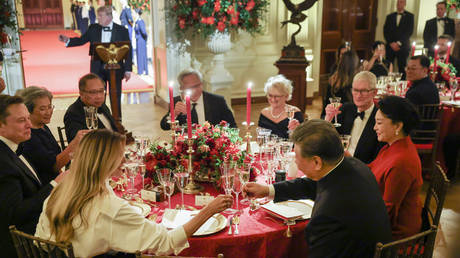
When Donald Trump and Xi Jinping sat down for a high-stakes dinner at the White House, the real story wasn't just what happened behind closed doors. It was who managed to secure a seat at the table—and who was left out in the cold.
Silicon Valley's elite crowded the room. Artificial intelligence and semiconductor supply chains now dictate geopolitical power, turning tech executives into modern-day heads of state. Yet, absences speak louder than attendance records. If you look closely at who stayed home, you see a sharp divide over how American technology interacts with Washington and Beijing.
The Power Players in the Room
The guest list read like a Who's Who of corporate dominance. Leaders from major AI and hardware firms rubbed shoulders with diplomats. Nvidia's Jensen Huang, OpenAI's Sam Altman, Apple's leadership, and top executives from Alphabet and Microsoft all made an appearance.
Why were they there? Because the stakes in the artificial intelligence race are existential. Trump and Xi spent hours talking about semiconductor trade, export controls, and how to keep advanced intelligence systems under human control. When governments decide the rules of compute power, CEOs cannot afford to skip dinner.
The Notable Absences
Not everyone received an invitation, and some who did chose to be elsewhere. Peter Thiel was thousands of miles away in Berlin accepting an award. His data-mining enterprise, Palantir, remains deeply embedded in defense tech and military contracts, operating in a different sphere of government alignment entirely.
Other corporate giants like Intel, IBM, and Oracle were entirely absent from the roster. That omission highlights a shifting hierarchy within American technology. Traditional legacy tech companies are losing ground in Washington's current obsession with frontier AI models and specialized chip manufacturing.
Dario Amodei of Anthropic was also missing from the head tables. Unlike tech leaders who push for fast, deregulated deployment, Amodei has consistently advocated for stricter safeguards and government oversight on advanced AI models. In an administration skeptical of heavy red tape, vocal proponents of safety don't always top the social registry.
The Missing Counterparts
The glaring asymmetry of the evening extended across the aisle. While American tech titans packed the room, zero Chinese corporate executives joined Xi Jinping's official delegation. Beijing's side consisted strictly of senior government officials.
That difference exposes a core friction point between the two systems. American capitalism relies on corporate chieftains lobbying directly for market access and deregulation. China's state-directed model keeps corporate players tightly managed behind a wall of statecraft.
What This Means Moving Forward
Silicon Valley has stopped pretending it can stay out of geopolitics. Code is policy. Chips are currency.
If you run a technology firm today, your relationship with Washington and foreign trade policy dictates your survival. The White House guest list wasn't just a social gathering. It served as a public ledger of which companies currently hold the ear of the state—and which ones are playing a dangerous game by staying outside the tent.