Dawn in the Western Pacific does not break with gentle pinks and soft oranges. It arrives like a sudden, merciless welding spark, turning the ocean into an expanse of hammered lead.
Commander Zhao stands on the darkened bridge of a Type 055 destroyer, his eyes reflecting the emerald glow of tactical displays. He has not slept in thirty-six hours. Around him, a flotilla of grey hulls cuts through the swells, moving with the cold, synchronized discipline of clockwork. They are rehearsing a choreography that no one hopes to perform for real.
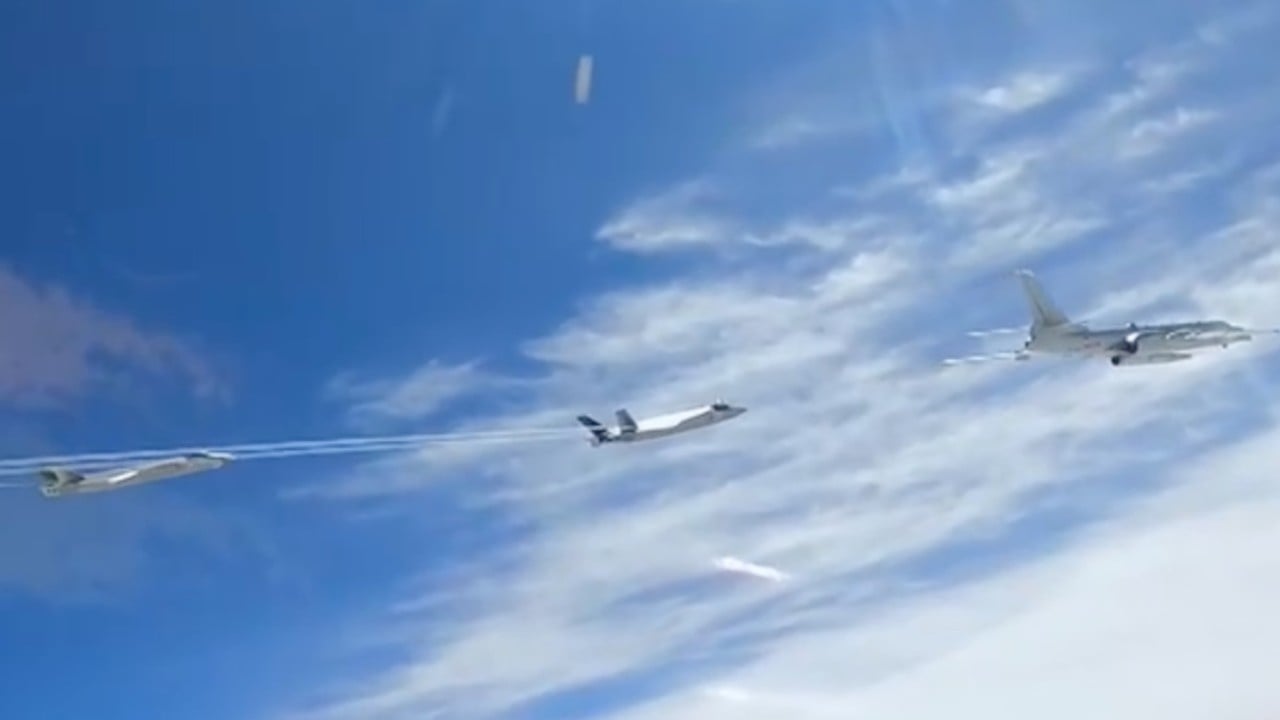
Miles above them, hidden in the grey stratosphere, a Xian H-6N bomber slices through the thin air. Beneath its belly hangs something heavy. Something dark. Something that changes the geometry of the sea below.
It is a weapon designed to end carrier groups before their radar screens even blink.
We talk about military modernization in sterile boardrooms and academic papers. We use terms like power projection, strategic deterrence, and anti-access area denial. But high above the water, inside the metal womb of a long-range bomber, these words dissolve into a simple, suffocating reality: the weight of gravity, the whine of twin turbofans, and the quiet countdown of a targeting computer.
The Anatomy of a Shift
Consider what happens next on the radar consoles of a naval task force miles away.
For decades, the math of ocean dominance was simple. Aircraft carriers ruled the waves because they projected power hundreds of miles beyond their hulls. They were floating cities, untouchable and supreme. But the skies are changing. When a Chinese H-6N carries a nuclear-capable, air-launched ballistic missile into an anti-ship exercise, it is not merely testing a piece of hardware. It is rewriting the physics of naval warfare.
Let us be entirely clear about the mechanics, because understanding the threat requires stripping away the mystery.
Note: The following scenario is a hypothetical reconstruction based on verified open-source defense analyses regarding Chinese military capabilities.
Imagine a pilot cruising at high altitude, flanked by escort fighters. In the cargo bay or slung beneath the fuselage, the missile is sealed in a protective thermal blanket. It is not an ordinary anti-ship cruise missile that skims the waves at subsonic speeds, vulnerable to Phalanx CIWS or rolling airframe missiles. This weapon climbs to the edge of space, accelerates to hypersonic speeds, and plunges downward at a velocity that defies interception.
When analysts spotted this configuration during recent exercises, the defense community did not panic. They adjusted their spreadsheets. But for the sailors stationed on those distant decks, the calculus shifted from theoretical to existential.
The Human Cost of Distance
Distance used to be a shield.
During the Cold War, superpowers measured security in thousands of miles of ocean buffer. If you stayed far enough away from a rival coastline, you were safe. But modern hypersonic and ballistic anti-ship missiles shrink the globe into a knife fight in a phone booth.
Talk to anyone who has served on a modern destroyer, and they will tell you about the phantom noises. Every creak of the hull sounds like an incoming threat. Every flicker of the generator brings a spike of adrenaline. When a nation deploys a nuclear-capable delivery system into a conventional maritime drill, it sends a message that bypasses diplomatic channels entirely. It whispers to the command structure: We can reach you. Wherever you think safe is, it is not.
This is the invisible architecture of deterrence. It is built not just on titanium, rocket fuel, and silicon chips, but on human nerves.
Consider a young sonar technician sitting in the bowels of a guided-missile cruiser, staring at a waterfall display of acoustic noise. He is twenty-two years old. He grew up playing video games in a midwestern suburb, and now he is listening to the heartbeat of an ocean where superpowers posture with extinction-level hardware. He does not care about geopolitical theory. He cares about whether the blip on his screen is a pod of whales or the acoustic signature of a silent submarine waiting to vector in that airborne missile.
The Weight of Ambiguity
Why carry a nuclear-capable asset in an anti-ship exercise? Why blur the lines between conventional posturing and strategic escalation?
Because ambiguity is a weapon.
In military strategy, clarity invites counter-preparation. If an adversary knows your exact limits, they can build a wall tailored to your height. But if they never quite know whether the bomber overhead is carrying a conventional warhead, a tactical nuclear payload, or a psychological message, they have to prepare for the worst-case scenario every single time.
That constant state of high alert is exhausting. It drains treasuries, frays alliances, and tests the psychological endurance of armed forces operating thousands of miles from home.
We watch these developments unfold through grainy satellite photos and defense ministry press releases translated from Mandarin and English. We treat them as data points in an ongoing great-power competition. Yet every flight, every drill, and every new missile integration casts a long shadow over actual human lives.
Commander Zhao finally steps away from the console as the first sliver of the sun breaches the horizon, turning the leaden sea into a sheet of polished copper. The bomber above has completed its run and turned back toward the mainland, swallowed by the clouds. The sea grows quiet again. But the ripples remain, widening outward across the Pacific, touching shores far beyond the horizon.