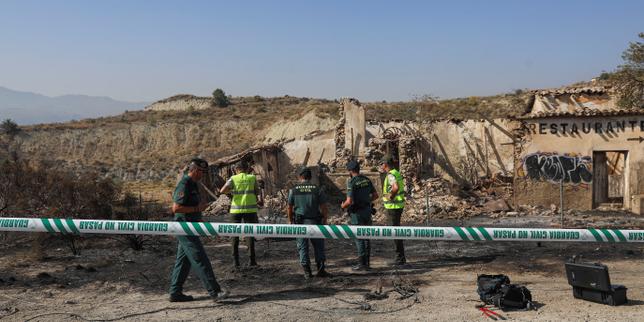
The smell of burnt pine does not leave a jacket easily. It clings to the wool, a bitter reminder of how quickly a paradise can turn into an oven. In the southern valleys of Spain, where the olive groves usually shimmer like silver under the Mediterranean sun, the air recently turned the color of bruised plums. The wind, normally a welcome relief from the Andalusian heat, became the enemy. It carried the sparks. It fed the monster.
When a wildfire rips through a landscape, the statistics follow a familiar, sterile cadence. Twelve dead. Hundreds evacuated. Hectares destroyed. But numbers are a terrible way to measure grief. They flatten the horror. They turn a sudden, violent tragedy into a data point on a screen. For a deeper dive into similar topics, we suggest: this related article.
To understand what happened in Andalusia, you have to look past the spreadsheets. You have to stand in the ash.
The Roar of the Sierra
Imagine waking up to a sky that is the wrong color. It is 4:00 AM, but there is no dawn. Only a heavy, suffocating orange glow that seems to press down on the roof. For broader context on this issue, extensive reporting can be read on USA Today.
For the families living on the slopes of the Sierra, the first sign of danger was not an official siren or a text alert. It was the sound. A deep, sub-bass rumble that vibrated through the floorboards, like a freight train barreling through a living room. Wildfires at this scale do not just burn. They roar. They create their own weather systems, sucking in oxygen and spitting out walls of flame that move faster than a person can run.
Consider the reality of a sudden evacuation. You have five minutes. What do you grab? The documents? The dog? The photo album on the shelf that your grandmother gave you? In those frantic moments, panic is a physical weight. The smoke stings your eyes, blinding you as you fumble for your car keys.
For twelve people, the exit routes disappeared.
The roads in these rural mountainous regions are narrow, winding ribbons of asphalt flanked by dense vegetation. When the fire jumps a ridge, those roads become traps. Thick, black smoke reduces visibility to zero in seconds. Drivers cannot see the curves ahead; they cannot see the oncoming traffic. The heat grows so intense that it cracks windshields and melts tires. It is a terrifying, claustrophobic nightmare where the air itself becomes toxic to breathe.
A Nation Halts
While the hillsides were still smoldering, the shockwave reached Madrid.
In the capital, the political machinery briefly ground to a halt. There is a specific kind of quiet that descends on a country when a tragedy of this magnitude strikes. It is not the quiet of sleep; it is the heavy silence of collective shock.
Inside the government buildings, King Felipe VI and Queen Letizia stood side by side, their heads bowed. Around them, officials and citizens alike stopped what they were doing to observe a minute of silence. Sixty seconds of absolute stillness to honor the lives cut short in the south.
But a minute of silence, no matter how solemn, cannot rebuild a razed village. It cannot bring back the livestock, the centuries-old trees, or the people who tended them. The royal gesture was a symbol of national mourning, a shared weight, but the real burden remains with the survivors who now have to sift through the charcoal of their former lives.
The New Normal of the Scrubland
It is easy to blame the weather. Spain is no stranger to hot summers, and Andalusia is historically one of the driest regions in Europe. Yet, something has fundamentally shifted in the mechanics of these disasters.
The summers are longer now. The heatwaves are not just intense spikes; they are prolonged marathons that bake the soil until it is hard as concrete and turn the undergrowth into kindling. A single stray spark, a discarded cigarette, or a lightning strike can trigger an explosion of fire that traditional firefighting methods are simply not equipped to handle.
The firefighters who tackle these blazes are not just fighting fire; they are fighting a changing ecosystem. They describe these modern wildfires as "megafires"—unpredictable beasts that defy computer models and behave with a terrifying autonomy. When the canopy catches fire, the flames can leap across highways and rivers as if they were nothing more than chalk lines on a sidewalk.
The aftermath of such an event leaves a scar that lasts for generations. The immediate danger passes when the last embers are extinguished, but the true crisis begins in the months that follow. Without the roots of the trees to hold the earth together, the next heavy rain will wash the topsoil away, causing mudslides and ensuring that nothing will grow there for years to come. The landscape becomes a ghost of itself.
The Weight of What Remains
Walk through one of the affected villages a few days after the fire has passed, and the silence is different from the one observed in Madrid. It is a hollow, ringing silence.
The color is gone. Everything is a uniform, matte gray. You see the metal frame of a bicycle, completely warped by the heat. You see a ceramic flowerpot, cracked open, the soil inside baked dry. These are the small, domestic monuments to a sudden interruption. Life was here, and then it was violently erased.
The community will rebuild, because humans always do. Neighbors will help neighbors clear the debris. New homes will rise from the foundations of the old ones. But the fear will linger. Every time the wind picks up on a hot August afternoon, every time the smell of smoke drifts over the ridge from a distant barbecue, a collective shudder will pass through the valley.
The twelve who died are not just a statistic to be filed away in a ministry report. They were the keepers of the local stories, the people who knew the best paths through the hills, the ones who kept the small rural economies alive. Their absence is a permanent hole in the fabric of the community.
As the smoke finally clears over Andalusia, the sun breaks through the haze, casting long, sharp shadows across the blackened earth. The fire is gone, but the warmth left behind is not the comfort of summer. It is the residual heat of a tragedy that Spain will be feeling for a very long time.