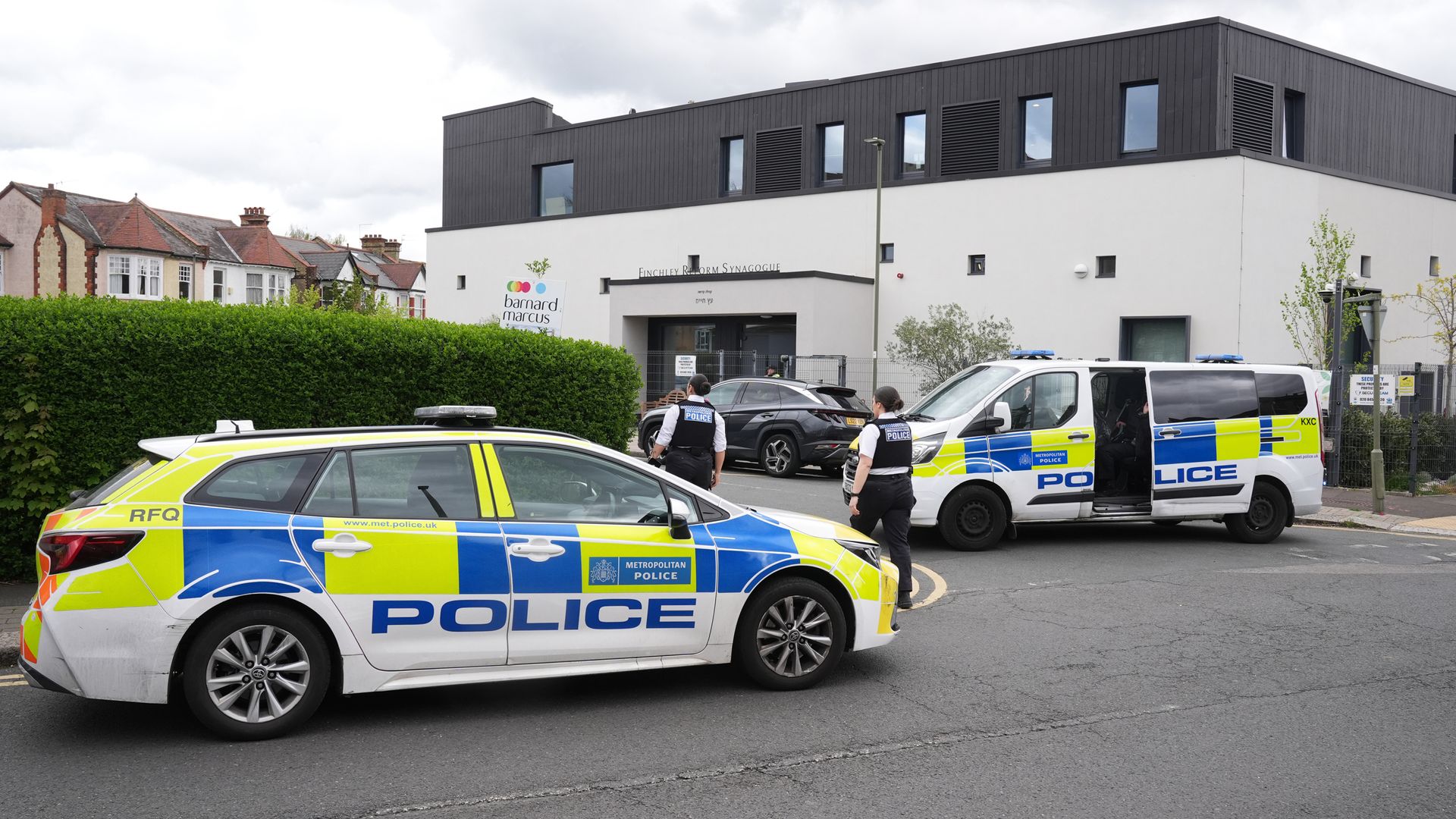
The third arrest following the attempted arson at a Finchley synagogue is not merely another entry in a police blotter. It is a siren. While the Metropolitan Police Counter Terrorism Command works through the mechanics of the case, the community in North London is forced to confront a reality where religious sanctuaries require the security protocols of a hard-target military installation.
The incident, which saw a suspect attempt to set fire to a place of worship in the heart of one of London’s most prominent Jewish neighborhoods, has shifted from an isolated act of malice into a broader investigation of radicalization and communal safety. This third suspect, a man in his late 20s, represents a significant development in a case that many hoped was a one-off. It isn't. The investigation now points toward a more organized or at least a more communal effort to strike at the heart of Jewish life in the capital. If you found value in this post, you should read: this related article.
The Infrastructure of Intimidation
When an arsonist approaches a synagogue, they are not just looking for a wooden door to burn. They are looking to incinerate the sense of normalcy that allows a minority group to exist in a pluralistic society. The Finchley attack failed in its physical objective—the building still stands—but it succeeded in its psychological one. It reinforced the "fortress" requirement that has become an expensive, exhausting reality for British Jews.
Security at these sites is no longer about a friendly volunteer at the gate. It involves high-definition surveillance, reinforced entry points, and constant coordination with the Community Security Trust (CST). The fact that a third person has been linked to this specific plot suggests that the threat is moving away from the "lone wolf" archetype that dominated security briefings for the last decade. Instead, we are seeing the emergence of small, localized clusters of hostility that feed off digital vitriol and translate it into physical action. For another angle on this event, refer to the recent update from Associated Press.
The police have been tight-lipped about the specific motivations, but the context is impossible to ignore. Hate crime statistics in London have spiked to levels that make the early 2000s look like an era of peace. The "why" in this case is often a toxic cocktail of geopolitical grievances and ancient prejudices, shaken and served via encrypted messaging apps.
The Failure of Deterrence
One must ask why the threat of a life sentence for terrorism or arson is no longer enough to keep a suspect away from a synagogue with a petrol can. The answer lies in the devaluation of consequence. For a certain subset of radicalized individuals, the act of the attack provides more social and ideological capital than the legal system can take away through incarceration.
Local law enforcement faces a massive hurdle. They are playing a permanent game of defense where the opponent only needs to get lucky once. The arrest of a third individual suggests that the Metropolitan Police are moving upstream, trying to find the source of the planning rather than just the hand that held the lighter. But the speed at which these cells can form online makes traditional surveillance look sluggish.
The Neighborhood on Edge
Walking down the streets of Finchley, the tension is palpable. This isn’t a community that is easily rattled—they have lived through cycles of tension before—but this feels different. It feels more sustained. The attempted arson wasn't a protest; it was an attempt to erase.
Residents are now asking questions that the Home Office isn't ready to answer:
- How did three individuals coordinate without triggering any early warning systems?
- What is the specific link between the three suspects beyond the shared target?
- Is the current police presence a temporary bandage or a permanent new requirement for the borough?
The reality is that "community policing" is a hollow phrase when the community in question is being targeted for its identity. You cannot police your way out of a deep-seated ideological hatred that has been allowed to fester in the dark corners of the internet.
The Mechanics of the Investigation
The Counter Terrorism Command doesn’t get involved for a simple case of property damage. Their presence indicates that this case has "terrorist connections" or "terrorist motivations." This distinction is vital. It changes the nature of the evidence being sought. We aren't just looking at fingerprints on a canister; we are looking at data packets, metadata, and financial trails.
The third arrest likely came from a breakthrough in digital forensics. When the first two suspects were taken into custody, their devices became a roadmap. Every "like," every shared video, and every direct message was a breadcrumb leading to the third man. This is the modern face of the hunt: an investigator in a windowless room in New Scotland Yard scrolling through thousands of lines of chat logs to find the moment the plan was hatched.
Beyond the Yellow Tape
The physical damage to the synagogue may be minimal, but the civic damage is profound. Every time an arrest like this is made, it confirms the fears of the parents who hesitate to send their children to the local Jewish school. It validates the anxiety of the elderly congregant who looks over their shoulder while entering the building for morning prayers.
The government’s response has been predictable—expressions of "solidarity" and "zero tolerance." But zero tolerance is a policy, not a result. The result is what we see in Finchley: a third man in a cell and a community wondering who is next. The arrests are a victory for the police, but they are a symptom of a much larger societal failure.
The Logistics of Radicalization
We have to stop treating these incidents as anomalies. They are the logical conclusion of a digital ecosystem that rewards extremism. The suspects in the Finchley case didn't wake up one morning and decide to commit arson. They were likely groomed by a constant stream of dehumanizing content that made the synagogue look like a legitimate target rather than a house of God.
The "how" is simple:
- Isolation: The individual is separated from moderate voices.
- Saturation: They are fed a diet of conspiratorial and hateful media.
- Activation: A specific event or "call to action" moves them from the keyboard to the street.
The third arrest suggests that this process is happening in groups. It is a social activity. They are egging each other on, validating each other's descent into criminality. This makes the threat far more dangerous because it provides a support structure for the perpetrator. They aren't just acting on a whim; they are acting for the "team."
The Resource Drain
Every one of these plots requires an enormous amount of state resources to dismantle. For every arrest made, dozens of officers are taken off other duties. Hundreds of hours of CCTV are reviewed. Forensic labs are backed up. The perpetrators of the Finchley attack are, in a sense, winning a war of attrition against the state's budget.
If every synagogue in London requires 24/7 armed protection or high-level surveillance, the cost becomes unsustainable. The goal of the arsonist isn't just to burn the building; it's to make the cost of being Jewish in London too high to bear. They want to make the state admit that it cannot protect its own citizens.
The third suspect is currently being questioned. The details that emerge will likely point to a wider network of influence that spans far beyond North London. It will show a web of digital radicalization that the current laws are ill-equipped to handle. We are fighting a 21st-century ideological war with 20th-century legal tools.
The Long Road to Recovery
Finchley will recover, but it will be a recovery marked by scars. The synagogue will be reinforced. The gates will be higher. The guards will be more alert. This is the tragedy of modern London: we measure "safety" by the strength of our locks rather than the peace of our streets.
The investigation continues, and more arrests may follow. Each one is a reminder that the fire this time was put out, but the fuel remains everywhere. We are waiting to see if the legal system can do more than just react to the smoke. It needs to find a way to drain the tank before the next match is struck.
The safety of the Finchley community depends on the ability of the police to prove that there is no anonymity for those who plot in the shadows. But more than that, it depends on a society that refuses to let this kind of hatred become a background noise we simply learn to live with. Stopping the fire was the easy part. Stopping the people who want to start it is the real challenge.
The case remains active. The suspects remain in custody. The community remains on guard. This is the new normal, and it is a failure of everything we claim to stand for.
Protecting a synagogue shouldn't require an act of parliament or a counter-terrorism task force. It should be a given. The fact that it isn't tells you everything you need to know about the current state of the city. We are one successful attack away from a total breakdown in communal trust, and the third arrest in Finchley is a grim reminder of how close we are to that edge.
The investigation is no longer just about arson. It is about whether a pluralistic society can survive when its religious centers are treated as combat zones. The fire in Finchley didn't take hold, but the heat is rising.
The police have done their job in securing the suspects, but the work of securing the peace hasn't even begun.


