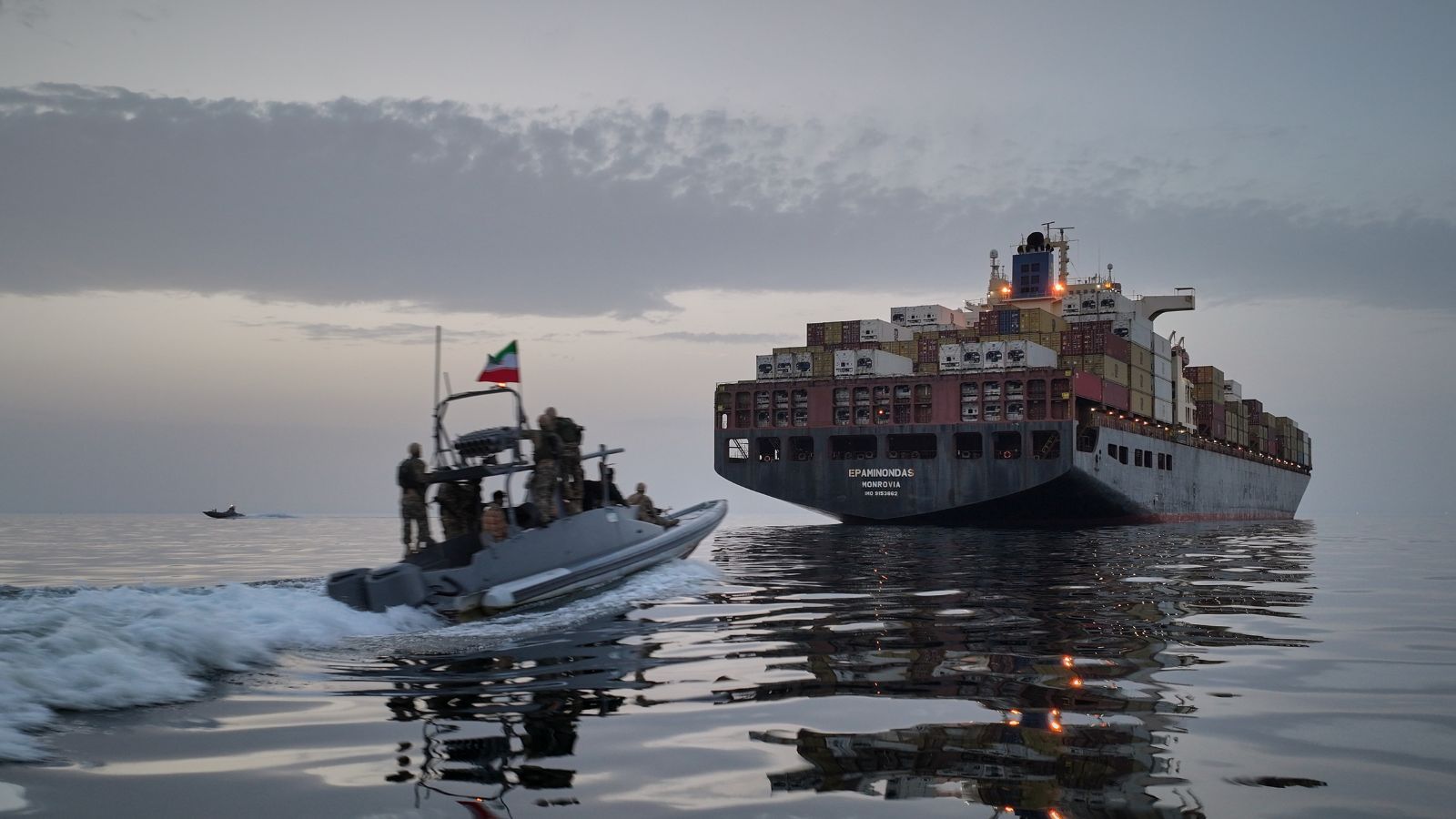
The global energy market is currently held hostage by twenty-one miles of water and a radical shift in maritime law that no one saw coming. When Tehran announced its "new rules" for the Strait of Hormuz this week, it wasn't just another piece of regional saber-rattling. It was a formal declaration that the era of "transit passage"—the legal bedrock that allows ships to move through international straits without interference—is effectively dead.
By imposing a sovereign management regime over the waterway, Iran is attempting to turn a global highway into a private toll road. This move comes as a direct response to the United States' refusal to lift a crushing naval blockade of Iranian ports, a standoff that has already sent Brent crude spiraling toward $160 per barrel and left twenty thousand seafarers stranded in a digital and physical no-man's-land. Don't miss our previous coverage on this related article.
The Mojtaba Doctrine and the End of UNCLOS
The shift in strategy coincides with the rise of Mojtaba Khamenei, who assumed leadership in March. His administration has discarded the cautious ambiguity of his predecessor, opting instead for what internal IRGC documents describe as "proactive control." Under these new rules, the Strait of Hormuz is no longer an international waterway subject to the United Nations Convention on the Law of the Sea (UNCLOS). Instead, Tehran now demands transit revenues paid in Iranian currency and reserves the right to board and "inspect for reparations" any vessel belonging to "hostile states."
This is a direct hit to the legal fiction the West has relied on for decades. While the U.S. Navy maintains that it is conducting a lawful blockade during an armed conflict, Iran is using that very conflict to rewrite the book on maritime sovereignty. They aren't just blocking ships; they are charging them for the privilege of being harassed. To read more about the context here, NBC News offers an excellent breakdown.
The Invisible Minefield
The physical reality on the water is even more precarious than the legal one. Unlike the crude contact mines of the 1980s Tanker War, the Islamic Revolutionary Guard Corps (IRGC) is now deploying Maham-3 and Maham-7 influence mines. These are not floating iron balls with spikes. They are sophisticated sensors that sit on the seabed, waiting for the specific magnetic or acoustic signature of a commercial tanker.
- Maham-3: A 300kg anchored mine designed for depths up to 100 meters.
- Maham-7: A specialized bottom mine for shallow coastal transit.
The U.S. Navy has reportedly destroyed sixteen minelaying vessels in the last month, but the IRGC operates thousands of small, nondescript speedboats. Detecting a single boat dropping a suitcase-sized sensor in the middle of a swarm is a mathematical nightmare for Aegis-class destroyers.
A Blockade of the Blockade
Washington’s strategy has evolved into what analysts are calling a "blockade of the blockade." By sealing off Iranian ports like Bandar Abbas, the U.S. hoped to starve the regime into a ceasefire. Instead, they have triggered a systemic collapse of the Gulf Cooperation Council (GCC) economic model.
Saudi Arabia and the UAE, despite their pipelines to the Red Sea, cannot move enough volume to bypass the Strait. QatarEnergy has already declared force majeure on all LNG exports after a series of "unattributed" strikes on the Ras Laffan complex. For Europe, which entered this spring with gas storage at a measly 30% capacity, the timing is catastrophic.
The U.S. administration is now trapped in a high-stakes game of chicken. If they escalate to clear the mines, they risk a full-scale shore-to-ship missile barrage from the Iranian coast. If they hold their position, the "grocery supply emergency" in the Gulf states—which rely on the Strait for 80% of their caloric intake—will turn into a full-blown famine.
The Economic Toll of a Twenty-Mile Gap
The numbers are staggering. Before the closure on March 4, 2026, roughly 20.9 million barrels of oil passed through this gap every single day. That is one-fifth of the world’s consumption. With that flow choked, the "geopolitical risk premium" is no longer a theoretical bump in gas prices; it is a permanent tax on global trade.
Asian economies—China, India, Japan, and South Korea—are the hardest hit, accounting for 75% of the oil that usually transits the Strait. While the U.S. is energy independent on paper, the global nature of pricing means American consumers are seeing record highs at the pump just months before the midterm elections.
The Failure of Traditional Deterrence
For twenty years, the U.S. Fifth Fleet relied on the "deterrence by presence" model. The idea was simple: keep a carrier strike group in the Arabian Sea, and the Strait remains open. That model failed the moment Iran realized that a $5,000 drone or a $20,000 mine could neutralize a $13 billion aircraft carrier's ability to protect commercial shipping.
The IRGC isn't trying to win a naval battle in the traditional sense. They are practicing "anti-access/area-denial" (A2/AD) on a shoestring budget. By forcing the U.S. to choose between a bloody amphibious invasion of the Iranian coastline or a humiliating withdrawal of the naval blockade, Tehran has seized the initiative.
The "new rules" aren't just about tolls or inspections. They are a test of whether the international community still has the stomach to enforce the freedom of the seas when the cost of doing so is a global economic depression. As of today, the answer from the markets is a resounding "no." Every day the Strait remains under "strict management," the more the world adjusts to a reality where the most vital chokepoints on earth are no longer public property.
The U.S. Navy can sink every ship Iran puts to sea, but they cannot "sink" a minefield they can't find or a legal precedent they can't enforce. The siege continues, and the price of oil is the least of our worries. The real cost is the permanent fracturing of the global maritime order.



