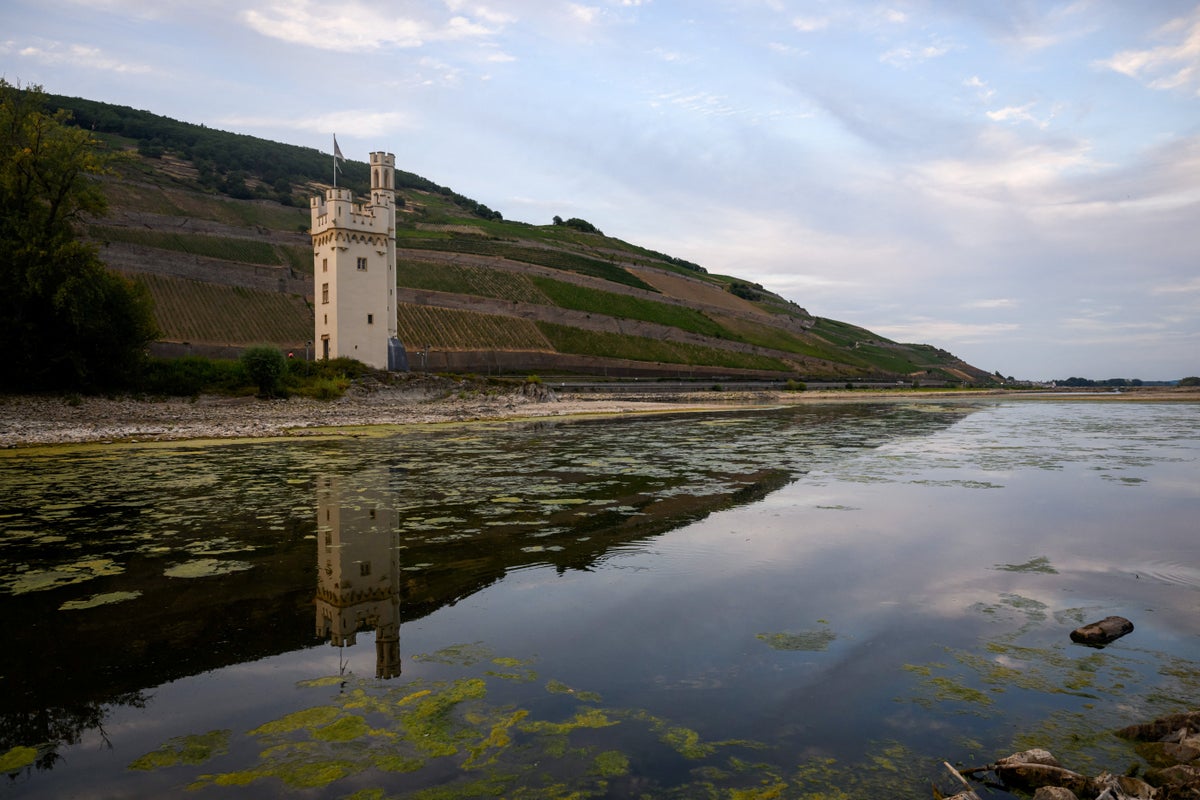
You rarely think about a river until it dries up and chokes the factories powering an entire continent. When the Rhine drops to critical depths, Europe's largest economy starts sweating. Summer heatwaves bring little rain, and water levels plunge. Ships scrape the riverbed. Industrial supply chains snap.
Most headlines focus on factory output or quarterly GDP numbers, but the real crisis sits in a narrow stretch of water near Kaub. If you want to understand why Germany's economic recovery remains fragile, you have to look at the muddy bottom of its busiest inland waterway.
The Bottleneck at Kaub and Why Cargo Fleets Struggle
The Rhine is not just a scenic backdrop for fairy-tale castles. It is a working commercial highway. Thousands of barge operators move coal, crude oil, chemicals, and steel containers between the North Sea ports and the industrial heartland of the Rhine-Ruhr region.
When water levels drop, the math turns brutal against shipping companies. Cargo vessels cannot float safely when they are fully laden. At certain low thresholds, a standard barge can only operate at twenty percent capacity.
Think about what that means for logistics. Moving the exact same amount of raw material suddenly requires five times the number of vessels. Companies scramble to secure smaller barges, but those are scarce. Freight rates skyrocket overnight. Transport times drag out as ships wait for room to pass through shallow bottlenecks like Kaub.
According to data from the Kiel Institute for the World Economy, a prolonged month of low water trims industrial production in Germany by about one percent. That is not a minor inconvenience. It is a direct hit to heavy manufacturing that ripples across borders.
The Domino Effect on Chemical Plants and Steel Mills
You might assume that cargo can simply be moved onto trucks or trains when the river gets too shallow. In reality, shifting massive freight volumes off water and onto land is physically impossible on short notice.
Rail networks like DB Cargo already operate near capacity. Highway bridges face strict weight limits, and finding enough qualified truck drivers to replace hundreds of heavy cargo barges is a pipe dream.
Chemical giants like BASF have learned this the hard way during past droughts in 2018 and 2022. When feedstock deliveries slow to a trickle, chemical complexes and steel mills have no choice but to throttle back operations.
These are foundational industries. When a chemical plant cuts output because basic inputs fail to arrive, plastics manufacturers, car factories, and pharmaceutical companies downstream face immediate shortages. One shallow river can throw a wrench into supply chains spanning the entire European Union.
Adapting to a Warmer Climate Reality
Droughts on the Rhine are no longer shocking anomalies. They are a recurring structural threat. Winter snowpacks in the Alps melt faster and earlier, leaving less runoff to feed the river during dry summer months.
Companies are adapting, though adaptation is expensive. Major manufacturers now invest in specialized shallow-draft vessels designed to carry payloads through lower depths. They maintain larger buffer inventories of essential raw materials near production sites, tying up working capital that could otherwise fund growth or innovation.
Port operators and logistics providers are pushing for structural changes, including deeper dredging channels and better real-time monitoring systems. Yet dredging is controversial due to environmental concerns, and engineering projects take years to complete.
If you run a business reliant on European supply chains, treating low water levels as a temporary weather glitch is a dangerous gamble. Resilience now requires redundant logistics routes, diversified supplier networks, and realistic pricing models that account for climate volatility. Keep a close eye on the gauge readings at Kaub. They tell you more about the health of European manufacturing than most financial reports.