The Cold Air of the West Wing
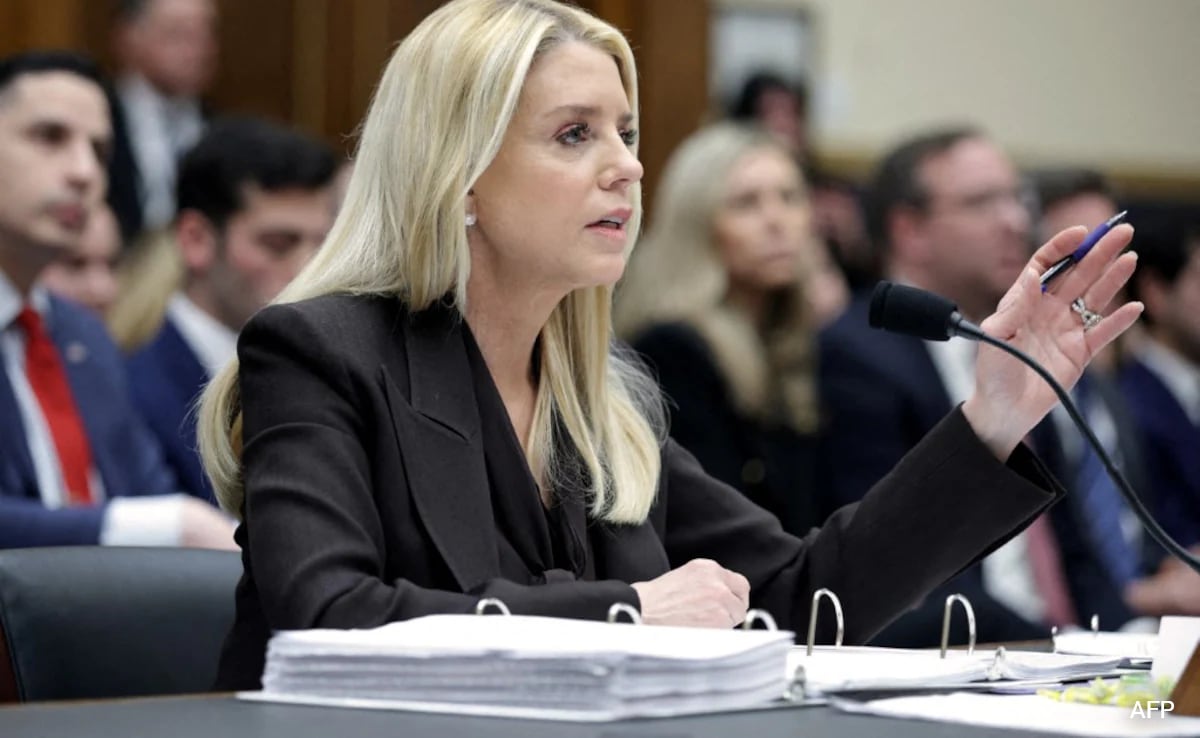
Power in Washington is often measured by the length of a hallway. At the start of an administration, that hallway feels infinite, gold-leafed, and heavy with the scent of fresh mahogany. But for Pam Bondi, the distance between the Oval Office and the exit may have just shrunk to a single, breathless step.
Rumors do not just drift through the capital; they vibrate. They hum in the dry heat of the briefing room and rattle the ice in tumblers at the Hay-Adams. The latest vibration is a jagged one: Donald Trump is reportedly considering firing his Attorney General before the ink on her commission has even had time to settle into the parchment.
It is a dizzying turn of events for a woman who was, only weeks ago, the ultimate insider. Bondi wasn't just a cabinet pick. She was a shield. She was the veteran prosecutor from Florida who had stood by the President through the fire of impeachments and the grind of campaigns. To see her name now linked with the word "firing" is to witness a specific kind of political vertigo.
The Irony of the Shield
Imagine a carpenter who spends months building a door specifically designed to keep the wind out, only to find the homeowner complaining that the door is too heavy to swing open. That is the metaphorical wall Bondi currently faces.
The Department of Justice is not a typical agency. It is a three-letter titan with the power to ruin lives, topple industries, and define the moral arc of a presidency. When a President selects an Attorney General, they aren't just looking for a lawyer. They are looking for a philosophy. Trump’s philosophy has always been one of absolute motion—a desire to see the machinery of the state move in lockstep with the executive will.
Bondi was supposed to be the one who understood the rhythm. She had the Florida grit. She had the camera-ready poise. Most importantly, she had the trust. But trust in a high-stakes administration is a volatile element. It can evaporate under the heat of a single disagreement or a perceived hesitation in the face of a bold directive.
The reports suggest a friction that is almost elemental. It isn't necessarily about a single case or a specific memo. It is about the "energy." In the world of high-level politics, "energy" is shorthand for a willingness to break things. If the President feels the DOJ is moving too slowly—if he feels the "deep state" he frequently rails against is still clogging the pipes—the person at the top becomes the primary blockage.
The Ghost of Sessions Past
To understand why this matters, we have to look back at the ghosts that haunt the halls of 950 Pennsylvania Avenue. This isn't the first time we've seen this play.
Years ago, Jeff Sessions was the first senator to jump on the Trump train. He was the loyalist’s loyalist. Yet, the moment he recused himself from the Russia investigation, he became a "traitor" in the eyes of the man who appointed him. The relationship didn't just fray; it disintegrated in public view, a slow-motion car crash played out over a thousand tweets.
Then came William Barr. He was the institutionalist who seemed, for a time, to be exactly what the President wanted—a sophisticated defender of executive power. But even Barr found a limit. When the 2020 election results were challenged, Barr refused to see ghosts where there were only numbers. He walked out.
Bondi is now standing in that same shadow. The stakes, however, feel higher this time. The President isn't just looking for a defender; he is looking for a disruptor. If Bondi is seen as someone who respects the "old ways" of the DOJ too much—the slow deliberations, the career-staff protocols, the adherence to norms that have stood since Watergate—she becomes an obstacle.
The Human Toll of the Red Pen
Politics is often discussed as a game of chess, but chess pieces don’t have heartbeats. They don’t have reputations to protect or families who watch the news with a knot in their stomachs.
Consider the atmosphere inside the Department of Justice right now. There are thousands of career employees—prosecutors, analysts, clerks—who wake up every morning and look at the headlines to see if their boss still has a job. When the leadership is in a state of constant flux, the mission stutters. Cases stall. Morale drops into the basement.
For Pam Bondi, the personal cost is an odd kind of public humiliation. To be selected for one of the most powerful jobs on Earth, only to have the person who chose you start sharpening the axe before you’ve even finished unpacking your boxes, is a brutal experience. It’s a reminder that in certain circles, loyalty is a one-way street that ends in a cul-de-sac.
We often think of these figures as titans of industry and law, but in these moments, they are remarkably fragile. They are subject to the whims of a single man’s temperament. The "reports" of her potential firing act as a trial by fire. It is a psychological pressure cooker. If she survives this round, she does so with the knowledge that her neck is always on the block. If she doesn’t, she becomes another name in the long list of "formers" who were once the center of the universe and are now just a footnote in a chaotic chapter of history.
The Mechanics of Discontent
Why would a President fire someone he just hired? To the outside observer, it looks like indecision or chaos. But from a certain perspective of power, it is a form of calibration.
If the goal is total transformation of the federal government, then the Attorney General must be a flamethrower, not a flashlight. A flashlight shows you what’s in the room. A flamethrower clears it out. If Bondi is acting like a flashlight—meticulous, observant, careful—she isn’t fulfilling the specific, unspoken requirements of the role as the President envisions it.
The tension usually boils down to the "independence" of the DOJ. Since the 1970s, there has been a sacred, if unwritten, rule that the Department of Justice operates with a degree of distance from the White House. The President sets policy; the DOJ enforces the law. But the current administration views that distance as a myth created by people who want to undermine the executive.
If Bondi is even perceived to be nodding toward that traditional independence, the "firing" discussions aren't just gossip. They are a warning shot. They are a way of saying: Remember who gave you this desk.
The Invisible Stakes
We tend to focus on the personalities—Trump’s volatility, Bondi’s poise—but the real story is the precedent being set. Every time an Attorney General is threatened with removal for anything other than gross incompetence, the foundation of the justice system shifts a few millimeters.
If the DOJ becomes a direct extension of the White House’s personal grievances or political ambitions, the concept of "equal justice under law" starts to look like a polite suggestion rather than a mandate. This isn't about whether you like Pam Bondi or whether you support Donald Trump. It’s about the terrifying realization that the law is only as strong as the people who are willing to be fired for it.
The "invisible stakes" are the cases you never hear about. The environmental regulations that aren't enforced. The civil rights investigations that are quietly shelved. The corporate fraud that goes unpunished because the people at the top are too busy fighting for their professional lives to focus on the work.
A Choice of Shadows
Bondi now finds herself in a position that no amount of Florida courtrooms could have prepared her for. She is in the "Grey Zone." This is the space where you are still in power but stripped of your authority. You have the title, but the world knows your expiration date might be tomorrow afternoon.
In this zone, every move is scrutinized. If she is too aggressive in her duties, she’s seen as auditioning for her job. If she’s too quiet, she’s seen as checked out. It is a miserable, public limbo.
There is a specific kind of silence that falls over a room when a "marked" official enters. Conversations stop. Eyes drift toward the door. People begin to wonder who the successor might be even as they are shaking the current incumbent's hand. It is a cold, lonely place to be, especially when you are meant to be the person who holds the scales of the nation's justice.
The truth is that we are no longer talking about a legal appointment. We are talking about a loyalty test that has no passing grade. In an environment where total fealty is the only currency, even the most devoted servant eventually runs out of change.
The reports of Trump discussing her firing aren't just news items. They are the sound of the machinery turning. They are the manifestation of a philosophy that believes the only way to lead is to keep everyone—even your closest allies—in a state of perpetual fear.
Pam Bondi may stay. She may go. But the hallway has already shrunk. The door is right there, and the handle is already turning. In the end, the most powerful people in Washington are often just guests who stayed five minutes too long at a party where the host has already moved on to the next guest.
The ink on the commission is dry. The air in the room is cold. And the walk to the door is shorter than anyone cared to admit.