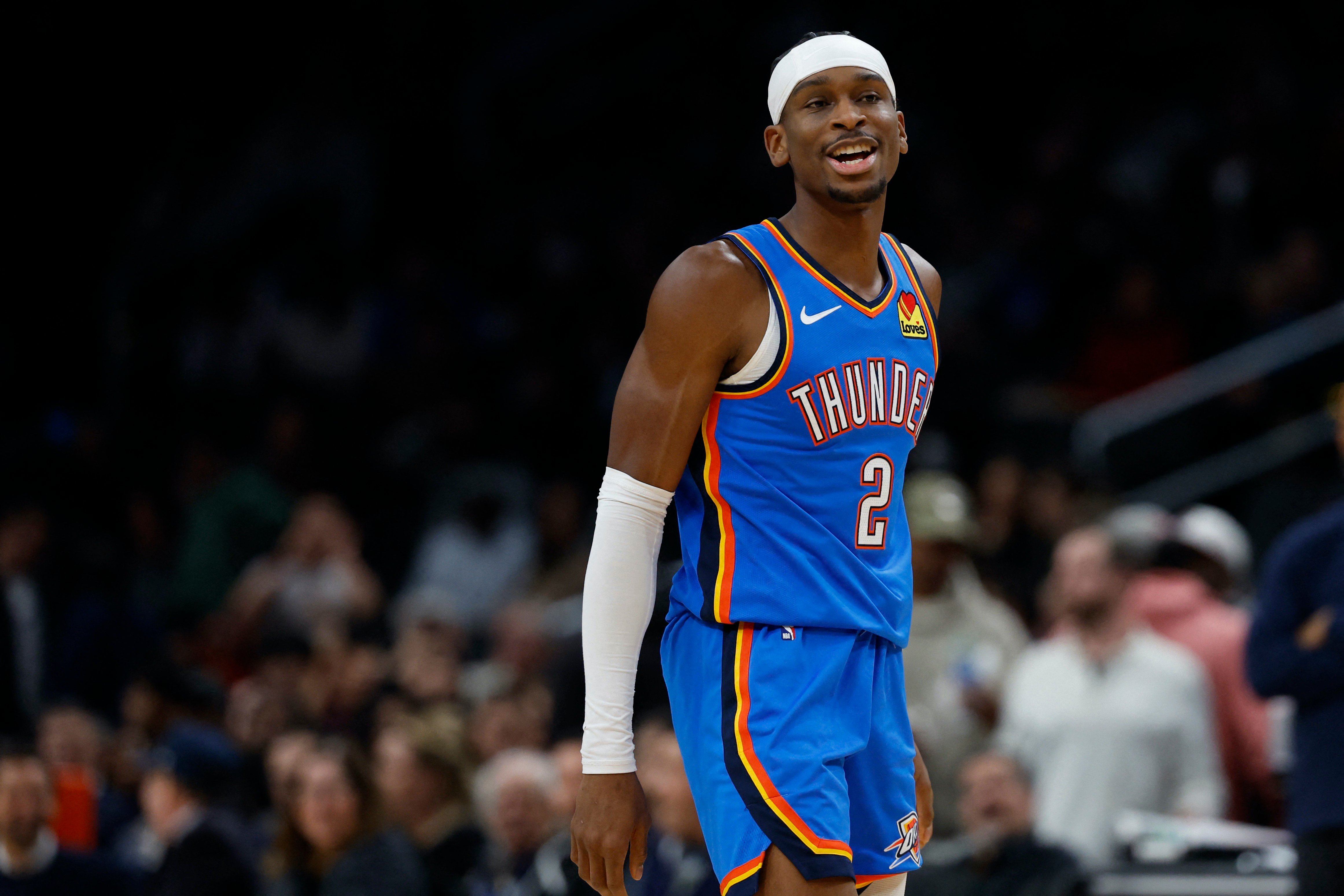
The box score tells a lie that everyone is eager to believe. Shai Gilgeous-Alexander puts up 31 points, the Oklahoma City Thunder beat the San Antonio Spurs, and the media machine cranks out the same tired narrative about "superstar leaps" and "playoff maturity."
They are looking at the wrong numbers. Don't forget to check out our earlier coverage on this related article.
While the general consensus celebrates Oklahoma City’s 2-1 lead as a coming-out party for a new dynasty, they are ignoring the structural decay in how the Thunder actually score. We are witnessing the glorification of a style that is built to thrive in the second round and evaporate in the Conference Finals. If you think SGA’s mid-range masterclass is the blueprint for a ring, you haven't been paying attention to how championship gravity actually works.
The Fraudulence of the Foul Line
The modern NBA fan has been conditioned to see a high free-throw rate as a sign of aggression. It isn't. It’s often a sign of a stagnant offense. If you want more about the background of this, The Athletic offers an in-depth summary.
SGA is the king of the "non-rim" drive. He enters the paint not to finish through contact, but to invite it. Against a young, disciplined Spurs defense, this works. Victor Wembanyama is a generational rim protector, but he is still learning the nuances of verticality. Shai exploits that lack of experience.
But look at the shot profile. When the whistle doesn't blow—which happens with brutal frequency in the later rounds of the postseason—that "efficiency" turns into a liability. A 31-point night on 10-of-22 shooting looks elite until you realize that 11 of those points came from the stripe.
In a slugfest against a veteran team like the Nuggets or the Timberwolves, those phantom whistles disappear. The Thunder are building their entire offensive identity on a foundation of sand. They are betting on the referees’ consistency, a gamble that has historically bankrupted every "foul-merchant" superstar from James Harden to Joel Embiid.
Wembanyama is the Problem Even When He Loses
The narrative coming out of Game 3 is that OKC "solved" the Wemby puzzle. That is a fundamental misunderstanding of spatial geometry.
Wembanyama finished with a stat line that would be a career highlight for most centers, yet he was labeled a bystander in his own arena. The reality? The Spurs lost because their backcourt is a graveyard of talent, not because the Thunder figured out how to negate a 7-foot-4 alien.
The Thunder won because they out-athleted a rebuilding roster. That’s not a tactical victory; it’s a talent gap. When SGA drives, he is seeing lanes that won't exist against a defense with multiple high-IQ rotators. The Spurs rotate like a team that just met in the parking lot.
The "contrarian" truth here is that the Thunder are actually playing worse basketball than they did in the regular season. Their ball movement has slowed. Their pace is erratic. They are becoming a "your turn, my turn" offense centered around SGA and Jalen Williams. It works against San Antonio because the Spurs can't punish the stagnation.
The Myth of the "Young and Fearless"
"They don't know they're supposed to lose yet."
This is the most overused trope in sports broadcasting. It’s lazy. The Thunder know exactly what’s at stake, and you can see it in their shot selection.
In the fourth quarter of Game 3, the Thunder stopped running their high-low sets. They stopped searching for the corner three. They reverted to SGA isolations. While the result was a win, the process was a disaster.
Compare this to the championship-level execution of the 2014 Spurs or the 2017 Warriors. Those teams used their stars to create advantages for the system. The Thunder are using their system to create advantages for one star.
I’ve seen this movie before. I watched the early 2010s Thunder do the exact same thing with Kevin Durant and Russell Westbrook. They were young, they were "fearless," and they were significantly more talented than this current iteration. They never won a title because when the pressure mounted, the system collapsed into hero ball.
SGA is currently the best hero-ball player in the league. That is a compliment that carries a hidden curse.
Defensive Smoke and Mirrors
Oklahoma City’s defense is being praised for its versatility. It’s actually just chaotic.
They gamble on passing lanes. They jump at pump fakes. Against a Spurs team that leads the league in unforced turnovers, this looks like defensive genius. Chet Holmgren is a spectacular recovery defender, but he is currently being asked to cover for four teammates who are consistently out of position.
If you put this defense against a team that doesn't panic—like the Celtics—the Thunder get carved up. The "scrappiness" that the media loves is actually a lack of structural discipline. They are playing with fire, and the Spurs just don't have the flamethrower necessary to burn them yet.
Why You Should Be Selling Thunder Stock
If you are an investor in NBA futures, now is the time to exit your OKC position.
The market is at an all-time high. People are comparing SGA to Jordan because of the mid-range fadeaways. They are calling Chet the "Wemby-stopper." It’s a classic bubble.
The Thunder are a very good team that is beating a very bad playoff team. The Spurs are only in this conversation because Wembanyama is a freak of nature. Take him off that roster, and the Spurs are a 15-win team.
Beating a 15-win team (plus a superstar) in five or six games isn't a statement. It’s a requirement.
The Efficiency Trap
Let's talk about "True Shooting Percentage." It’s the darling of the analytics community, and it’s the primary weapon used to defend SGA’s MVP candidacy.
The problem with TS% is that it treats all points as equal. They aren't.
Points scored in the flow of an offense generate momentum. They tire out the defense. They create "gravity" that opens up shots for teammates. Points scored at the free-throw line during a dead ball do none of those things. They allow the defense to rest. They reset the transition game.
SGA’s efficiency is "sterile." It doesn't make the players around him better in a tangible way. It keeps the score close, and it wins games against mediocre opponents, but it doesn't break the spirit of an elite defense.
To win at the highest level, you need "loud" points. You need the three-pointer that forces a timeout. You need the dunk that causes a defensive scheme to over-rotate. Shai provides "quiet" points. They add up, but they don't transform the game.
Stop Asking if the Thunder are Ready
The question shouldn't be whether the Thunder are ready for the bright lights. They clearly are. They have the ego and the talent.
The question is whether their style is viable.
The history of the NBA is a graveyard of teams that relied on high-volume, mid-range scorers who lived at the free-throw line. From Adrian Dantley to Carmelo Anthony, the archetype is famous for regular-season dominance and second-round exits.
SGA is the modern evolution of that archetype. He is more efficient, he is a better defender, and he has a cooler nickname. But the DNA is the same.
The Thunder are 2-1 because they have more talent than San Antonio. They will likely win this series. And when they do, the media will double down on the "SGA is the New Face of the League" narrative.
Don't buy the hype.
The Spurs are providing a blueprint for how to bother OKC—stay home on the shooters, concede the mid-range, and wait for the whistles to stop. A better team will execute that blueprint to perfection.
The Thunder aren't a dynasty in waiting. They are a high-end experiment in how far one-on-one efficiency can carry a roster with no Plan B.
Watch the tape, not the highlights. The highlights show Shai gliding to the rim. The tape shows four teammates standing still, waiting for a pass that usually isn't coming.
That isn't championship basketball. It's an audition for a scoring title.
(mh=Exx0AwU1qOejun8t)0.jpg)


