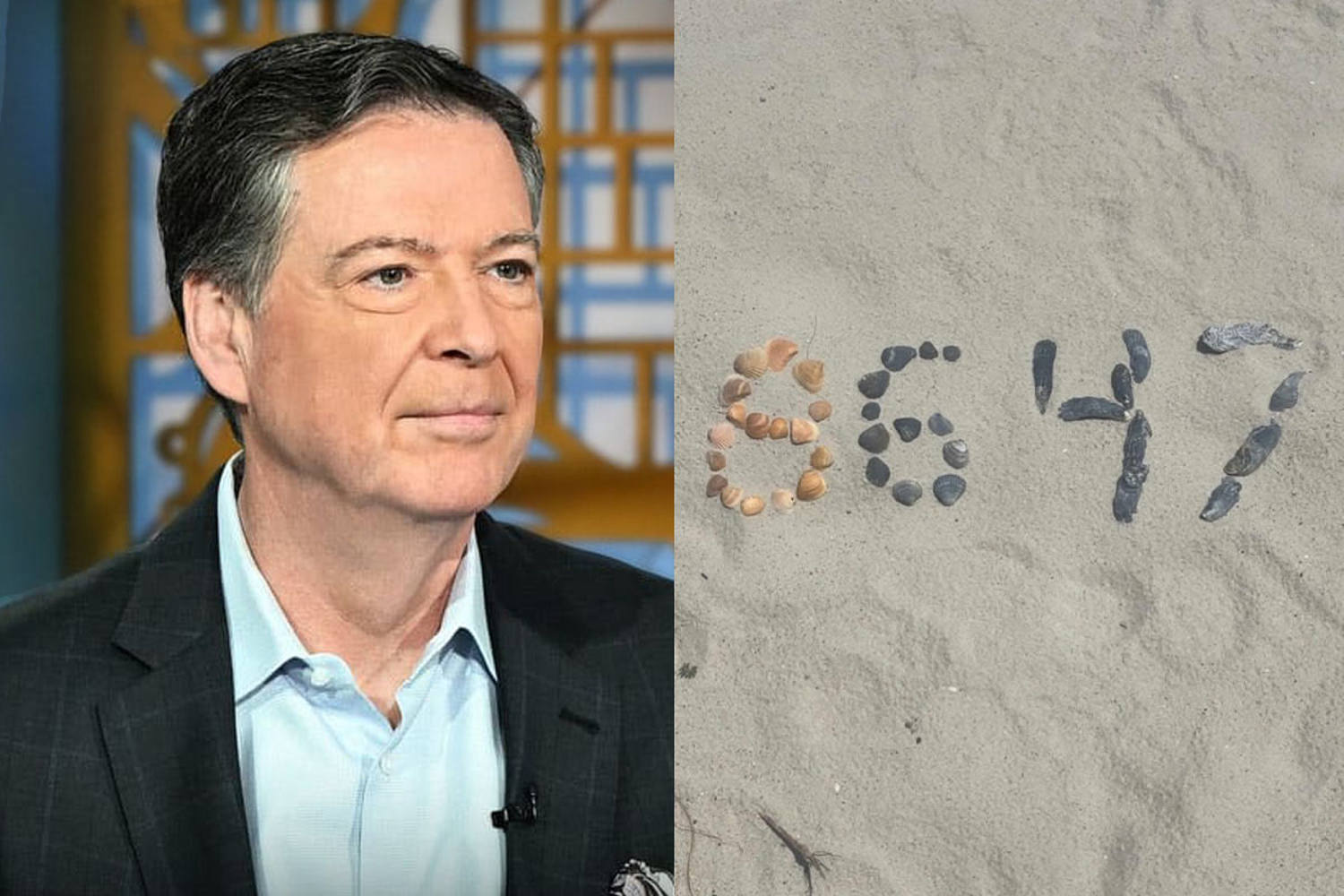
The federal indictment of former FBI Director James Comey represents a dangerous shift in the machinery of American justice. By treating an Instagram photograph of seashells as a criminal threat against the President, the Department of Justice has moved beyond standard law enforcement into the realm of political retribution. This case is not merely about a social media post; it is a test of whether the First Amendment can survive when the executive branch weaponizes the legal system against its most visible critics.
The core of the dispute rests on a photograph Comey shared in May 2025. It featured seashells arranged on a North Carolina beach to spell the numbers "86 47." To the Department of Justice, this was an implicit solicitation of violence against the forty-seventh president. To any reasonable observer of modern political discourse, the numbers are a well-worn shorthand for "eject" or "remove"—a common slogan used by opposition groups throughout the country.
Legal teams often frame these moments as constitutional crises. In this instance, the rhetoric holds weight. The government is attempting to criminalize the interpretation of symbols. If a federal judge allows this prosecution to proceed to trial, the definition of a "true threat" effectively expands to encompass almost any expression of political dissent. The Supreme Court ruling in Watts v. United States established a clear barrier between hyperbolic political speech and illegal threats. By choosing to ignore that distinction, prosecutors have signaled a willingness to use the courts as instruments of intimidation.
This is the second time the current administration has sought to bring charges against Comey. The first attempt, which alleged that the former FBI director misled Congress, ended in ignominy when a federal judge threw out the case after determining the prosecutor responsible for the indictment had been appointed illegally. The recurrence of these charges suggests an institutional obsession that transcends standard legal review. It points toward a pattern of behavior where the Department of Justice functions as an extension of personal grievance rather than an impartial guardian of the law.
The implications for the American public reach far beyond the fate of a former high-ranking official. Consider a hypothetical scenario where a private citizen posts a critique of local government on social media, using aggressive metaphors or symbolic imagery. Under the logic applied in the Comey case, that citizen could theoretically be subject to a federal investigation, potentially leading to surveillance, interrogation, and years of costly legal defense. When the government demonstrates that it is willing to pursue a former FBI chief for an aesthetic choice on Instagram, the implicit message to the public is one of caution and silence.
There is also the matter of the personnel driving these decisions. Acting Attorney General Todd Blanche, who once served as the President’s personal defense lawyer, is under significant pressure to demonstrate loyalty to the administration. The timing of this indictment, arriving in an environment where the Department of Justice is being actively realigned to mirror the President's personal agenda, cannot be viewed as a coincidence. It is an exercise in power intended to signal that no critic, regardless of their background or former status, is immune from state-sanctioned harassment.
The defense filing submitted this week is precise. It avoids getting bogged down in the specific connotations of "86," focusing instead on the absurdity of the criminal charge in the context of protected speech. By highlighting that thousands of items bearing similar slogans are currently sold online and displayed at protests nationwide, Comey’s attorneys are effectively pointing out the government's selective enforcement. Prosecutorial discretion is meant to be used for the pursuit of justice, not for the systematic targeting of political rivals.
If the court permits this case to move forward, it will validate a standard that will be difficult to reverse. The erosion of civil liberties is rarely a sudden collapse; it is an incremental degradation of norms. Each successful prosecution of this nature makes the next one easier to justify.
The motion to dismiss is currently before the court. Its success would signal that the judiciary still maintains a degree of independence from executive overreach. A denial, however, would confirm that the institution is no longer capable of preventing the transformation of the Department of Justice into a mechanism of political silencing. The choice rests with the judge, but the consequences will be felt by every citizen who speaks out against the state.