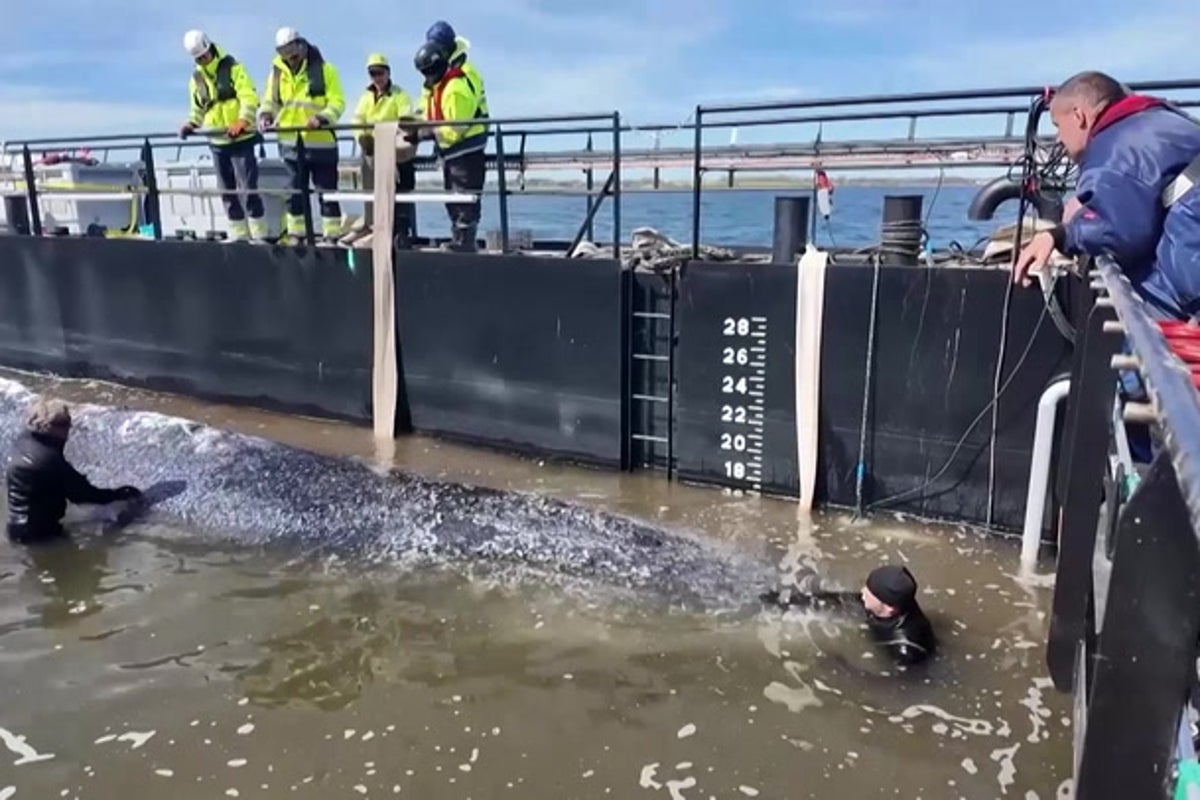
The headlines are predictable. They are dripping with sentimentality and fueled by a collective, misplaced sense of heroism. "Save Timmy!" the crowds scream while pouring buckets of seawater over a dying mammal on a Baltic beach. It makes for a great Instagram story. It’s fantastic for the local tourism board’s PR. But as someone who has spent fifteen years studying marine biology and navigating the cold bureaucracy of conservation funding, I can tell you that this "audacious rescue" is a textbook example of emotional vanity over ecological intelligence.
We are watching a multi-million-dollar theater production where the script is written by people who think nature is a Disney movie. It isn't. Nature is a brutal calculation of energy and outcomes. By attempting to "rescue" a stranded whale in a body of water it was never meant to inhabit, we aren’t being kind. We are being arrogant.
The Baltic Sea is a Death Trap, Not a Sanctuary
The first mistake the public—and the media—makes is treating the Baltic Sea like a generic ocean. It is not. It is a brackish, shallow, busy bathtub. For a large cetacean like a sperm whale or a humpback, entering the Baltic is often a one-way trip to starvation or noise-induced madness.
The salinity levels are wrong. The depth is wrong. The prey density is insufficient for a creature of that scale. When a whale "strands" here, it is rarely an accident. It is usually a symptom of a terminal failure. The whale is likely sick, deafened by industrial shipping noise, or suffering from parasitic infections that have compromised its navigation.
By forcing this animal back into the water, we aren't "giving it a second chance." We are dragging out a painful, inevitable death. We are essentially taking a terminally ill patient out of a hospital bed and throwing them into a marathon they didn't ask to run.
The Massive Opportunity Cost of Sentimentality
Let’s talk about the money. A rescue operation of this magnitude—involving heavy machinery, specialized transport tanks, 24-hour veterinary teams, and international logistics—costs hundreds of thousands, if not millions, of dollars.
Where does that money come from? Usually, it’s diverted from less "photogenic" but vital conservation efforts.
- Eelgrass Restoration: While you're cheering for Timmy, the seagrass meadows that actually sustain the Baltic's oxygen levels and carbon sequestration are dying from lack of funding.
- Pollution Mitigation: The Baltic is one of the most polluted seas on Earth. The runoff from agricultural nitrates is creating massive "dead zones" where nothing survives.
- Sustainable Fisheries: Small-scale fishermen are being squeezed out by industrial trawlers that destroy the seabed.
If you spent that "Timmy" budget on protecting the Baltic’s indigenous porpoise population—the harbor porpoise—you could actually save a species. But harbor porpoises aren't thirty tons. They don't have cute nicknames given to them by local school children. They don't trend on X. So, we let a whole species slide toward extinction while we burn the annual budget on a single, doomed individual.
I’ve seen NGOs burn through their entire reserve fund on a single high-profile stranding because the donors want to see a "save." It’s an ecological shell game. We trade the long-term health of an entire basin for a three-minute segment on the nightly news.
The Physiological Reality of a Stranding
People see a whale on a beach and think "it just needs to get back to the water." They ignore the physics of being a whale.
Whales are designed to be supported by the buoyancy of water. The moment a thirty-ton animal hits the sand, its own weight begins to crush its internal organs. The muscles begin to break down, releasing myoglobin into the bloodstream, which eventually leads to kidney failure. This is called crush syndrome. Even if you get the whale back into the water, it is often a "swimming dead" animal. Its kidneys are already fried. Its lungs are bruised.
Dragging a whale by its tail—which is often the only way to move it—frequently results in spinal damage or internal hemorrhaging. The "rescue" itself is a form of torture. If we were truly compassionate, we wouldn't be reaching for a net. We would be reaching for a sedative and a bolt gun.
Stop Asking "How Do We Save Him?" and Start Asking "Why Is He Here?"
The "People Also Ask" sections for these stories are filled with questions like:
- "How can I help the whale?"
- "Will Timmy be okay?"
- "Can we fly him back to the Atlantic?"
These are the wrong questions. They focus on the individual at the expense of the system. The question we should be asking is: Why are the navigation systems of these giants failing so frequently?
The answer is uncomfortable because it points back to us. It’s not just climate change; it’s the literal roar of our economy. The Baltic is a highway for cargo ships and tankers. The acoustic pollution is deafening. Imagine trying to find your way home through a thick fog while someone blares a stadium-grade speaker directly into your ear. That is what a whale experiences in the Baltic.
If we want to "save" whales, we don't do it on a beach in Germany or Poland. We do it in the boardroom. We do it by mandating quieter propulsion systems. We do it by slowing down shipping lanes. But that's hard. That requires a shift in how we consume and trade. It’s much easier to go to the beach with a bucket and feel like a hero.
The Ethical Failure of "No Kill" Conservation
There is a toxic trend in modern environmentalism that refuses to acknowledge that death is a necessary part of a healthy ecosystem. We have become so sanitized that we view every natural death as a tragedy that must be prevented.
In a healthy ocean, a whale carcass—known as a "whale fall"—is one of the most important biological events. It provides food for thousands of organisms for decades. It cycles nutrients back into the deep sea. By "saving" a stranded whale and then potentially euthanizing it or having it die in a tank, we are stealing that nutrient load from the ecosystem.
We are so obsessed with the "life" of this one animal that we ignore the "lives" of the thousands of scavengers and microorganisms that are being robbed of their natural bounty. It’s a human-centric view of the ocean that has no basis in actual biology.
The Better Way Forward
If you find yourself on a beach looking at a stranded giant, here is the brutal reality:
- Acknowledge the end: Most strandings are terminal. Accept it.
- Focus on Data: Instead of a "rescue," we should be performing high-fidelity diagnostics to understand exactly what went wrong. Is it mid-frequency active sonar? Is it a new pathogen?
- Invest in the Boring Stuff: Take the money you would have donated to the "Save Timmy Fund" and give it to an organization working on nitrogen runoff or ship noise regulation. It’s not flashy. You won't get a sticker. But you will actually be saving whales.
We have to stop treating the ocean like a petting zoo where we get to decide who lives and who dies based on how "sad" we feel. Our empathy is being weaponized against the very environments we claim to love.
The most courageous thing we could do for Timmy isn't to drag him back into a sea that's trying to kill him. It’s to let him go, and then fix the world that drove him onto the sand in the first place.
Stop pouring water on the whale and start looking at the maps. The rescue isn't happening on the beach. It's failing there.