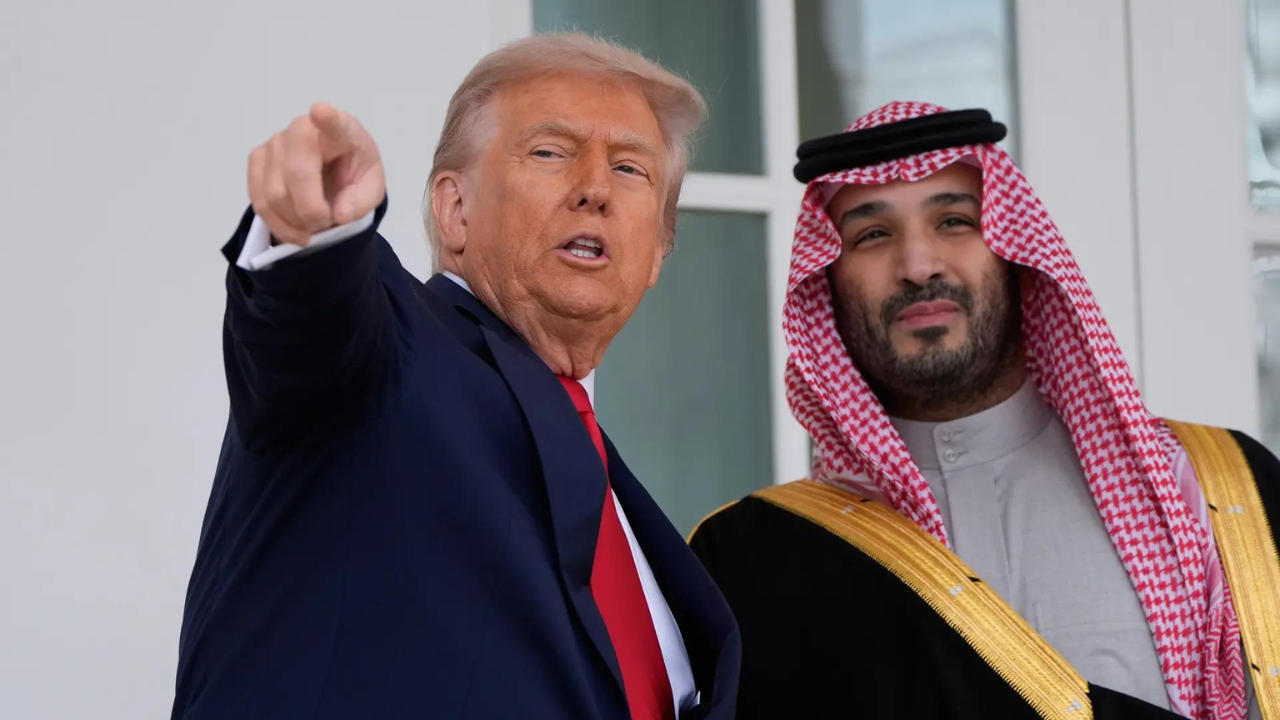
The idea that Saudi Arabia is some puppeteer pulling Donald Trump’s strings to force a war with Iran isn't just lazy journalism. It’s a fundamental misunderstanding of how power, oil, and survival work in the 21st century.
Most "insider" reports claim Crown Prince Mohammed bin Salman (MBS) is desperate for the U.S. to glass Tehran. They paint a picture of a desert kingdom whispering in the ear of a populist president, hoping to use American boots to settle a sectarian grudge. It’s a neat, cinematic story. It also happens to be dead wrong.
I’ve sat in rooms where these regional dynamics are dissected by people who actually have skin in the game, not just a deadline and a Twitter feed. The reality is far more clinical, far more cynical, and infinitely more interesting than a simple "please fight my war" request.
The Myth of the Saudi Warmonger
If you think MBS wants a hot war with Iran, you haven’t looked at the Saudi balance sheet lately.
The Kingdom is currently attempting the most ambitious economic pivot in human history: Vision 2030. You don't build NEOM, host the World Cup, and try to turn Riyadh into a global tech hub by starting a regional conflagration that would see Iranian missiles raining down on your desalination plants and refineries.
The "lazy consensus" says Riyadh wants the U.S. to take out the Ayatollah. The nuanced truth? Riyadh wants Iran contained, not exploded. A collapsed Iran creates a power vacuum that breeds the kind of chaos—ISIS 2.0 or worse—that threatens the very stability the House of Saud needs to sell its IPOs and attract foreign investment.
Trump is Nobody’s Proxy
The second great delusion is that Trump is a malleable tool of the Gulf.
Those who push the "MBS is calling the shots" narrative ignore Trump’s most consistent, lifelong foreign policy instinct: he hates paying for other people's security. He isn't interested in being the Kingdom’s private security guard unless the invoice is paid in full and the "America First" optics are bulletproof.
Trump doesn't take orders; he makes deals. If he’s leaning into a hardline stance on Iran, it’s because he views it as a "maximum pressure" lever to force a new nuclear agreement that he can slap his name on. It isn't about Saudi grievances. It’s about the art of the squeeze.
The Petrodollar is the Real General
To understand why the U.S. and Saudi Arabia are locked in this dance, stop looking at the religious maps and start looking at the currency charts.
The relationship isn't built on shared values or a mutual love of golf. It’s built on the recycling of petrodollars. When Saudi Arabia sells oil in U.S. dollars and then reinvests those dollars back into U.S. Treasuries and weapons contracts, it provides a massive, invisible subsidy to the American lifestyle.
If the U.S. walks away from the Middle East, or if the region becomes so unstable that oil stops flowing, that feedback loop breaks. That’s the real "war" everyone is afraid of—an economic one.
Misconception: Sectarianism Drives Policy
People love to talk about the Sunni-Shia divide as if it’s 16th-century Europe.
Modern geopolitics is about logistics.
Saudi Arabia’s primary concern isn't what's happening in the mosques of Qom; it’s what's happening at the Bab el-Mandeb strait and the Strait of Hormuz. Iran’s ability to choke off global trade is the only reason Saudi Arabia cares about Iran’s military capabilities.
If the U.S. keeps Iran "alive" as a threat, it gives the U.S. a permanent excuse to keep a massive military footprint in the region. This is the paradox: the "threat" of Iran is actually a stabilizing force for the U.S.-Saudi alliance. Without a common enemy, the reason for the U.S. to provide a security umbrella for Riyadh evaporates.
The Cost of Being Right
The contrarian take here has a downside: it means there is no "solution" to the Iran-Saudi tension.
If you're looking for a peaceful, democratic Middle East where everyone shakes hands, you’re looking for a fantasy. The "tension" is the feature, not the bug. It maintains the status quo. It keeps the oil flowing. It keeps the weapons orders coming in.
Imagine a scenario where the U.S. actually did "solve" the Iran problem.
- The threat vanishes.
- The U.S. pulls its carrier groups out of the Persian Gulf.
- Saudi Arabia, now without a protector, has to drastically increase its own military spending, potentially bankrupting Vision 2030.
- Without the U.S. presence, China or Russia steps in to fill the void.
Riyadh knows this. Washington knows this. The only people who don't seem to know this are the pundits writing about MBS "urging" Trump into a war.
Why the Media Gets it Wrong
Most journalists look at foreign policy through the lens of "personality." They focus on the bromance between Trump and MBS or the personal animosity toward Tehran.
This is amateur hour.
States don't have friends; they have interests. MBS doesn't "like" Trump any more than Trump "likes" any other foreign leader. They are two CEOs of massive, nuclear-adjacent corporations trying to maximize shareholder value.
The media focuses on the theater—the gold medals, the glowing orbs, the sword dances—because the reality of sovereign debt and energy logistics is boring. But the "boring" stuff is what actually moves the tanks.
Stop Asking if We’re Going to War
The question "Is Saudi Arabia calling the shots for a war with Iran?" is the wrong question. It assumes a level of Saudi control that doesn't exist and a level of American stupidity that is overstated.
The real question you should be asking is: "How much is the U.S. willing to pay to ensure Saudi Arabia doesn't pivot its oil sales to the Chinese Yuan?"
That is the $30 trillion question. Iran is just the convenient backdrop for that negotiation.
If you want to understand the next four years of Middle East policy, ignore the headlines about "secret reports" and "urging war." Follow the money. Follow the oil. Everything else is just noise designed to keep you from noticing who is actually holding the bill.
The Kingdom isn't looking for a war. It’s looking for a hedge. And Trump isn't looking for a fight. He’s looking for a win.
Go back to your maps and your history books, because the current analysis is failing you. The status quo isn't being disrupted; it’s being reinforced by the very tension everyone claims to fear.
Stop waiting for the explosion. It’s bad for business.