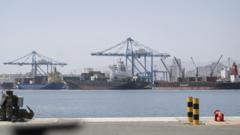
The air in the Persian Gulf doesn’t just hang; it clings. It is a thick, saline shroud that smells of sulfur and old diesel, a humidity so dense it feels like breathing through a wet wool blanket. Out here, miles from the shimmering glass towers of Dubai, the horizon is a flat, deceptive line where the gray sea meets a hazy sky. This is the Strait of Hormuz. It is the world’s jugular vein.
On a Tuesday afternoon, that vein began to pulse with a feverish heat.
Imagine a deckhand on a commercial tanker—let’s call him Elias. He is thirty-four, thousands of miles from his home in Manila, leaning against a rusted railing and thinking about nothing more than the cold soda waiting for him in the galley. To Elias, the "geopolitics of energy" is a phrase for people in suits. To him, the reality is the vibration of the massive engines beneath his boots and the knowledge that twenty percent of the world’s petroleum is currently floating right under his feet.
Then, the silence of the afternoon broke.
It started as a low whine, a high-pitched mechanical scream that cut through the rhythmic chugging of the tanker. Then came the wakes. Dozens of them. Iranian fast boats—small, nimble, and terrifyingly quick—tore across the water like hornets. They didn't just pass; they swarmed.
The Anatomy of a Skirmish
The technical term for this is "asymmetric warfare." It sounds clinical. It sounds like something you’d discuss over coffee in a Washington D.C. think tank. But as those Boghammar patrol boats circled the UAE-flagged oil facility, the technicalities evaporated. In their place was the raw, jagged edge of a confrontation that has been simmering for decades.
These boats are not warships in the traditional sense. They are the tactical equivalent of a street fighter’s switchblade. While a U.S. destroyer is a massive, multi-billion-dollar shield of Aegis radar and vertical launch systems, these Iranian vessels are built for chaos. They are fiberglass hulls packed with high-output outboard motors and heavy machine guns. They rely on the "swarm" logic—overwhelmed sensors, confused targets, and the sheer audacity of speed.
When the Iranian forces began their approach toward the UAE oil facility, they weren't just targeting steel and pipes. They were targeting the global psyche. Every barrel of crude oil that sits in those offshore terminals represents a link in a chain that powers your commute, cools your home, and dictates the price of the bread on your table.
The U.S. Navy’s response was not a choice; it was a reflex.
Fire in the Water
The transmission crackled over the emergency frequencies, a series of warnings delivered in the flat, monotone voice of a professional who knows exactly how close the world is to a catastrophe. The U.S. patrol ships moved to intercept. When the fast boats ignored the radio calls and the flares, the air changed. The "thud-thud-thud" of warning shots into the water created localized geysers, white plumes of foam that stood in stark contrast to the dark, oily blue of the Gulf.
The Iranians didn't blink.
In a moment that lasted seconds but will be analyzed for years, the U.S. forces transitioned from "deterrence" to "engagement." It is a heavy word. It means the safety is off. It means the calculus of human life has shifted. The U.S. strikes were surgical—targeting the lead vessels to break the momentum of the swarm.
Smoke began to rise, a black smudge on the horizon that looked, from a distance, like a smudge of charcoal on a painting. For Elias on his tanker, the soda was forgotten. The world had shrunk down to the sight of fire on the water.
The Invisible Stakes
Why does this happen? Why here, and why now?
To understand the spark, you have to understand the pressure cooker. For Iran, these maneuvers are a form of "kinetic diplomacy." When sanctions bite or diplomatic channels clog, they use the Strait of Hormuz as a pressure valve. They remind the world that they hold the key to the gas station. It is a dangerous game of chicken played with live ammunition.
The UAE oil facility represents the intersection of ancient rivalries and modern necessities. The United Arab Emirates has spent decades positioning itself as a stable hub of global commerce, a bridge between East and West. By attacking their infrastructure, Iran isn't just striking a neighbor; they are poking a hole in the fabric of regional stability.
Consider the ripple effect. Within minutes of the first shots being fired, the digital nerves of the world’s financial markets began to twitch. In London, New York, and Tokyo, algorithms picked up the news. The price of Brent Crude didn't just rise; it spiked. It is a ghost-like process where a fire in the Gulf translates into a three-cent increase at a pump in suburban Ohio by the following morning.
The Human Cost of High Policy
We often speak of these events in terms of "assets" and "targets." We talk about the "U.S. Fifth Fleet" or "Revolutionary Guard Corps." But these entities are made of people.
On the Iranian fast boats, there are young men, barely out of their teens, gripped by a cocktail of nationalist fervor and the adrenaline of high-speed combat. On the U.S. ships, there are sailors from places like Nebraska and Oregon, staring at green radar screens and making split-second decisions that could ignite a regional war.
The tragedy of the "fast boat" strategy is its intimacy. Unlike a long-range missile strike launched from a thousand miles away, this is eye-to-eye combat. You can see the pilot of the other boat. You can see the color of his life jacket. It makes the violence personal. It makes the margin for error razor-thin.
The U.S. strikes were designed to be a "proportional response." That is another one of those phrases that masks the reality of metal tearing through fiberglass. The goal was to stop the attack without escalating into a full-scale invasion. It is the geopolitical equivalent of a surgeon trying to remove a tumor with a broadsword.
The Quiet After the Storm
By nightfall, the fast boats had retreated to the safety of the Iranian coastline. The U.S. ships remained on station, their silhouettes dark against the moonlit water, like silent sentinels guarding a fragile peace.
The UAE facility stood, its lights flickering in the dark, still pumping the lifeblood of the global economy. The damage was physical, but it was also psychological. The "safe" waters of the Gulf had been proven, once again, to be a theater of the unpredictable.
Elias eventually got his soda. He sat on a hatch cover and watched the stars. He knew that tomorrow the tanker would continue its journey. He knew that the world would read the headlines and then move on to the next crisis, the next celebrity scandal, the next political tweet.
But the smell of the smoke lingered.
The salt in the air now carried the metallic tang of spent cordite. We live in a world that assumes the lights will always turn on and the ships will always arrive. We treat the stability of the global energy market as a law of nature, like gravity or the tides. It isn't. It is a precarious, man-made construct, held together by the restraint of teenagers on fast boats and the vigilance of sailors in a humid, sulfurous sea.
The fire is out for now. But the water is still warm. And in the dark of the Persian Gulf, the hum of the engines never truly stops.
The ocean has a way of swallowing the evidence of a battle, smoothed over by the endless, rolling waves, leaving nothing behind but the uneasy silence of a world waiting for the next spark to catch.