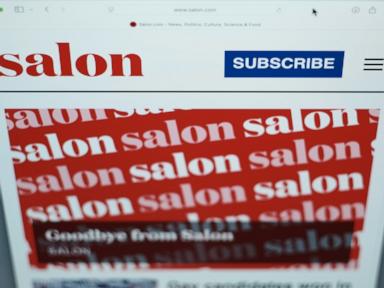
Every time a legacy digital media brand turns off the lights, the obituary writes itself. Pundits pour one out for the golden age of the internet, blame the algorithmic stranglehold of Google and Meta, and lament the death of independent journalism.
It is a comforting lie. It absolves executives of terrible business decisions and writers of producing content nobody actually wanted to read.
The shuttering of Salon—once an indispensable titan of early web discourse—is being mourned with the exact same predictable script. Media critics are framing it as a tragedy of the modern attention economy, a noble casualty of changing search habits and programmatic ad decay. They are missing the forest for the trees. Salon didn't get murdered by Silicon Valley. It committed slow-motion financial and editorial suicide over two decades by trading sharp, iconoclastic journalism for predictable outrage farming, all while clinging to a broken monetization model that punished its remaining loyal readers.
If you want to understand why digital media outlets keep collapsing, stop looking at the tech monopolies. Look at the product.
The Myth of the Golden Age Martyr
Launched in 1995 by former San Francisco Examiner journalists led by David Talbot, Salon genuinely broke new ground. In an era when legacy newspapers treated the web as a dumping ground for print shovelware, Salon understood that the internet required a different voice. It was smart, literary, irreverent, and fearless. It broke major stories, published brilliant cultural criticism, and proved that an online-only publication could command national respect.
Then came the survival panic.
When the dot-com bubble burst and the economic realities of digital publishing set in, Salon faced a choice that every digital native outlet eventually confronts. It could stay small, lean, and fiercely loyal to a high-value niche audience, or it could chase scale at all costs.
It chose scale. And scale requires volume. Volume requires speed. Speed kills quality.
I have watched dozens of media companies burn through tens of millions of dollars chasing the same mirage. Executives stare at traffic charts like slot machines, convinced that if they just publish thirty more posts a day, the programmatic ad revenue will finally cover the payroll. What actually happens is brand dilution. When you flood your homepage with aggregated hot takes to capture fleeting social clicks, you train your core audience to stop taking you seriously. You stop being a destination and become a commodity.
By the mid-2010s, Salon had largely abandoned the nuanced, contrarian edge that made it famous. Instead, it leaned heavily into hyper-partisan, predictable political commentary. The headlines became formulaic. The arguments became circular. If you knew the topic of a Salon piece before clicking, you already knew the exact conclusion the writer would reach.
In media, predictability is fatal. Readers do not pay for—or even tolerate ads for—an echo chamber they can get for free on social media in thirty seconds.
The Programmatic Death Spiral
To understand the mechanics of Salon’s collapse, you have to understand the specific poison of programmatic advertising.
Programmatic advertising—the automated buying and selling of online ad space via real-time bidding—promised publishers effortless monetization. Instead, it created a race to the bottom. Because advertisers could track users across the entire web using third-party cookies, they no longer needed to pay a premium to advertise on a prestigious publication like Salon. Why pay a thirty-dollar CPM (cost per thousand impressions) to reach a Salon reader on Salon.com when you could follow that exact same person to a cheap weather site or a gaming forum and buy their attention for two dollars?
Rather than recognizing that programmatic ads were destroying the value of their inventory, Salon doubled down on the volume needed to make pennies per click add up.
The user experience became actively hostile. Pages groaned under the weight of auto-playing videos, pop-up overlays, and sluggish ad trackers that drained laptop batteries and froze mobile browsers. You didn't read a Salon article; you fought your way through an obstacle course of junk ads just to get to the third paragraph.
Imagine a scenario where a high-end restaurant realizes its profit margins are shrinking, so the owners decide to blast strobe lights in the dining room, play loud commercials over the speakers between bites, and water down the wine to save on costs. When the regulars stop coming, the owners blame the invention of food delivery apps. That is the exact logic of the ad-supported digital media executive.
Why "Pivot to Subscriptions" Usually Fails
When the programmatic well inevitably dried up—accelerated by privacy changes, ad blockers, and platforms keeping users inside their own walled gardens—publishers scrambled for the lifeboat of reader revenue. Subscriptions and memberships became the new gospel.
Yet most legacy digital brands failed to make the leap, and Salon’s struggles with its membership tiers illustrate why. You cannot spend fifteen years training your audience that your content is free, disposable, and optimized for rage-clicks, and then suddenly ask them to pull out a credit card out of charity.
Successful subscription businesses—look at the New York Times, the Financial Times, or individual powerhouses on Substack—are built on clear utility or singular authority. People pay for:
- Actionable intelligence that helps them make money or do their jobs better (e.g., Bloomberg, The Information).
- Exclusive, deeply reported journalism you literally cannot find anywhere else.
- Distinct, idiosyncratic voices that challenge the reader's assumptions rather than flattering their biases.
A general-interest political and cultural blog offering repurposed news and predictable partisan takes possesses none of these traits. Asking readers to fund "independent journalism" as a moral duty is a terrible business strategy. Guilt is not a recurring revenue model. Value is.
What Everyone Gets Wrong About the Digital Media Collapse
When news of Salon's shutdown broke, the usual questions surfaced across industry newsletters and search engines. People want to know if independent online journalism is dead, or if AI and search algorithm updates have made running a digital publication impossible.
Both questions are built on a flawed premise. Independent online journalism isn't dead; bloated, middle-management-heavy, ad-dependent media companies are dead.
Look at the actual data of the creator economy and independent publishing right now. Thousands of independent writers, investigative reporters, and niche analysts are making six and seven figures running lean operations with zero venture capital and zero programmatic ads. Outlets like 404 Media, Defector, and Puck proved that small teams of journalists who own their audience relationships can build profitable, sustainable businesses without chasing a hundred million monthly pageviews.
The collapse of older digital brands isn't proof that people stopped reading. It is proof that people stopped tolerating bad business models.
The Uncomfortable Truth About Audience Capture
There is a massive downside to the contrarian, reader-funded model that modern publishers rarely admit: it is terrifyingly unforgiving.
When you rely on programmatic ads, you can hide behind aggregate traffic numbers. One viral rage-bait post can mask the fact that nobody cares about the other forty articles you published that week. When you rely directly on paying subscribers, there is nowhere to hide. Every single piece has to justify its existence. If you bore your audience, churn spikes immediately. If you pander to them too obviously, they feel patronized and cancel.
Furthermore, stepping off the traffic treadmill means accepting a drastically smaller cultural footprint. You will not be the talk of the entire internet every day. You have to trade the ego boost of massive vanity metrics for the quiet reality of unit economics. Most legacy media executives—and frankly, many journalists—are addicted to the vanity metrics. They would rather preside over a sinking ship with ten million monthly visitors than captain a profitable speedboat with fifty thousand paying subscribers.
How Media Companies Survive What Comes Next
If you are building a publication, a content brand, or a digital media business today, Salon's demise is a masterclass in what to avoid. Survival requires tearing up the old digital playbook completely.
- Kill the ad-tech bloat immediately. If your website takes more than two seconds to load because of third-party ad scripts, you are actively telling your audience you do not respect their time. Strip the site down to bare metal. Speed is a feature.
- Stop competing with free. Never publish a story that can be summarized in a two-sentence social media post or answered instantly by a search engine. If a piece doesn't contain original reporting, proprietary data, or a genuinely counter-intuitive argument, don't publish it.
- Own the distribution. Stop building your house on rented land. Social media algorithms are designed to keep users on the platform, not to send you free traffic. Use social platforms strictly as a funnel to capture email addresses. An email list is the only asset a tech giant cannot throttle overnight.
- Price for conviction, not volume. Stop trying to get a million people to give you a dollar. Find ten thousand people who view your work as indispensable and charge them a hundred dollars a year. Build for the die-hards, not the tourists.
Salon had a historic head start on the internet. It had the talent, the brand recognition, and the cultural cachet to define online journalism for a century. It squandered that advantage by mistaking clicks for loyalty and outrage for influence.
The internet didn't kill Salon. Salon just forgot to give people a reason to care.