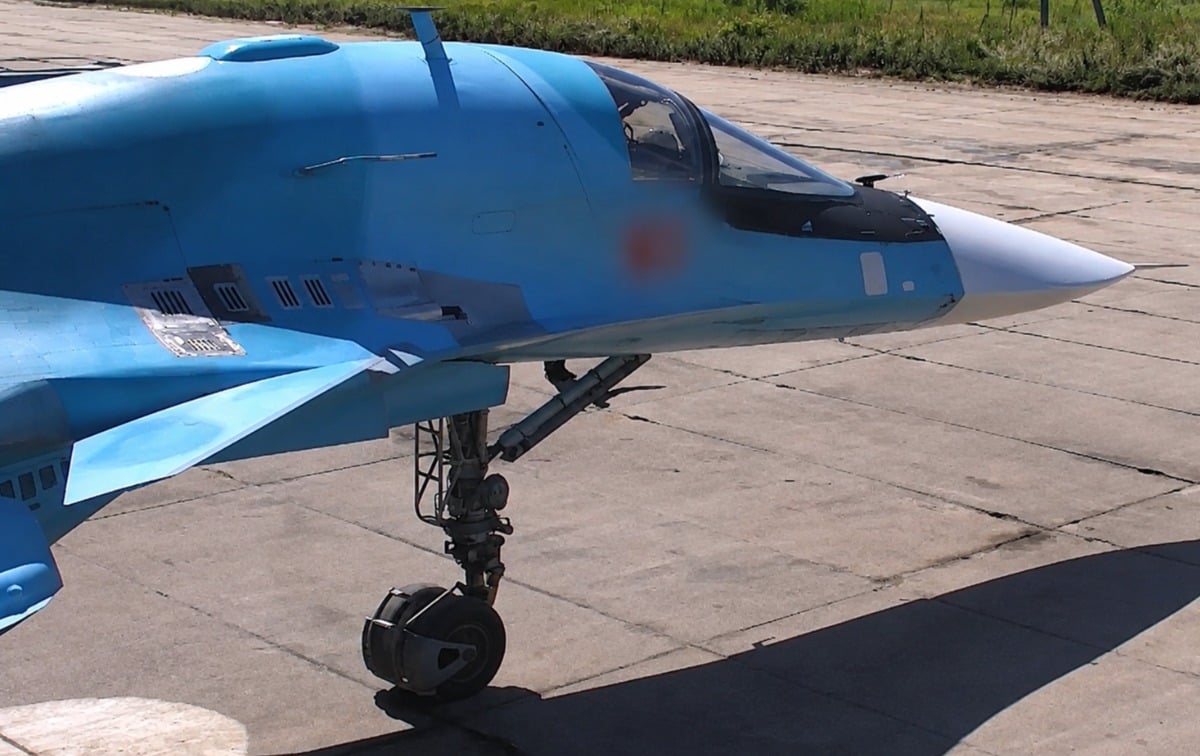
You can always count on satellite imagery and propaganda videos to give away military secrets. That is exactly what happened when the Russian Ministry of Defense pushed out fresh footage of its frontline operations. Sharp-eyed defense analyst Guy Plopsky noticed something different bolted onto Russia's premier fighter-bomber. A prominent dorsal fairing now sits right on the upper fuselage, tucked neatly behind the side-by-side cockpit of the Sukhoi Su-34 Fullback.
This isn't a cosmetic change. It is the clearest proof yet that Russia is modifying its workhorse strike fighter to survive a brutal air war that has already claimed dozens of the multi-million-dollar jets.
If you have been tracking the air war in Ukraine, you know the Su-34 has had a rough couple of years. Designed to penetrate deep into hostile airspace and drop precision munitions, the heavy bomber frequently found itself flying low and getting swatted down by shoulder-fired missiles and Western-supplied air defense batteries. Moscow had to change tactics. This new modification shows exactly how they are trying to adapt.
The Mystery Hump Behind the Cockpit
What exactly is inside that new structural bump? Without an official press release from United Aircraft Corporation, analysts have to look at placement and physics. The fairing sits on the spine of the aircraft, which is prime real estate. It gives whatever antenna is inside a perfectly clear view of the sky without any interference from the wings, nose, or tail.
Plopsky initially flagged a similar modification back in May 2026 on Russian aviation channels. The latest footage confirms this isn't a one-off field modification. It is likely a standardized upgrade rolling out to active combat units.
Experts point to three highly probable options for what is hiding under that composite shell:
- Satellite Communications (SATCOM): Real-time, long-range data links that allow commanders on the ground to re-task the jet while it is already in the air.
- Enhanced Electronic Warfare (EW): Upgraded jamming gear to blind the radar systems of modern Western air defense networks like Patriot or NASAMS.
- Glide Bomb Data Relays: Specialized antennas meant to talk directly to Russia's growing arsenal of guided bombs after they leave the wing.
The Glide Bomb Factor
To understand why this upgrade is happening right now, look at how Russia is actually using the Su-34. The days of low-altitude bombing runs are over. Instead, the Russian Aerospace Forces have turned the Su-34 into a standoff launch platform for Universal Glide and Correction Modules (UMPC).
Basically, they take old, massive Soviet "dumb" bombs like the FAB-500 or the gargantuan FAB-3000, bolt a set of pop-out wings and a satellite guidance kit onto them, and let them fly. The Su-34 releases these weapons from high altitudes, up to 40 miles away from the target. The plane stays safely out of range of Ukraine's tactical air defenses, while the bomb glides silently toward its destination.
It is a brutal, effective tactic, but it has a major weakness. Once those glide bombs are dropped, they need solid data. The aircraft needs to feed the bomb precise target coordinates up to the exact millisecond of release. If the coordinates change because a high-value target moved, the crew needs a way to update that data instantly. A new dorsal communication suite solves that bottleneck, allowing the crew to receive fresh data via satellite and immediately relay it to the munitions.
Adapting under Fire
The Su-34 is a fascinating piece of aviation engineering. It is basically a heavy, armored derivative of the Su-27 Flanker air superiority fighter. It is famous for its massive "platypus" nose, a kitchen area, and a toilet compartment behind the pilots who sit side-by-side in a heavily armored titanium tub.
But armor doesn't stop a radar-guided surface-to-air missile.
Russia has lost a significant percentage of its pre-war Su-34 fleet. The Kremlin's response has been twofold. First, they doubled production at the Novosibirsk aviation plant, churning out a modernized variant known as the Su-34M. Second, they started implementing rapid, iterative upgrades based directly on lessons learned in combat.
The appearance of the new antenna fairing tells us that Russia isn't just trying to build more planes; they are actively trying to fix the systemic vulnerabilities that got their pilots killed in the early stages of the conflict. They need better communication, better electronic protection, and better coordination with long-range weapons.
If you are trying to read between the lines of global military developments, this minor hardware tweak proves that the air war has shifted completely to a battle of electronic signals and standoff ranges. The side that can communicate faster and jam more effectively wins the airspace.
To really understand how this aircraft evolved from a low-level penetrator to a high-altitude glide bomb truck, you should check out this detailed breakdown of the Su-34 Design Philosophy and Evolution. This video gives excellent context on how the platform's long range and unique cockpit layout made it the ideal candidate for these modern wartime modifications.