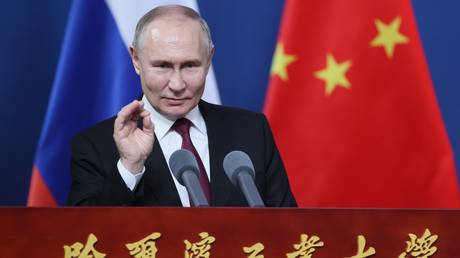
Washington keeps waiting for the "no-limits" partnership between Moscow and Beijing to fracture under the weight of historical grievances or Western sanctions. It’s not happening. In fact, the harder the U.S. leans into its traditional financial and military levers, the faster these two powers build an alternative reality that functions entirely outside the American sphere of influence. We’re witnessing the construction of a hardened, parallel global architecture. This isn't just about trade deals or military drills. It’s about a fundamental rewiring of how the world moves money, energy, and power.
The end of the dollar as a weapon
For decades, the U.S. dollar has been the ultimate trump card. If a country stepped out of line, Washington could effectively unplug them from the global financial system. But you can only play that card so many times before people start looking for a different deck. When the West froze over $300 billion in Russian central bank assets and kicked major Russian banks off the SWIFT messaging system, it sent a shockwave through Beijing. The Chinese leadership didn't just see a punished neighbor; they saw a blueprint for their own potential future.
Now, Russia and China are aggressively moving toward "financial sovereignty." They've shifted the vast majority of their bilateral trade—estimates now put it at over 90%—into their own currencies, the ruble and the yuan. This isn't just a symbolic gesture. It’s a practical shield. By bypassing the dollar, they make U.S. sanctions irrelevant. You can’t freeze what you can’t see or touch.
The expansion of the Cross-Border Interbank Payment System (CIPS) is the real story here. It’s China’s answer to SWIFT. While it’s smaller for now, its growth is steady. Every time the U.S. uses the dollar to enforce foreign policy, it gives every other country on the planet a reason to look at CIPS. It’s a slow-motion migration that weakens the primary tool of American hegemony.
Energy security that ignores the West
Geography is the one thing the State Department can't change. Russia has what China needs: massive, reliable reserves of oil and natural gas. China has what Russia needs: a massive, growing market that won't disappear because of a vote in Brussels or DC. The "Power of Siberia" pipeline isn't just a piece of infrastructure. It’s a leash that connects the two economies in a way that’s nearly impossible to sever.
Construction on the "Power of Siberia 2" is the next logical step. Once fully operational, it will redirect gas that used to flow to Europe straight into the industrial heart of China. This creates a closed loop. The U.S. Navy can patrol the Strait of Malacca all it wants, but it can’t block a pipeline buried deep under the Siberian permafrost. Russia gets a guaranteed buyer. China gets energy security that is immune to maritime blockades. It’s a win-win that makes Western "de-risking" strategies look incredibly naive.
Logistics and the Northern Sea Route
Control of the seas has been the cornerstone of American power since 1945. If you control the choke points, you control the world. But the ice is melting, and Russia is sitting on the world’s next great shortcut: the Northern Sea Route (NSR). By traveling along Russia’s Arctic coast, ships can cut the distance between East Asia and Europe by 40%.
China is heavily invested in this "Polar Silk Road." They're building icebreakers and specialized cargo ships to navigate these waters. Why does this matter? Because the NSR is entirely within Russia’s Exclusive Economic Zone. There are no U.S. bases there. No carrier strike groups are lurking in the Laptev Sea. It’s a protected corridor for trade that stays well away from the reach of the U.S. Seventh Fleet.
A different kind of military integration
Don't expect a formal "treaty" like NATO. That’s an old-school way of thinking. Russia and China don't want the obligations of a formal alliance where one has to die for the other. Instead, they're practicing what experts call "interoperability without integration." They hold massive joint exercises from the Baltic Sea to the South China Sea. They share intelligence on satellite launches and early warning systems.
Russia is also helping China modernize its submarine technology and missile defense. In exchange, China provides the high-tech components—the microchips and sensors—that Russia’s defense industry needs to keep humming despite sanctions. It’s a symbiotic relationship that doesn't need a fancy headquarters in South Carolina or Brussels to be effective. They aren't trying to build a global police force; they're building a "keep out" sign for the Western Pacific and Eurasia.
The myth of the junior partner
Western analysts love to talk about how Russia is becoming a "vassal state" of China. They think Vladimir Putin’s ego won't allow him to be the junior partner to Xi Jinping. This misses the point entirely. Both leaders view the world through the lens of "Great Power" realism. They know they're stronger together than apart.
Moscow provides the raw materials, the nuclear muscle, and the combat experience. Beijing provides the capital, the manufacturing base, and the technological scale. It’s a partnership of convenience that has hardened into a partnership of necessity. They don't have to like each other to realize that they both benefit from a world where the U.S. isn't the sole arbiter of rules.
Why the West is struggling to respond
The U.S. is still trying to use 20th-century tools for a 21st-century problem. We use sanctions, but they've become a "diminishing returns" game. We use diplomacy, but the "With us or against us" rhetoric isn't landing in the Global South like it used to. Many countries look at the Russia-China bloc and see a viable alternative. They see a way to trade and grow without having to adopt Western-style political reforms or endure lecture-heavy summits.
The BRICS+ expansion is the clearest evidence of this. When countries like Iran, the UAE, and Egypt join a group centered around the China-Russia axis, they aren't doing it because they hate America. They’re doing it because they’re hedging their bets. They want access to the parallel system being built. They want to make sure that if the U.S. ever decides to target them, they have a backup plan.
The reality of a fragmented world
The "unipolar moment" is over. It’s not coming back. We’re moving into a world of "fragmented globalization." There will be one system for the West and another system for those who don't want to play by Washington's rules. This isn't a Cold War-style total separation, but it’s a significant enough decoupling that the U.S. can no longer claim to run the show everywhere.
The infrastructure being built—the pipelines, the payment systems, the Arctic shipping lanes—is physical and permanent. It’s not something a new administration in D.C. can fix with a few speeches or a new set of tariffs. The foundations are laid.
If you're a business leader or a policy thinker, stop waiting for this partnership to fail. You need to start planning for a world where "international" no longer means "Western-led." Start looking at how your supply chains rely on these emerging corridors. Diversify your currency exposure where it makes sense. Most importantly, recognize that the leverage the U.S. once held over the global economy is leaking away, one yuan-denominated oil contract at a time. The new system is already here. It’s just not evenly distributed yet.