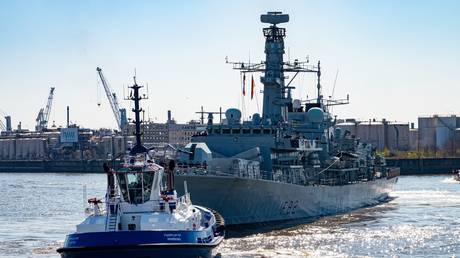
The British Royal Navy is currently sailing through its most dangerous period in modern memory. While politicians in London continually insist that the UK remains a top-tier maritime power, the reality on the water tells a completely different story. The fleet has shrunk to a level that has senior military figures sounding the alarm, warning that the nation's security is being gambled away on paper promises and delayed budgets.
Former First Sea Lord Admiral Lord Alan West recently pulled no punches when assessing the situation. He openly stated that the navy has been reduced to its worst state in British history. To find a time when the fleet took this kind of hammering, you have to look all the way back to 1667. That was the year the Dutch fleet famously sailed up the River Medway to Chatham, burned British warships at anchor, and walked away with the flagship. Don't miss our earlier post on this related article.
Today, the threat doesn't come from Dutch fireships, but from systematic underfunding, political neglect, and a chronic shortage of hulls. The UK now operates the smallest fleet in its long history. For a nation that relies on the sea for its economic survival and global influence, this isn't just an embarrassment. It's an active threat to national security.
A Shocking Decline in British Sea Power
The numbers reveal the sheer scale of the collapse. Over the past two years, the government has aggressively hollowed out the fleet to save cash. Nine ships have been axed entirely from the active roster. This rapid sell-off includes four frigates, two amphibious assault ships, two fleet tankers, and a nuclear-powered attack submarine. If you want more about the history here, The Washington Post provides an in-depth summary.
To put that in perspective, this two-year peacetime cull represents a greater loss of hulls than the entire fleet suffered during the 1982 Falklands War, where Argentine forces managed to sink seven British vessels.
What makes this situation terrifying is the lack of immediate backups. The government dropped plans for the proposed Type 83 destroyers and the Type 32 frigates, slapping them with the "unaffordable" label. This leaves the front line desperately thin. Right now, the core of the surface fleet relies on just 13 principal surface combatants, broken down into six Type 45 destroyers and seven aging Type 23 frigates.
But even that number is a massive overstatement of real combat readiness. Walk down to the docks and you'll see the truth. At any given moment, a huge chunk of these ships are stuck in deep maintenance or docked due to severe crew shortages. In reality, the nation is frequently left relying on just three operational destroyers and three or four frigates to cover the entire globe. The two multi-billion-pound aircraft carriers, HMS Queen Elizabeth and HMS Prince Wales, regularly sit in port without enough escort ships to form a viable, independent carrier strike group.
The Brutal Numbers Behind the Fleet Collapse
The maritime math simply doesn't add up anymore. During the Falklands conflict, the UK managed to send a task force of 127 ships, including 43 dedicated warships. Today, if you count every single vessel the navy owns—down to small coastal patrol boats and survey vessels—the total number sits around 51 hulls.
The submarine service is facing an even deeper crisis. Reports have highlighted that the UK’s entire available fleet of nuclear-powered attack submarines has spent extended periods stuck in port awaiting urgent repairs and maintenance overhauls. This leaves massive gaps in the GIUK gap, the stretch of water between Greenland, Iceland, and the UK that serves as the gateway for Russian submarines entering the Atlantic.
Because there aren't enough hulls to share the load, the burden on the remaining crews has become intolerable. Submariners who used to deploy for ten or twelve weeks at a time are now being sent beneath the waves for grueling 36-week stints. Spending nine months underwater without seeing daylight takes a massive toll on human beings. Sailors are returning home physically broken and mentally drained. Unsurprisingly, they are throwing in their papers and quitting in droves, creating a vicious cycle where crew shortages prevent ships from sailing, which forces the remaining ships to stay out longer.
Why a Small Fleet Fails the Modern Threat Check
The government recently announced a £15 billion boost for the armed forces, aiming to bring total military funding to nearly £300 billion over the next four years. Politicians love using these announcements to brag about record investment. They talk big about the Russian threat and standing up to global aggression. But money on a spreadsheet in 2026 doesn't automatically put steel in the water.
The new Type 26 and Type 31 frigates currently being built won't arrive in significant numbers until the 2030s or even the 2040s. You can't fight a war today with a ship that is still a blueprint or a half-finished hull in a Scottish shipyard.
We have already seen the real-world consequences of this weakness. When Iran-backed Hezbollah militants launched drone attacks against British sovereign bases in Cyprus, the navy failed to deploy a single major warship to protect the area in time. The Type 45 destroyer HMS Dragon was spotted thousands of miles away in Gibraltar weeks after the strike occurred. If the navy cannot even protect its own sovereign overseas bases from proxy threats, it has no hope of protecting global shipping lanes or deterring peer adversaries.
Tonnage Versus Hull Count Is a Dangerous Illusion
Defenders of the current strategy love to point out that the Royal Navy still ranks fourth globally when you measure by total tonnage, sitting comfortably behind the US, China, and Russia. They argue that a few massive, high-tech ships are far more lethal than a larger fleet of older vessels.
This argument ignores a fundamental rule of naval warfare. A ship can only be in one place at a time.
You cannot use one high-tech destroyer to protect an aircraft carrier in the Pacific, hunt submarines in the North Atlantic, and patrol the Red Sea against drone attacks all at once. Tonnage doesn't give you presence. Hulls do.
While the UK struggles to keep a handful of escorts operational, rival nations are building navies at a staggering pace. China operates a massive surface fleet of well over 300 ships and continues to pump out new destroyers and frigates every year. Even France now outnumbers the UK in active naval personnel. The British strategy of trying to maintain global reach on a shoestring budget has left the Senior Service overstretched, under-armed, and dangerously exposed.
Moving Beyond the Paper Navy
Reversing this historic decline requires a complete shift in how defense spending is managed. Throwing money at distant, long-term programs like the Dreadnought class or the SSN-AUKUS submarines won't fix the immediate operational emergency. The government needs to take immediate steps to keep the fleet afloat.
The first priority must be fixing the maintenance bottleneck. The UK has plenty of high-tech ships, but they spend far too much time tied up at the docks waiting for parts and engineers. Investing heavily in domestic shipyard capacity and streamlining the supply chain will get existing destroyers and submarines back to sea far quicker than waiting a decade for new builds.
Next, the Ministry of Defence must end the unsustainable 36-week submarine deployments. If the navy doesn't fix its retention crisis, it won't matter how many ships are built because there won't be anyone left to sail them.
Finally, the government needs to stop buying gold-plated, overly complex ship designs that take decades to develop and get cancelled the moment budgets get tight. The navy needs simple, adaptable, and affordable combat vessels that can be built quickly and in large numbers.
Britain can no longer afford to rely on the glorious history of its navy to deter modern adversaries. If the current trajectory doesn't change fast, the UK risks completely losing its ability to project power, leaving its global trade routes and domestic waters wide open to those who wish to exploit its obvious weakness.