The air in the Harz mountains does not smell like politics. It smells like resin, wet earth, and the unmistakable, sweet rot of death.
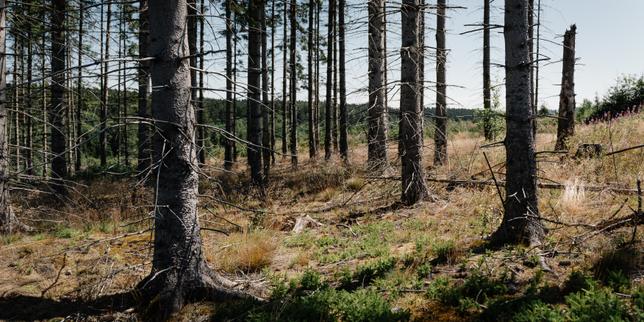
Stand beneath the canopy of Saxony-Anhalt, and you will hear a sound that defies the stillness of the forest: a dry, rhythmic clicking. It is the bark beetle, millions of them, burrowing beneath the stressed skin of dying spruces. Climate change did not simply warm these woods; it opened a vein. Years of relentless drought have left the trees defenseless, turning emerald ridges into skeletal graveyards of grey timber. For a different view, read: this related article.
Walk fifty meters out of the tree line, past the rusted boundary sign of a small regional village, and you will hear a different kind of clicking. It is the sound of ballpoint pens on clipboards, the chatter of outdoor beer tents, and the heavy, calculated cadence of a political rally.
Election season has arrived in eastern Germany. And the forest is on the ballot. Further insight on this trend has been shared by TIME.
It is easy to look at a map of Saxony-Anhalt and see only abstract geometry. Blue lines for rivers, green patches for federal parks, shaded gradients for voting districts. But maps lie. They separate the ecology from the economy, the trees from the ballot box, the dying timber from the living anger of people who feel forgotten by Berlin.
Consider a hypothetical resident named Thomas. (To understand Saxony-Anhalt today, you must invent a Thomas, because a thousand real ones look just like him.) Thomas is fifty-four. He spent thirty years working a local timber mill that now runs on half-shifts because the local supply of healthy spruce has evaporated. His grandfather planted these trees. His father hauled them. Thomas watched them wither under baking summer suns, turning brown in July, stripped bare by autumn.
When Thomas walks the perimeter of the Harz National Park, he does not see a protected ecosystem. He sees neglect. He sees dead wood left to rot by environmental bureaucrats who sit behind glass desks in Magdeburg or Frankfurt. He sees a government that cares more about esoteric climate targets than the livelihood of the men who built their lives around the harvest.
Enter the Alternative für Deutschland.
Extreme politics does not grow in a vacuum. It grows in the mulch of legitimate grievances. For years, mainstream political parties treated the ecological crisis in eastern Germany as a technocratic problem—a matter of forestry management budgets and carbon offset quotas. They talked about adaptation strategies and biodiversity metrics.
They forgot to talk to Thomas.
The far right made no such mistake. They arrived in the villages of Saxony-Anhalt not with policy papers, but with simple, dangerous narratives. They pointed at the dying trees and whispered that the decay was a metaphor for a dying nation. They blamed distant elites, green regulations, and cosmopolitan indifference for the rot on the hillsides.
The trees are dying because the state has abandoned you, the subtext ran. We will bring back the order. We will bring back the axe.
It is a masterclass in opportunistic radicalization. The extremists did not invent the bark beetle. They did not cause the subterranean heatwaves cracking the regional water table. But they weaponized the grief. They took a tangible, heartbreaking environmental collapse and hitched it to a wagon of cultural grievance and anti-democratic sentiment.
To stand in these woods is to realize that democracy is as fragile as a shallow-rooted spruce. Both require stability, moisture, and time to weather the storms. When the climate changes, the soil shifts. And when the soil shifts politically, the extremists are the first to plant their flags in the rubble.
Listen closely to the stump speeches echoing through market squares in towns like Wernigerode or Quedlinburg. You will hear phrases about " Heimat"—homeland—weaponized into exclusion. You will hear the preservation of the landscape conflated with the preservation of an idealized, homogenous past that never truly existed.
The tragedy of Saxony-Anhalt is not just that a forest is dying. Forests die; nature is violent, cyclical, and indifferent to our attachments. The true tragedy is that the death of these trees is being harvested for authoritarian power. Every hectare of grey, needleless timber becomes a billboard for despair. Every fallen trunk is leveraged by political actors who offer simple, hateful answers to complex ecological realities.
Mainstream politicians are scrambling to catch up. They organize town halls. They distribute pamphlets about sustainable reforestation. They promise subsidies for wood processing plants.
Too late.
When a house is on fire, you do not hand the owner a brochure on fire safety. You grab a bucket. And right now, the democratic bucket in eastern Germany feels terribly small against an inferno fueled by thirty years of post-reunification economic anxiety, demographic decline, and cultural dislocation.
Walk back into the forest as the sun dips behind the jagged ridge of the Brocken. The shadows lengthen, stretching long and dark across the clear-cut patches where heavy machinery has churned the mud. A solitary raven calls out from the skeleton of a towering spruce.
The trees cannot vote. But they tell us everything we need to know about the weather ahead.
The wind is rising through the dead branches, and it carries a chill that has nothing to do with the coming autumn.