The fifty-year ban on civil supersonic flight over American soil is finally hitting the scrap heap.
For decades, if you wanted to fly faster than the speed of sound, you had to be a military pilot or shell out thousands for a seat on the long-retired Concorde, which was strictly limited to ocean routes anyway. The 1973 blanket ban by the Federal Aviation Administration (FAA) effectively put an artificial speed limit on our skies. Breaking the sound barrier over land was illegal, period. Building on this topic, you can also read: Electromagnetic Orbital Launch on the Tibetan Plateau by the Numbers.
That just changed. The FAA officially issued a Notice of Proposed Rulemaking that aims to throw out the old speed-based prohibition and replace it with a sensible, performance-based noise standard. Instead of banning speed, the government is banning the boom. If an aircraft can prove its supersonic footprint is quiet enough, it gets the green light to fly across the continental United States without needing specialized, bureaucratic research permits.
If you think this is just another empty regulatory promise, you aren't paying attention to the physics. Analysts at Gizmodo have provided expertise on this situation.
The Death of the Sonic Boom
The old ban existed for good reason. When a conventional aircraft breaches Mach 1, it compresses air molecules into a massive shockwave that drags along the ground behind it. This sonic boom sounds like a nearby explosion. It doesn't just wake up the neighborhood; it rattles dishes, breaks windows, and structural damage is a very real hazard. In the 1960s, military tests over cities like Oklahoma City generated thousands of noise complaints. Public outrage forced the government to slam the brakes on commercial supersonic progress.
Aerospace engineering in 2026 is completely different. The shift away from a flat ban comes directly on the heels of major technical breakthroughs.
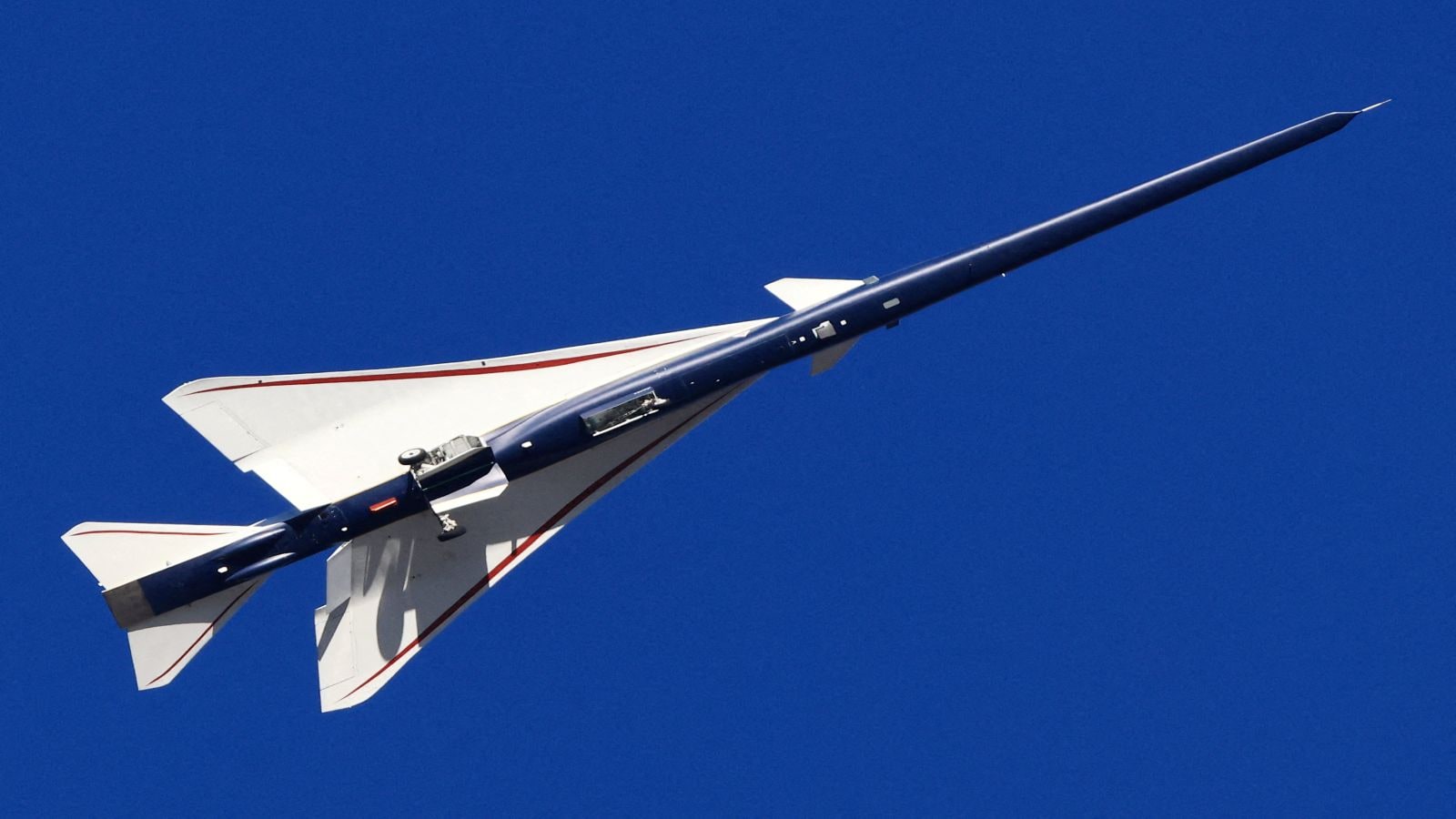
NASA recently wrapped up successful testing of its experimental X-59 aircraft, built alongside Lockheed Martin. The X-59 hit Mach 1.1 at 43,400 feet, but instead of sending a window-shattering shockwave to the dirt, it produced a muted "sonic thump."
The physics behind this are fascinating. Engineers altered the geometry of the plane, using a dramatically elongated, needle-like nose to prevent the individual shockwaves generated by the nose, canopy, and wings from combining into one loud boom.
Private industry is taking a slightly different, highly practical approach. Boom Supersonic, a company building commercial supersonic airliners, recently proved the viability of a technique known as Mach cutoff during test flights of its XB-1 demonstrator over the Mojave Desert.
Mach cutoff relies on a clever interplay of atmospheric conditions, flight speed, and altitude. When a plane flies just above the speed of sound under specific conditions, the warmer air layers closer to the ground act as a natural acoustic shield. The shockwave literally bends, refracts, and bounces back up into the upper atmosphere before it ever touches human ears on the ground.
Decoding the New Rules
The FAA isn't giving aerospace companies a free pass to cause chaos. The proposed framework sets a strict surface overpressure limit of 0.11 pound per square foot (psf).
To put that number in perspective, a traditional Concorde sonic boom hammered the ground with roughly 2.0 psf of pressure. The new standard requires a massive 95% reduction in ground impact. Manufacturers won't get a stamp of approval based on theory alone. Under the new rules, companies must use verified flight test equipment, acoustic modeling, and rigorous measurement data to prove their planes meet the threshold.
Aircraft Sonic Boom Comparison (Ground Overpressure)
--------------------------------------------------------
Concorde (Legacy)       | 2.00 psf (Loud Explosion)
FAA Proposed Limit      | 0.11 psf (Maximum Allowed)
X-59 / Modern Designs   | < 0.10 psf (Quiet Thump)
--------------------------------------------------------
The regulatory shift follows a June 2025 executive order titled Leading the World in Supersonic Flight, which ordered federal agencies to fast-track civil supersonic aviation. Transportation Secretary Sean Duffy noted that the update focuses on safely modernizing the airspace while protecting folks on the ground.
The FAA timeline is surprisingly tight. They intend to propose a secondary rule later this year to govern takeoff and landing noise around airports, aiming to finalize the entire regulatory package by mid-2027.
What This Means for Business and Travel
Let's talk practical impact. The standard commercial flight from New York to Los Angeles or Washington to London drags on for roughly six to seven hours. Supersonic aircraft operating under these new guidelines will easily cut those transcontinental and transatlantic travel times in half.
You're looking at a three-hour flight to cross the country. This changes the game for international business, critical logistics, and organ transport.
Naturally, skeptics point to the Concorde's ultimate failure as proof that high-speed flight isn't commercially viable. But comparing modern aviation efforts to a jet designed in the 1960s is foolish. The Concorde failed because it was an inefficient gas guzzler that couldn't fly overland, restricting its market to a sliver of wealthy transatlantic travelers.
Today's designs rely on advanced carbon fiber composites that reduce weight, highly optimized engines that don't require raw afterburners to cross the sound barrier, and now, the legal path to fly anywhere over the US mainland.
If you are a stakeholder in aviation, a frequent business traveler, or an aerospace investor, your next steps are clear. Watch the public comment period for this FAA proposal over the coming months. Pay attention to how the agency tackles the upcoming takeoff and landing noise rules later this year, because airport-adjacent noise remains the final political hurdle. The engineering problems are solved. The regulatory path is clearing. Supersonic flight is coming back, and it's going to be a lot quieter than before.