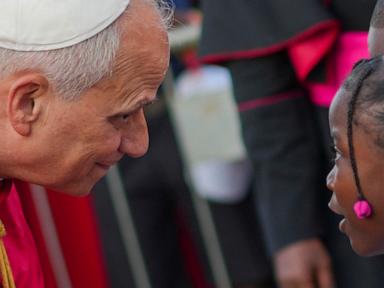
Pope Leo XIV didn't hold back when he touched down in Malabo this week. Standing next to Teodoro Obiang Nguema Mbasogo—the world's longest-serving president—the Pope delivered a blistering critique of what he calls the "colonization of minerals." It’s a bold move. You don't often see a religious leader look an autocrat in the eye and tell him his economic system "kills," but that's exactly what happened on April 21, 2026.
The timing isn't accidental. As the U.S. and China scramble for Africa's critical minerals to fuel the green energy transition, the Pope is pointing out the glaring paradox. Equatorial Guinea is one of the richest countries in Africa per capita thanks to oil, yet over half the population lives in poverty. It's a textbook case of a resource curse, and the Vatican is tired of watching the global north treat the continent like a vending machine.
The Economy That Kills
When the Pope talks about "economic colonialism," he’s referring to a system where foreign powers and local elites strip a country of its wealth while the average person can’t afford a decent meal. Equatorial Guinea’s oil boom in the 90s promised a lot. It delivered massive infrastructure projects and a shiny new capital, Ciudad de la Paz, but it didn't deliver for the 1.7 million people living outside the inner circle.
Leo XIV quoted his predecessor, Pope Francis, noting that the "poison of greed" has turned natural resources into a source of conflict rather than development. He wasn't just talking about historical colonial powers like Spain either. He’s looking at the modern landscape where "first come, first serve" mineral concessions are being handed out while domestic healthcare and education systems rot.
The numbers are pretty staggering. Oil makes up about 90% of the country’s exports. Despite this, the national poverty rate sits at over 50%. You've got 1% of the population holding the keys to the vault while the rest are essentially told to wait for crumbs that never fall.
Obiang’s Iron Grip and the Mineral Scramble
Teodoro Obiang has been in power since 1979. Think about that. He’s seen nine U.S. presidents come and go. Under his watch, Equatorial Guinea has become a strategic hub for oil and, increasingly, the minerals needed for high-tech manufacturing. The Pope’s visit highlights a massive tension: the world needs these resources, but the way they’re being extracted is gutting the social fabric of the nation.
Obiang's government has faced decades of allegations involving corruption and human rights abuses. The Pope's speech about the "lust for power" and "unjust wealth" felt like a direct hit. He warned that "the earthly city is centered upon the proud love of self," contrasting it with a vision of leadership that actually serves people.
The geopolitical context makes this even more volatile. With ExxonMobil exiting and the government desperately trying to "reinvigorate" the sector through the EG Ronda 2026 licensing round, there’s a frantic energy in Malabo. They’re offering up 24 blocks for exploration. The Pope is basically asking: who is this really for?
The Illusion of Progress
We see high-tech gadgets everywhere. The Pope even mentioned that smartphones and AI are in the pockets of the poor, but they don't have clean water or dignified work. It’s a weird, digital-age version of inequality. You can post on social media about your hunger, but you still can't buy bread.
The Church is trying to position itself as a mediator or at least a moral compass. They’re pushing for a "right to information" so local communities actually know what’s being dug up under their feet. This isn't just "feel-good" rhetoric. It’s a push for transparency in a country where the state budget is often treated like a family checkbook.
What Real Change Looks Like
If you want to understand why this matters for the rest of us, look at your phone. The minerals inside it likely came from a place where the "See, Judge, Act" model of social justice is desperately needed. The Pope’s message is that we can't grow accustomed to the "bloodshed that has marked this country for decades."
So, what are the next steps?
First, there has to be a shift in how mineral concessions are handled. The "first come, first serve" model the government just rolled out is a transparency nightmare. It bypasses public auctions and makes backroom deals easier. International observers and investors need to demand better reporting standards.
Second, the wealth distribution gap isn't going to fix itself. The Pope called for "sound politics" to eliminate obstacles to human development. In plain English: spend the oil money on schools and hospitals, not more vanity projects in the jungle.
Finally, keep an eye on the 2026 licensing rounds. If these contracts are signed without any community benefit agreements, we’re just watching the same movie on a different screen. The "economic colonialism" the Pope warned about is alive and well—it just has a better PR team now.
Stop looking at Africa as a mine. Start looking at it as a partner. If we don't, the "economy that kills" will eventually come for everyone's stability, not just those in the Gulf of Guinea.