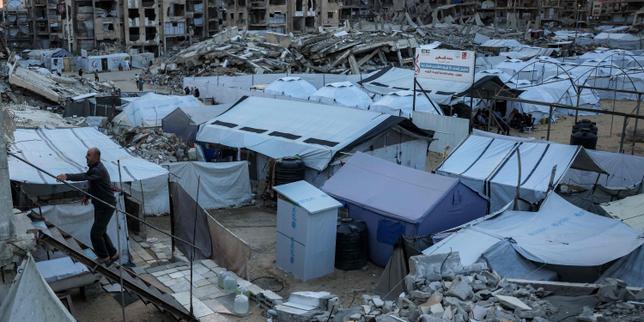
Headline casualty reports from Gaza—such as a single strike killing seven people according to civil defense crews and hospital staff—compress complex operational, informational, and humanitarian dynamics into a single static figure. The analytical blueprint is straightforward: separate verified facts from operational inferences, map how casualty counts are generated and contested under active hostilities, trace the downstream strain on emergency response and medical triage, and evaluate the limits of any analytical or strategic response when access and ground truth remain constrained.
Conventional breaking news coverage treats a headline death toll as a complete event rather than a signal produced by an institutional chain. When a French-language wire headline states that Israeli strikes in Gaza killed seven people according to civil defense and hospitals, it identifies three core elements: an actor/action ("frappes israéliennes"), an aggregate outcome ("sept morts"), and two reporting nodes ("la défense civile et des hôpitaux"). What that compressed framing omits is equally consequential: the specific location type, strike timing, distinction between combatants and civilians if ascertainable, damage to surrounding infrastructure, and the verification lag between a kinetic impact and a confirmed tally.
The Verification Architecture Behind Casualty Figures
In active conflict zones with damaged communications, restricted movement, and dense urban layouts, a casualty figure is not a raw sensor reading; it is an output of a multi-step reporting pipeline. Each link in that chain introduces specific strengths, blind spots, and potential friction.
- First-responder retrieval: Civil defense units and local rescue crews operate closest to impact sites, making them primary witnesses to immediate structural damage and initial body recovery. Their count can be delayed or incomplete when rubble obscures victims, when secondary strikes or ongoing fire prevent immediate entry, or when fuel and equipment shortages slow clearance.
- Hospital intake and mortuary logs: Receiving hospitals record fatalities brought in by ambulances, private vehicles, or family members. These logs are structured and auditable relative to chaotic street scenes, yet they can undercount deaths where bodies are not transported to a facility and can experience surges or reporting bottlenecks when power, internet connectivity, or staffing are degraded.
- Belligerent statements and independent monitoring: Military authorities, international agencies, and local health bodies often operate on divergent timelines and evidentiary standards. Discrepancies between an initial local report and later tallies frequently reflect evolving recovery and verification rather than bad faith alone, though parties to a conflict also contest attribution, target selection, and status classifications.
A known fact in this reporting structure is that initial figures from civil defense and hospitals represent what rescue teams and facilities have encountered up to that point, not necessarily a final, exhaustive accounting. An educated hypothesis—to be tested against subsequent reporting rather than assumed as fact—is that a low single-digit or small-group fatality count from a single incident may either remain stable or rise modestly if adjacent debris is cleared or critically injured patients succumb at a receiving ward. Treating an early number as immutable creates false precision; discarding it entirely ignores the only near-real-time indicators available from affected neighborhoods.
Cause-and-Effect Chains Beyond the Headline Number
Headline reporting tends to isolate a kinetic event from its cascading operational consequences. Analyzing the subject through causal chains reveals how even a localized strike interacts with broader system constraints.
From Kinetic Impact to Triage Bottlenecks
A strike does not affect a medical system solely through the fatalities it produces. Wounded survivors arriving simultaneously place acute demand on surgical capacity, blood supplies, anesthesia, sterile consumables, and ward space. When hospital infrastructure itself has suffered prior damage, supply interruptions, or generator strain, each incoming cluster of casualties compounds crowding and forces clinicians into stricter triage trade-offs. Consequently, survival rates for treatable trauma depend heavily on facility functionality and transit time, not merely on the severity of injuries at the moment of impact.
From Incident Reporting to Information Asymmetry
Rapid headlines satisfy immediate news cycles, yet they often outpace detailed corroboration. When an initial report cites seven deaths without specifying whether they resulted from one munitions impact or multiple strikes across different zones, analysts face an attribution and aggregation problem. Combining separate incidents into a single narrative can obscure distinct tactical contexts, while waiting days for exhaustive forensic verification leaves public understanding reliant on incomplete early snapshots.
From Local Disruption to Strategic Signaling
Localized strikes and their reported tolls feed into diplomatic pressure, legal scrutiny, and domestic political narratives far from the point of impact. Observers frequently ask how a specific incident alters ceasefire prospects, external arms transfers, or humanitarian access negotiations. In practice, single incidents rarely shift strategic trajectories on their own unless they intersect with broader thresholds—such as repeated strikes near protected facilities, high-profile civilian harm, or visible breakdowns in deconfliction arrangements.
Conceptual Frameworks for Structured Analysis
To move beyond reactive headline reading, analysts can organize evidence around three practical frameworks that separate observation from speculation.
The Incident Evidence Matrix
Every piece of information surrounding a reported strike can be sorted across four dimensions: source provenance (who reported it and from where), temporal anchor (when the strike occurred versus when the count was published), corroboration status (whether independent visual, medical, or institutional records align), and uncertainty bounds (what remains unverified, such as exact munition type or individual identities). Applying this matrix prevents a reader from treating a preliminary civil defense estimate with the same evidentiary weight as a multi-source post-incident review.
The Operational Friction Model
In contested environments, outcomes are shaped by friction across four operational domains: access (whether ambulances, inspectors, and journalists can reach the site), utilities (power, water, and telecommunications required to sustain care and reporting), protection (safety risks to responders and civilians during recovery), and throughput (the rate at which casualties can be evacuated, treated, and logged). When friction rises in any of these domains, both humanitarian outcomes and data reliability deteriorate together.
Fact Versus Inference Discipline
Rigorous analysis requires explicit separation between observed facts and analytical inferences. Observed facts include the publication of a report citing civil defense and hospital sources, the stated fatality count, and any confirmed facility admissions. Analytical inferences include assessments of likely tactical intent, projections of broader escalation, or estimates of unreported casualties. Making that boundary explicit keeps analysis accountable when new facts emerge.
Practical Steps for Evaluating Conflict Strike Coverage
For analysts, researchers, and informed readers tracking reports like a seven-fatality strike toll in Gaza, disciplined evaluation follows a clear sequence.
- Log the exact attribution and timestamp. Record who stated the figure (civil defense, hospital administration, military spokesperson, or international agency) and note whether the count refers to a single strike or multiple strikes over a defined window.
- Check for revision dynamics. Track subsequent updates over the next 24 to 72 hours to see whether the number is confirmed, revised upward as debris is cleared or critical patients die, or re-categorized as more details emerge.
- Separate fatalities from total harm. Account for injured survivors, displaced households, and damage to clinics, roads, or water lines, which often carry longer-lasting operational consequences than headline death tolls alone.
- Cross-check independent indicators. Look for corroborating details—such as satellite imagery, hospital status reports, aid agency field notes, or official statements—while noting where verification remains blocked.
- State confidence levels explicitly. Assign high confidence only to directly corroborated facts, moderate confidence to consistent multi-source patterns, and low confidence to single-source claims about intent or unverified numbers.
Limitations and Analytical Blind Spots
Even a disciplined analytical framework has sharp boundaries. In active conflict settings, independent on-the-ground verification is frequently restricted, meaning analysts often work with partial visibility and competing accounts. Source access can be uneven across neighborhoods, and rapid operational tempo can outstrip formal record-keeping.
There is also a structural risk of over-interpreting small numbers. A count of seven fatalities in a dense conflict environment is tragic and operationally significant, yet statistically small enough that sampling delays, reporting lags, or definitional differences can loom large in early coverage. Mistaking a preliminary count for a complete accounting—or assuming a single reporting lag reflects deliberate distortion—both degrade analytical judgment.
Strategic Play for Decision-Makers and Analysts
Treat early strike casualty headlines as triage triggers for verification, not final conclusions. Build monitoring workflows that pair immediate incident logging with mandatory follow-up checks on hospital capacity, access constraints, and revised tallies, and enforce a strict rule in every brief or assessment: never state an uncorroborated operational cause or strategic conclusion as established fact when the underlying evidence only supports a provisional hypothesis.


