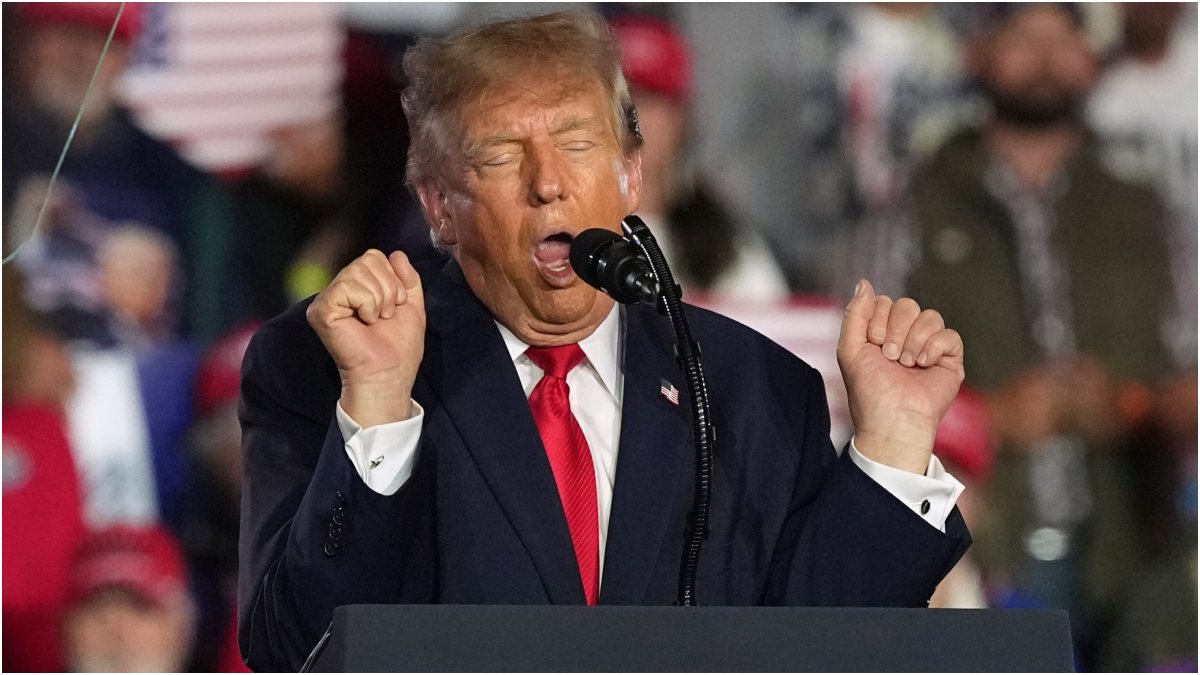
Modern American midterm elections operate under a well-documented structural gravity where the incumbent president’s party almost uniformly loses congressional seats. When a sitting executive explicitly frames a non-presidential cycle as a direct referendum on their personal leadership, they accelerate this structural penalty by collapsing local candidate differentiation into a single nationalized binary. In the recent midterm cycle, Donald Trump executed a deliberate campaign strategy centered on personal loyalty, executive grievances, and individual brand dominance, converting hundreds of localized legislative races into a unified national plebiscite on his presidency.
To understand why this strategy produced predictable electoral losses, analysts must strip away surface-level partisan narratives and examine the underlying mechanics of voter turnout, candidate positioning, and political nationalization. Conventional political commentary often treats midterm losses as mysterious shifts in public mood or simple communication failures. In reality, these outcomes represent the mathematical convergence of differential turnout models, negative partisanship, and the elimination of ticket-splitting behavior across swing districts.
The Structural Baseline of Midterm Penalties
Since the end of the Second World War, the president’s party has lost seats in the House of Representatives in almost every midterm election, with rare anomalies occurring only during acute national crises or periods of exceptional economic expansion. Political science defines this phenomenon through two primary mechanisms: the surge-and-decline theory and thermostatic public opinion.
Under surge-and-decline dynamics, presidential elections draw low-propensity, peripheral voters to the polls who disproportionately favor the winning executive. Two years later, without the presidency on the ballot, these peripheral supporters revert to non-voting status. The electorate shrinks and shifts toward high-propensity, core partisan voters. Simultaneously, the opposition party experiences an anger-driven mobilization surge, motivated by policy losses incurred during the first two years of the new administration.
Thermostatic public opinion compounds this turnout asymmetry. As an administration enacts its legislative or executive agenda, the ideological center of the electorate moves in the opposite direction, seeking to restore policy equilibrium. Voters use the midterm ballot as a corrective mechanism to install divided government and constrain executive overreach.
When an incumbent president actively campaigns on the premise that the election is a personal referendum, they neutralize every traditional defense mechanism available to down-ballot members of their own party. Instead of allowing vulnerable incumbents to run localized, district-specific campaigns focused on constituent services or moderate bipartisan credentials, a personalized referendum forces every candidate onto the exact same ideological terrain.
The Mechanics of Political Nationalization
Over the past three decades, American electoral behavior has undergone intense nationalization. Ticket-splitting—the practice of voting for a presidential candidate of one party and a congressional candidate of another—has fallen to historic lows. Today, the correlation between presidential vote share and congressional vote share in a given district regularly exceeds 0.90.
By centering the midterm campaign entirely on his own persona, Trump accelerated an already rigid nationalization trend. This strategic choice imposed three distinct operational constraints on Republican candidates across the country:
- Elimination of Ideological Elasticity: In competitive suburban and exurban districts, congressional candidates require ideological flexibility to build winning coalitions of partisan base voters and moderate independents. A nationalized referendum strips away this flexibility. Voters no longer evaluate the local representative on committee assignments, infrastructure funding, or regional policy alignment; they evaluate the candidate solely as a proxy vote for or against the president.
- Asymmetric Base Mobilization: A personality-driven campaign relies heavily on maximizing turnout among the president’s most devoted base voters. While this approach generates high energy at rallies and strong primary turnout, it proves structurally inefficient in general elections when the president is not actually on the ballot. Many populist voters drawn specifically to Trump’s personal brand exhibit lower electoral attachment to traditional party institutions, resulting in significant drop-off when only down-ballot names appear on the ticket.
- Activation of Negative Partisanship: In polarized environments, fear and opposition to the rival party motivate voter behavior far more reliably than affection for one’s own leadership. By keeping himself at the absolute center of daily media cycles, Trump provided the opposition party with a singular, unifying focal point. Democratic strategists did not need to construct complex policy arguments across four hundred distinct districts; they simply needed to tether local Republican candidates to the president’s rhetoric and approval ratings.
The Cost Function of Executive Over-Exposure
In political communications, executive visibility carries diminishing marginal returns. Early in a term, presidential travel and media saturation can set the legislative agenda and pressure reluctant lawmakers. However, during a midterm cycle, excessive executive visibility alters the framing of the election from a choice between two competing governing visions to a binary judgment on the incumbent’s performance.
This dynamic exposes a critical flaw in modern populist campaign strategy: the confusion of media dominance with coalition expansion. Commanding daily headlines ensures that the political conversation revolves around the executive’s chosen topics, yet dominating the news cycle does not equate to persuading median voters.
When the executive’s approval rating sits underwater—typically below the 45 percent threshold—making the election a referendum on the president mathematically guarantees defeat in competitive districts. Even if voters harbor doubts about the opposition party’s economic or social policies, a referendum frame removes the opposition from scrutiny. Voters do not compare two flawed alternatives; they simply register dissatisfaction with the status quo.
The Candidate Quality Variable
A secondary consequence of personalizing the midterm cycle occurs months before November, during the primary election phase. When an incumbent president defines party loyalty exclusively through personal allegiance rather than ideological alignment or electoral viability, primary electorates reward candidates who mimic the executive’s style over candidates who possess broad general-election appeal.
In multiple key battleground races, primary voters selected nominees whose political profiles were optimized for media appearances and base-pleasing rhetoric rather than suburban persuasion. Once these nominees entered the general election, they faced an immediate structural deficit:
- Fundraising Disparities: General-election donors and institutional party committees often hesitate to invest heavily in candidates perceived as erratic or structurally unviable, creating cash-on-hand disadvantages during the critical final weeks of media buying.
- Suburban Alienation: College-educated suburban voters, who now form the decisive swing bloc in American politics, prioritize institutional stability, predictable governance, and economic competence. Candidates selected purely for loyalty to a polarizing executive struggle to clear basic credibility thresholds with this demographic.
- Lack of Incumbency Cushion: Where loyalty tests drove sitting moderate incumbents into retirement, the party forfeited the measurable statistical advantage of incumbency, turning safe or lean-party seats into open-seat toss-ups.
The Strategic Misallocation of Campaign Resources
A rigorous audit of the midterm campaign reveals how a referendum strategy distorts resource allocation across the political map. Rather than concentrating financial and organizational capital in the twenty to thirty truly competitive House districts and five battleground Senate states that determine congressional control, a personality-driven campaign tends to deploy resources based on media visibility and personal grievance.
Rally schedules and surrogate deployments frequently prioritized deep-red strongholds where the party already held massive structural advantages, or high-profile blue states where media coverage was guaranteed despite zero mathematical path to victory. While these events generated impressive crowd sizes and strong digital fundraising numbers, they produced minimal marginal votes in the swing districts that actually govern legislative majorities.
In modern campaign management, every dollar and every hour of executive time carries an opportunity cost. Time spent relitigating past elections or settling intra-party scores in safe districts is time subtracted from targeted voter registration, ballot-chasing operations, and localized persuasion advertising in purple districts.
Operational Realities of the Post-Midterm Landscape
The resulting shift in congressional power immediately alters the operational reality of the executive branch. Losing the House majority—or facing a hostile chamber—terminates the president’s ability to pass unilateral partisan legislation, shifts the legislative calendar to opposition priorities, and transfers subpoena power to rival committee chairs.
Under divided government, executive governance becomes reliant on administrative rulemaking, executive orders, and judicial appointments—mechanisms that remain vulnerable to court challenges and reversal by subsequent administrations. Furthermore, the legislative branch transitions from a protective shield into an investigative apparatus, consuming executive branch bandwidth through oversight hearings, document requests, and budgetary standoffs.
Strategic Imperatives for Future Midterm Cycles
To avoid repeating the structural failures of a personalized referendum, party strategists and executive teams must enforce strict operational discipline in future non-presidential cycles:
- Decouple Executive Approval from Down-Ballot Messaging: When presidential approval ratings trail below 48 percent, the White House must intentionally lower its public profile during the final ninety days of the campaign. Communication strategies must pivot from executive personality to localized economic conditions and specific opposition policy failures.
- Enforce Primary Viability Filters: National party committees and aligned super PACs must intervene early in contested primaries to ensure nominees possess the demographic appeal and fundraising capacity required to win median voters in swing districts, rejecting loyalty tests that produce unviable general-election candidates.
- Shift from Referendum to Choice Framing: Campaign messaging in battleground districts must relentlessly frame the election as a binary choice between two concrete governing agendas rather than a judgment on a single individual. Voters must be forced to weigh the specific costs of the opposition’s platform rather than casting a cost-free protest vote against the executive.
- Reallocate Capital to Turnout Infrastructure: Redirect campaign capital away from large-scale rally production and toward year-round field operations, early-vote banking, and data-driven persuasion targeting low-propensity swing voters in decisive suburban counties.