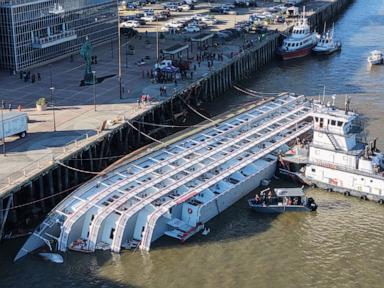
Federal investigators just pulled a critical piece of evidence from the bottom of the Mississippi River. It’s the bridge audio from the infamous collision between a massive cruise ship and an ocean-going tanker, an incident local headlines quickly dubbed the "Mississippi miracle" because nobody died.
You’ve probably seen the blurry cell phone videos of the impact. Sparks flying. Steel groaning. Hundreds of passengers screaming on the upper decks while the river current pushed two floating skyscrapers together in the dark. For months, everyone has been guessing how two vessels packed with radar, GPS, and licensed river pilots managed to slam into each other on a stretch of water they navigate every single day. Now, the National Transportation Safety Board (NTSB) has the black box recordings. And honestly, the recovery of that audio changes everything about how we look at maritime safety on America’s busiest river. Recently making headlines lately: What Everyone Misses About Isaac the Cat Surviving the Brooklyn Building Collapse.
Why the Mississippi Miracle Almost Turned Into a Tragedy
Let’s get one thing straight first. Calling a ship collision a "miracle" sounds great on a news chyron, but in the maritime world, it’s just another way of saying we got extraordinarily lucky.
When a cruise ship carrying thousands of passengers and crew collides with a commercial tanker loaded with fuel or chemicals, the margin between a minor hull scrape and a mass-casualty disaster is measured in inches. On the lower Mississippi, the river isn't a peaceful, lazy stream. It’s a fast-moving, muddy highway with treacherous bends, shifting sandbars, and intense currents that can push a 100,000-ton vessel sideways before a captain can even spin the wheel. Further details on this are covered by BBC News.
In this specific crash, the sheer physics of the impact should have been catastrophic. Tankers are built with double hulls to prevent spills, and modern cruise ships are compartmentalized to stay afloat even when breached. Yet neither design is meant to absorb a direct, high-tonnage crunch in the middle of a narrow shipping channel. If the angle of impact had been ten degrees sharper, or if the tanker’s cargo tanks had ruptured near the cruise ship’s engines, we wouldn't be talking about a miracle. We’d be talking about one of the worst maritime disasters in U.S. history.
That’s why the NTSB and the U.S. Coast Guard spent so much time and effort securing the Voyage Data Recorder (VDR). Without the actual bridge recordings, an investigation relies heavily on human memory. And anyone who has ever been in a car crash knows how unreliable memory gets when adrenaline floods the brain.
How Investigators Recover Audio From Damaged Ships
People hear "black box" and picture an indestructible orange cylinder surviving a fiery plane crash. Maritime Voyage Data Recorders work on a similar principle, though they’re built to survive crushing water pressure and saltwater corrosion rather than high-altitude impacts.
A VDR sits high up on the ship’s bridge, usually inside a protective capsule bolted to the deck or mast. It continuously records a rolling loop of data:
- Bridge audio from multiple microphones mounted near the helm, radar stations, and bridge wings.
- VHF radio communications between the ship, nearby vessels, and vessel traffic services.
- Radar and ECDIS screens showing exact positions, headings, and electronic chart overlays.
- Engine orders and rudder angles proving when the crew tried to slow down or turn.
When a crash happens, that capsule can get crushed by falling rigging, flooded by seawater, or knocked loose entirely. Even when the ship stays afloat, electrical fires or sudden power losses can corrupt the final seconds of data on the hard drives.
Federal technicians don't just plug these units into a laptop and hit play. They have to carefully extract the memory boards, clean away soot or moisture, and mirror the raw data bit by bit in a specialized lab. Getting clean, intelligible audio from a noisy ship bridge—where alarms are blaring, diesel engines are vibrating through the floorboards, and multiple people are shouting over each other—takes weeks of acoustic filtering.
What Bridge Recordings Reveal That Radar Never Will
Radar tells you what happened. Audio tells you why.
If you look at Automatic Identification System (AIS) tracking data from the Mississippi River crash, you can trace the exact path both vessels took. You can see the speed over ground, the rate of turn, and the exact second their hulls met. What AIS data completely misses is the human element inside the wheelhouse.
On the lower Mississippi, large ocean-going vessels are legally required to take on local river pilots. These pilots know every eddy, every bend, and every quirk of the river. When a collision occurs, it’s almost never because a single piece of equipment magically broke. It’s usually a chain of small communication failures.
Here is what NTSB investigators listen for in those recovered audio files:
- Passing agreements on VHF Channel 13. Ships on the Mississippi constantly talk to each other to arrange "one-whistle" (port-to-port) or "two-whistle" (starboard-to-starboard) passes. Did one pilot call out a maneuver that the other never acknowledged? Did a third vessel clutter the radio channel at the exact wrong moment?
- Bridge Resource Management (BRM). A river pilot gives the navigation orders, while the ship's captain and bridge team execute them. Sometimes, a language barrier or a steep hierarchy stops a junior officer from speaking up when they notice the helmsman turned the wheel the wrong way. The audio captures that hesitation—or that silence.
- Distraction and fatigue. Was the bridge crew focused on the channel ahead, or were they dealing with an unrelated mechanical alarm, a phone call, or sheer exhaustion during a late-night watch?
- The exact timing of the "Oh no" moment. Investigators measure the precise seconds between the first verbal warning on the bridge and the moment the engine telegraph was slammed to full astern. That gap tells them whether the crew was caught completely off guard or was actively fighting a mechanical steering failure.
The Dangerous Reality of Modern Mississippi River Traffic
You can’t understand this crash without understanding how crowded that river actually is. The stretch of the Mississippi between Baton Rouge and the Gulf of Mexico is one of the largest port complexes in the world.
Every single day, massive bulk carriers hauling grain, chemical tankers, container ships, and giant cruise liners share the same winding channel with thousands of smaller push-boats shoving thirty-barge tows. It is tightly choreographed chaos. Most of the time, the system works because the pilots are extraordinarily good at what they do.
When something goes wrong, though, the river doesn't forgive. Ships this size don't have brakes. A fully loaded tanker moving downriver with a four-knot current behind it can take well over a mile to come to a complete stop, even with its engines running in reverse. And the moment you cut power to a ship's propeller, you lose water flow over the rudder—meaning you lose the ability to steer. Captains often have to speed up to turn a ship away from danger, which feels completely counterintuitive to anyone used to driving a car.
Cruise ships face an entirely different problem. Their towering superstructures act like giant sails. A sudden squall or crosswind coming off the Louisiana marshes can push a cruise ship laterally across the channel faster than its bow thrusters can compensate. Put a wind-blown cruise ship and a heavy, current-pushed tanker in the same river bend at night, and you have a recipe for disaster.
What Happens Next in the NTSB Investigation
Recovering the audio is a massive milestone, yet it’s nowhere near the end of the process. Maritime investigations move slowly because the stakes are too high to guess.
Over the next several months, the NTSB will transcribe every word spoken on both bridges, syncing those timestamps down to the millisecond with the radar tracks and engine logs. They will interview the river pilots, the ship captains, the helmsmen, and the Coast Guard Vessel Traffic Service operators who were watching the sector on shore-based radar.
Once the factual record is locked in, the board will release a preliminary report outlining the timeline of events without assigning blame. The final determination of probable cause—the report that actually forces shipping companies, pilot associations, and regulators to change their rules—usually takes twelve to eighteen months.
If you’re a traveler planning a cruise out of New Orleans, or someone who watches maritime news closely, you don't need to panic, nor should you ignore the warning signs. When the NTSB releases its preliminary factual docket later this year, read the bridge transcript summary directly on the agency's website rather than relying on sensationalized headlines. Pay attention to whether the failure came down to mechanical steering loss or basic radio miscommunication—because those two causes tell entirely different stories about how safe our waterways really are.