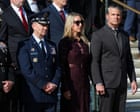
Silence isn't optional at Arlington National Cemetery.
When news broke about Pete Hegseth and his aides getting scolded by a sentinel for laughing at the Tomb of the Unknown Soldier, the internet did what it always does. People immediately picked political sides, argued about who was right, and completely missed the actual protocol that governs America's most sacred military site.
Honestly, most people have no idea how strict the rules at the Tomb actually are. Whether you're a high-profile television host, a government official, or a tourist from Ohio on a spring break trip, the soldiers guarding that plaza don't care about your title. They care about respect. And if you break the silence, you're going to hear about it—loudly, publicly, and without an ounce of hesitation.
Why the Tomb of the Unknown Soldier Demands Absolute Silence
To understand why a sentinel will bark at a group of grown adults for chuckling, you have to understand what that marble sarcophagus represents. Dedicated on November 11, 1921, the Tomb holds the remains of unidentified American service members from World War I, World War II, and the Korean War.
The inscription on the back reads, "Here rests in honored glory an American soldier known but to God."
That isn't just poetic phrasing to the men and women of the 3rd U.S. Infantry Regiment—better known as The Old Guard—who guard it 24 hours a day, 365 days a year. They've kept an unbroken watch since July 2, 1937, through blizzards, hurricanes, and scorching Virginia summers. When you step onto the Memorial Amphitheater plaza, you aren't walking into a museum or a photo op. You're walking into an active military post and a cemetery.
When visitors laugh, talk loudly, or step over the chains, the sentinel on duty doesn't politely ask them to quiet down. They execute a sharp, deliberate routine designed to halt the behavior immediately.
How a Sentinel Confronts Disrespectful Visitors
If you've never seen a Tomb Guard challenge a crowd, it's jarring. The guard stops their 21-step march, turns sharply toward the offender, brings their M14 rifle to port arms, and projects a booming command across the plaza.
The standard script is unmistakable: "It is requested that all visitors maintain an atmosphere of silence and respect at all times."
If the talking, laughing, or boundary-crossing doesn't stop right away, the guard escalates. They'll step off the mat, click their heels, and state firmly that the area is a sacred shrine and that if visitors cannot remain quiet, they will be escorted out.
It happens way more often than you think. Every single week, tourists get yelled at for whispering too loudly, letting their kids run near the chains, or taking selfies with goofy expressions. High-profile figures aren't exempt from this. In fact, because they're often surrounded by entourages, cameras, and staffers whispering logistics, political figures and media personalities are actually more prone to accidentally triggering a sentinel's warning.
The Incident Involving Pete Hegseth and His Aides
Reports surfaced detailing an incident at Arlington National Cemetery where Pete Hegseth and members of his team were reprimanded by a Tomb Guard after laughing near the monument.
Context matters here. Hegseth is an Army National Guard veteran who served in Iraq and Afghanistan, which is precisely why the headline drew so much heat from both critics and fellow veterans. People expect a civilian tourist who has never served to occasionally misunderstand military decorum. They hold someone with a military background—and public prominence—to a much higher standard.
At the same time, anyone who has spent time around political press tours, media shoots, or VIP visits knows how easily a group loses situational awareness. Aides crack a nervous joke. Someone whispers a comment about camera angles or scheduling. Before anyone realizes how sound carries across the stone amphitheater, a quiet chuckle echoes right toward the mat.
The sentinel doesn't pause to figure out who started the joke or whether the person laughing is a decorated combat veteran. The guard hears noise, sees disrespect, and enforces the standard. Period.
What Most People Get Wrong About Tomb Guard Protocol
Whenever a viral video or news story shows a guard yelling at someone at Arlington, the comment sections fill up with wild myths. Let's clear up the biggest misconceptions right now.
- Myth 1: The guards aren't allowed to speak or move off the mat. Completely false. While they don't engage in casual conversation, breaking silence to protect the dignity of the Tomb is literally part of their orders. They will step off the rubber mat in a heartbeat if someone crosses the chain or refuses to quiet down.
- Myth 2: Their rifles aren't real or functional. The M14 rifles carried by the sentinels are fully functional weapons, kept spotless to military inspection standards. While they aren't loaded with live ammunition during standard ceremonial watches, the guards are active-duty infantry soldiers trained in combat.
- Myth 3: VIPs get special treatment or private access without rules. Even the President of the United States has to follow strict ceremonial choreography during wreath-laying ceremonies. Aides, Secret Service agents, and press pools are briefed beforehand on where to stand and when to stay silent. Nobody gets a pass to chat on the plaza.
- Myth 4: You can't take photos at the Tomb. You actually can take photos and videos from behind the stanchions, provided you don't use flash during certain ceremonies and you don't disrupt the Changing of the Guard. What gets people in trouble isn't the camera—it's the loud commentary while filming.
Why Sound Carries So Dramatically at Arlington
If you've ever visited the Memorial Amphitheater in person, you know the acoustics are brutal if you're trying to have a private conversation.
The plaza is surrounded by white Imperial Danby marble, stone steps, and open air. There's no carpet, no acoustic paneling, and very little background hum once the tour buses shut off down the hill. A normal conversational whisper on the upper steps travels straight down to the mat where the sentinel is marching.
During the Changing of the Guard—which happens every hour from October through March, and every half hour from April through September—the crowd goes dead silent. The only sounds you hear are the crisp click of the guards' steel-plated heel taps and the slap of leather rifle slings. In that kind of quiet, even a suppressed laugh sounds like a firecracker.
Aides and staffers traveling with public figures often make the mistake of treating the walk up to the plaza like a normal event backstage. They forget that the transition from the cemetery walkways to the Tomb plaza is instant. The moment you clear the steps, you are on stage in front of grieving families, veterans, and armed sentinels.
The History Behind the Strictness of The Old Guard
The rules weren't invented just to intimidate tourists. They exist because, in the early years after the Tomb was dedicated, the monument wasn't guarded at all.
Between 1921 and 1925, the site had no full-time military watch. Tourists routinely picnicked on the marble steps, chipped pieces off the stone for souvenirs, and walked directly across the top of the vault. Congress and the War Department were appalled. By 1926, a civilian watchman was hired, and later that year, a military guard was posted during daylight hours.
In 1937, the guard became permanent—day and night, without a single break. The Society of the Honor Guard, Tomb of the Unknown Soldier maintains strict records and traditions around this duty. Becoming a Tomb Guard requires passing an intense screening process, memorizing pages of Arlington history verbatim, and maintaining uniform standards down to fractions of a millimeter.
When a sentinel snaps at a visitor for laughing, they're defending nearly a century of hard-won reverence. They're making sure the plaza never slips back into being treated like a casual tourist attraction.
How to Visit Arlington National Cemetery Without Embarrassing Yourself
Whether you're visiting on your own, bringing family, or staffing a VIP event, avoiding a public reprimand from The Old Guard comes down to basic preparation and spatial awareness.
- Silence your phone before you get off the bus or leave your car. Don't wait until you reach the steps. Ringing phones, text chimes, and camera shutter clicks are the fastest way to draw a sentinel's attention.
- End all conversations at the bottom of the stairs. Treat the perimeter chains and steps as a hard sound barrier. If you need to coordinate logistics, take a photo, or explain something to your kids, do it before walking onto the plaza.
- Stand during the Changing of the Guard and Taps. If you're physically able, stand at attention when the relief commander announces the guard change or when a bugler plays Taps. Place your right hand over your heart if you're a civilian, or render a hand salute if you're a veteran or active-duty service member.
- Keep hands out of your pockets and remove hats. Basic military courtesy applies across the plaza. Hats come off, sunglasses stay respectful, and leaning against the chains or marble walls is a guaranteed way to get corrected.
- Respect the grieving families nearby. Arlington isn't just a monument—it conducts up to 30 funerals every single weekday. The person standing ten feet away from you on the plaza might have just buried a spouse, parent, or child an hour earlier.
If you ever find yourself standing on that marble plaza, look at the faces of the veterans watching the guard change. You'll quickly realize why the silence matters so much—and why the soldiers pacing that black mat will never let anyone break it without consequences.