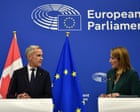
Brussels made a splash, then hit the brakes.
In September 2026, European Commission President Ursula von der Leyen stood before the European Parliament in Strasbourg and floated a bold idea—bringing Canada into the European Union fold as its very first "associate member". Six weeks later, just hours before leaders sat down for the October 29–30 summit in Montreal, the EU quietly scrubbed those exact words from its draft joint statement.
If you only read the headlines, it looks like a humiliating diplomatic retreat. It isn't. What actually happened between Strasbourg and Montreal tells a much messier, more revealing story about European treaty law, German politics, Donald Trump's trade war, and what Ottawa is really getting out of Brussels.
Why the EU Backed Away From the Associate Member Label
The problem was never Canada. European capitals genuinely want closer ties with Ottawa. The problem was that von der Leyen invented a legal category on the fly without asking the 27 member states first.
As EU Ambassador to Canada Geneviève Tuts later admitted to a Canadian Senate committee in November 2026, von der Leyen's September speech caught plenty of European governments completely off guard. There is no such thing as "associate membership" in the EU treaties. Article 49 of the Treaty on European Union governs full accession—and strictly limits membership to European states. Association agreements exist for countries like Chile and Israel, and non-members like Norway and Switzerland navigate the single market through bespoke arrangements, yet none of them carry the title of "associate member".
When drafts of the Montreal summit declaration started circulating in Brussels on October 28, national governments pushed back hard. Early drafts included at least two explicit references to Canada becoming an associate member, alongside a note admitting it would take another year just to figure out what the term meant.
Germany led the revolt. Berlin treated the label as a red line, arguing it had zero legal foundation and hadn't been properly vetted. France, Italy, and Greece quickly joined the chorus of skeptics, echoing earlier questions from the Czech Republic, Luxembourg, and Slovakia.
There was also an awkward political backstory in Berlin. Earlier in 2026, German Chancellor Friedrich Merz had floated a similar "associate" status for Ukraine as a stepping stone toward full EU membership. Kyiv flatly rejected the idea, and EU leaders never debated it properly. Handing Canada a shiny new title that hadn't been defined—while candidate countries in Eastern Europe and the Western Balkans spend years grinding through strict accession chapters—created a diplomatic headache nobody in Berlin or Paris wanted.
European Council President António Costa's team scrambled to broker a compromise before the summit kicked off. By the 6 p.m. Brussels deadline on Wednesday, October 28, "associate member" was gone. In its place, the joint statement promised an "ever closer association of Canada to the EU, short of full membership itself" and gave officials until the next summit in 2027 to define the framework.
Von der Leyen and Carney Refused to Drop the Phrase
Here is the funny part. Even after European diplomats scrubbed the term from the official communiqué, neither von der Leyen nor Canadian Prime Minister Mark Carney stopped using it.
Landing in Montreal on October 29, von der Leyen posted straight to social media: "We have a new ambition: bringing Canada closer to us than ever before, as associate member of the EU." She repeated the exact pitch during her major speech in the city.
Carney played it cooler, though he didn't back down either. Ahead of the summit, he brushed off the semantic squabble in Brussels. "The good news is it doesn't matter about specific names or nomenclature," Carney told reporters. "What matters is the difference that it will make to the lives of Canadians … and Canada as a whole becoming a more independent, more sovereign nation, so we can live our lives as we choose." Yet by the time the summit wrapped on October 30, Carney stood beside European leaders and confirmed that Ottawa and Brussels were still working in parallel toward "Canada becoming the European Union's first Associate Member" by June 2027.
Honestly, both leaders knew what they were doing. The phrase "associate member" wasn't drafted by treaty lawyers—it was designed as a geopolitical signal aimed straight at Washington.
The Elephant in the Room Is Donald Trump
You can't understand why Brussels and Ottawa are suddenly acting like long-lost twins without looking south.
With U.S. President Donald Trump waging aggressive trade wars and straining traditional transatlantic alliances, both Canada and Europe realized their heavy reliance on Washington had become a massive vulnerability. Carney said the quiet part out loud during the summit week. Canada had become "excessively reliant on a single country," he argued, adding that reducing that dependence was Ottawa's responsibility regardless of whether U.S. policy ever shifts back.
Trump certainly noticed. When von der Leyen first floated the associate membership offer in September, Trump dismissed the idea as "laughable" and threatened to halt trade with the EU over it.
That pushback explains why von der Leyen kept repeating the phrase in Montreal even after Germany forced it out of the official text. Walking back the headline completely would have looked like caving to pressure from Washington. Keeping the phrase alive in speeches while softening the legal text gave Brussels the best of both worlds—political defiance on camera, treaty caution on paper.
What Canada and the EU Actually Signed in Montreal
Strip away the diplomatic drama over two words, and the actual deliverables from the Montreal summit are substantial. In fact, focusing purely on the dropped label misses the real shift happening across the Atlantic.
During the two-day gathering, Carney, von der Leyen, and Costa formally launched the Alliance for the Future—a new strategic framework open to other like-minded democracies. More importantly, they concluded substantive negotiations on concrete deals that go way beyond standard free trade.
- Critical minerals financing: Canada and the European Investment Bank wrapped up talks on a dedicated agreement to channel European capital directly into Canadian critical mineral projects. Europe desperately needs lithium, nickel, cobalt, and rare earths for electric vehicles and defense manufacturing without relying on Chinese supply chains, and Canada has them in the ground.
- Digital trade and instant payments: Both sides concluded negotiations on a digital trade agreement to strip away cross-border data barriers and make it easier for Canadian and European companies to sell online. They also committed to linking their instant-payment systems so cross-border transfers move faster and cost less.
- Supercomputing and AI: Canada secured access to Europe's JUPITER supercomputing initiative. Carney noted that JUPITER can crunch calculations in a single day that would take Canada's fastest research computer six months. The two sides are also partnering on AI climate simulations through the Destination Earth program.
- Defense industrial integration: Building on their 2025 Security and Defence Partnership, Canada became the first non-European nation to join SAFE, the EU's €150 billion defense procurement instrument, letting Canadian defense firms tap directly into European military spending.
- Competition enforcement and mobility: Negotiators finalized a competition agreement to crack down on cross-border anti-competitive behavior, alongside plans to expand Erasmus+ educational exchanges and recognize professional credentials across borders by 2027.
Compare this to the Comprehensive Economic and Trade Agreement (CETA), which has been provisionally applied since 2017 yet still hasn't been fully ratified by every EU member state—Cyprus only confirmed its ratification plans to Carney in November 2026. The Alliance for the Future bypasses that slow, clunky ratification trap by locking in targeted sectoral agreements where Brussels already holds executive authority.
What "Associate Membership" Could Mean by June 2027
So if Canada isn't joining the EU—and nobody wants regulatory harmonization forced down Ottawa's throat—what are negotiators actually building between now and June 2027?
Ambassador Geneviève Tuts clarified a critical point in mid-November 2026: regulatory harmonization is not the goal. That matters enormously. Countries inside the European Economic Area, like Norway and Iceland, enjoy nearly full access to the EU single market, but they pay a steep price. They have to adopt vast swathes of EU rules and regulations without getting a vote in Brussels—a setup Europeans jokingly call "fax democracy."
Canada won't accept that, and neither would Canadian industries. Sensitive sectors like Canada's supply-managed dairy industry remain off the table for wholesale European integration, even as both sides look for targeted workarounds.
Instead, the model taking shape looks like modular, sector-by-sector integration. Think of it as an umbrella sitting on top of CETA, Horizon Europe (which already lets Canadian researchers compete for EU science grants on equal footing), SAFE defense procurement, and the new digital and critical minerals pacts. Rather than forcing Canada to adopt European product standards across the board, Brussels and Ottawa are building mutual recognition agreements—where each side trusts the other's regulatory standards in specific industries.
Canadian cabinet ministers and European commissioners are scheduled to meet in March 2027 to hammer out the exact legal architecture before Carney travels to Brussels for the European Council meetings in June 2027.
How to Track What Actually Matters Next
If you're following EU-Canada relations—whether for business, trade policy, or investment—don't get distracted by whether the words "associate member" reappear in a press release next summer. Watch three concrete indicators instead:
- The March 2027 ministerial readout: Look for binding timelines on linking instant-payment networks and implementing the digital trade rules. That's where small and mid-sized businesses will see immediate cost savings.
- European Investment Bank project approvals: Check which Canadian critical mineral mines and processing facilities receive the first wave of EIB-backed financing. Capital deployment proves the deal has teeth.
- Remaining CETA ratifications: Keep an eye on whether holdout EU parliaments finally ratify CETA alongside Cyprus in 2027, which would unlock the treaty's full investment court provisions.
Brussels dropped a catchy political label because German lawyers didn't like the paperwork. Meanwhile, Canada and the European Union quietly built the deepest transatlantic economic and defense partnership outside of NATO.
Watch how CBC News covered the EU dropping the associate membership title before the Montreal summit for a quick visual recap of how European resistance unfolded ahead of the leaders' meeting.