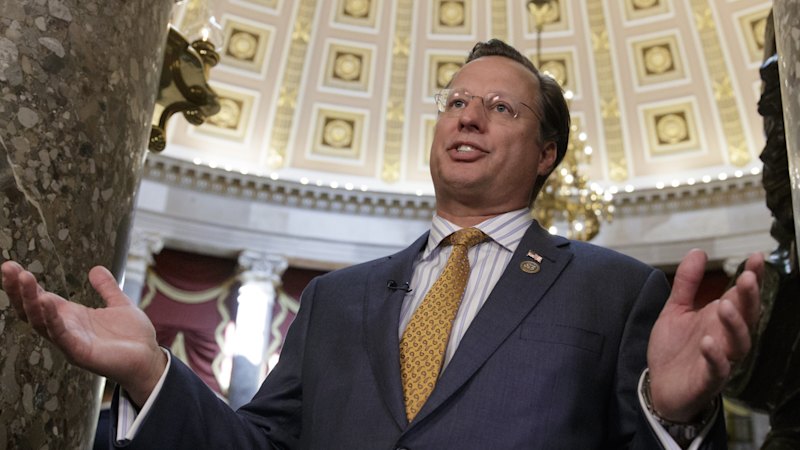
The vacancy sign hanging over the American embassy in Canberra for the last 15 months was not a clerical oversight. It was a message. Now that the White House has finally named David Brat as the nominee for United States Ambassador to Australia, the message has shifted from neglect to something far more transactional.
While critics label the former Virginia congressman a "bargain-bin" pick due to his lack of traditional diplomatic seasoning, that assessment misses the sharper reality of the second Trump term. Brat is not a consolation prize. He is a hand-picked enforcement officer for a presidency that views the Australian alliance through the cold lens of a balance sheet rather than the warm glow of historical sentiment. For a different perspective, see: this related article.
The Architect of the New Trade War
David Brat is best known in American political lore for his 2014 upset victory over Eric Cantor, a defeat that signaled the death of the old-guard Republican establishment. He arrived in Washington not as a builder of bridges, but as a demolition expert. For Australia, his appointment signals that the era of "mateship" is being replaced by a rigorous audit.
Brat is an economist by training, but his brand of economics is far from the neoliberal orthodoxy Canberra has relied on for decades. He is a vocal proponent of the White House tariff regime, arguing that punitive import taxes are necessary to reclaim American capital. This puts him on a direct collision course with the Australian government, which has long viewed free trade as the bedrock of its prosperity. Related reporting on this matter has been provided by Reuters.
By sending a tariff hawk to Canberra, the administration is making it clear that Australia will no longer receive automatic exemptions from the trade barriers being erected around the American market. The "special relationship" is being renegotiated in real-time, and Brat is the man sent to collect the bill.
Faith, Finance, and Foreign Policy
The choice of Brat also introduces a peculiar ideological tension into the relationship. A graduate of Princeton Theological Seminary, Brat has spent much of his academic career arguing that capitalism cannot function without a specific Christian ethic. This blending of scripture and spreadsheet is a hallmark of the new Republican movement, but it sits awkwardly with the secular, pragmatic bureaucracy of the Australian Department of Foreign Affairs and Trade.
More concerning for regional stability are Brat's previous statements on global conflicts. In 2022, he suggested that Ukraine should surrender territory to Russia to end the war—a position that stands in stark contrast to Australia’s firm support for Kyiv. If the American ambassador is signaling a retreat from traditional security guarantees, it leaves Canberra in a precarious position as it tries to balance its primary security ally with its primary trading partner, China.
The Iranian Fault Line
The timing of this appointment is critical. Tensions between the White House and the Albanese government have reached a boiling point over the war in Iran. The President has repeatedly criticized Australia for its perceived failure to assist in reopening the Strait of Hormuz, an essential artery for global fuel supplies.
In this context, the ambassadorial role is less about hosting garden parties and more about securing military and logistical commitments. Brat is not coming to Canberra to listen; he is coming to demand. The vacancy was a vacuum; the appointment is a pressure cooker.
Extortion and the Digital Economy
The diplomatic friction extends beyond the battlefield and into the server room. The administration recently labeled Australia’s media bargaining laws—which force tech giants like Google and Meta to pay for news content—as "foreign extortion."
Brat will likely serve as the frontline defender of American Big Tech. While the Australian government frames these laws as a way to protect public interest journalism, the Trump administration sees them as a targeted tax on American innovation. Having an ambassador who views local regulation as criminal behavior does not suggest a smooth path forward for bilateral cooperation on technology or critical minerals.
The End of Diplomatic Immunity
For years, Australia enjoyed a level of diplomatic immunity in Washington. Whether it was the Morrison-Trump "pals" routine or the high-profile tenure of Caroline Kennedy, Canberra was used to being the "good student" in the alliance. Those days are over.
The nomination of David Brat confirms that the administration views Australia as a mid-sized economy that needs to be brought to heel on trade, tech, and defense spending. He is a veteran of the Tea Party wars, comfortable with conflict and indifferent to the sensibilities of the diplomatic cocktail circuit.
Australia must now decide if it will adjust its own stance to meet this more aggressive American posture or risk a permanent fracturing of the alliance. The "bargain-bin" label is a distraction. The real story is that the U.S. has stopped sending diplomats to Australia and started sending debt collectors.