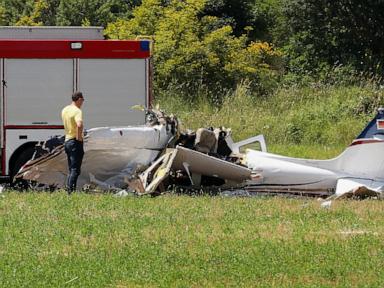
A German-registered Beechcraft G36 Bonanza, carrying four people on a tourist flight from Austria, plunged into a field near the Adriatic resort town of Medulin, Croatia, instantly killing everyone on board. Local eyewitnesses described a terrifying sequence where the high-performance, six-seat private aircraft entered a death spiral before striking the ground near the Medulin sports airfield. While wire services rushed out brief, formulaic updates on the body count and the smoke clearing from the Istrian peninsula, they missed the macro trend entirely. This tragedy is not an isolated piece of bad luck. It is part of a systemic surge in private aviation accidents across Southern Europe, driven by a volatile mix of unpredictable microclimates, aging cross-border infrastructure, and the dangerous illusion that flying a complex light aircraft over the Mediterranean is a simple weekend hobby.
The wire reports did what they always do. They gave you the time (11:20 a.m.), the location (the Campanoz area), and the first responders involved. What they failed to give you is the operational context that explains why a seasoned airframe like a Beechcraft Bonanza—often called the Cadillac of single-engine aircraft—ends up falling out of the sky on a routine summer morning.
The Myth of the Easy Mediterranean Summer Flight
General aviation in Europe operates under a patchwork of regulatory jurisdictions and varying levels of regional airfield support. Many private pilots from northern nations like Germany and Austria look at the Adriatic coast as the ultimate weekend getaway. The flight seems straightforward on a map.
It rarely is.
The Istrian peninsula is notorious among seasoned commercial aviators for generating rapid, violent changes in localized weather. Thermal currents rising from the warm Adriatic sea collide with cooler air masses rolling off the Dinaric Alps, creating sudden downdrafts, microbursts, and severe low-level turbulence. When a pilot transitions from the structured, highly controlled airspace of central Europe to the more relaxed, visual flight rules (VFR) environment of regional Mediterranean airfields, the margin for error shrinks drastically.
Eyewitness accounts from the Medulin crash specifically noted that the aircraft "spiraled" into the ground. In aviation terms, a spiral dive or an aerodynamic stall-spin at low altitude is almost always a sign of spatial disorientation or a desperate, uncoordinated maneuver to correct for a sudden loss of airspeed. When a pilot gets caught in a sudden thermal shift while preparing to land at a visual-only sports airfield, the workload inside the cockpit spikes instantly. If they haven't trained for the specific microclimates of the northern Adriatic, the results are routinely fatal.
The Deadly Trap of High Performance and Low Flight Hours
The Beechcraft G36 is not a trainer plane. It is a fast, heavy, high-performance machine equipped with complex avionics, a constant-speed propeller, and retractable landing gear. It requires constant proficiency to fly safely.
Herein lies the core vulnerability of the private aviation boom in Europe.
- The Wealth Gap in Safety: The individuals who can afford to purchase, maintain, and fuel a German-registered aircraft capable of cross-border European touring are often busy professionals. They have the money for the asset, but they rarely have the time to maintain true flight proficiency.
- The Currency Illusion: Holding a valid private pilot license (PPL) is not the same as being "current" or proficient. A pilot who flies 20 to 30 hours a year mostly in calm weather over Bavaria is fundamentally unequipped to handle a sudden emergency over the rugged terrain of Croatia.
- Instrument vs. Visual Training: Many tourist flights are conducted under VFR. If a pilot encounters unexpected coastal haze, cloud layers, or a sudden line of convective storms, they can lose the horizon in seconds. Without an active instrument rating and rigorous currency training, a pilot trying to manually stabilize a spiraling aircraft will suffer from sensory illusion, making the wrong inputs and driving the plane further into the ground.
To make matters worse, regional sports airfields across Southern Europe often lack the sophisticated radar, automated weather reporting systems (AWOS), and dedicated air traffic control infrastructure found at larger hubs. Pilots landing at places like Medulin are frequently required to rely entirely on their eyes and local radio advisories from airfield operators who may or may not be monitoring the frequency continuously. You are effectively flying back in time technologically the moment you leave major European radar coverage.
Infrastructure Strain and the Cross-Border Investigative Nightmare
When a commercial airliner goes down, a massive, well-funded apparatus swings into action. When a small private plane crashes in a rural or coastal area of a foreign country, the process degrades into a logistical and bureaucratic quagmire.
The investigation into the Medulin crash involves a German-registered aircraft, an flight origin in Austria, and a crash site in Croatia. This means three separate national aviation authorities—the German Luftfahrt-Bundesamt (LBA), the Austrian Federal Ministry for Climate Action, Environment, Energy, Mobility, Innovation and Technology (BMK), and the Croatian Air Accident Investigation Agency (AIN)—must coordinate across language barriers and differing legal frameworks.
This fragmentation delays crucial safety lessons. Preliminary reports can take months, and definitive final reports often take years to emerge. By the time the aviation community learns exactly what triggered the mechanical or human failure in Istria, the industry has moved on, and more under-prepared pilots have made the same fatal journey down the coast.
The hard truth is that Europe’s general aviation infrastructure is split into a two-tier system. The upper tier consists of commercial routes managed by Eurocontrol, backed by billions of euros in technological upgrades. The lower tier is a Wild West of private pilots, flying increasingly complex machinery into aging, under-equipped regional strips with little more than a smartphone app for navigation and a prayer for good weather. Until European regulatory bodies mandate stricter currency requirements for high-performance aircraft operations across borders, and until regional airfields are upgraded with standardized weather telemetry, the fields of the Mediterranean will continue to collect wreckage.
The four individuals who lost their lives in Medulin were looking for a weekend escape. Instead, they became the latest data point in a quiet, deadly crisis that the aviation industry prefers to treat as a series of unfortunate accidents rather than what it actually is: a systemic failure of training, infrastructure, and pilot culture.