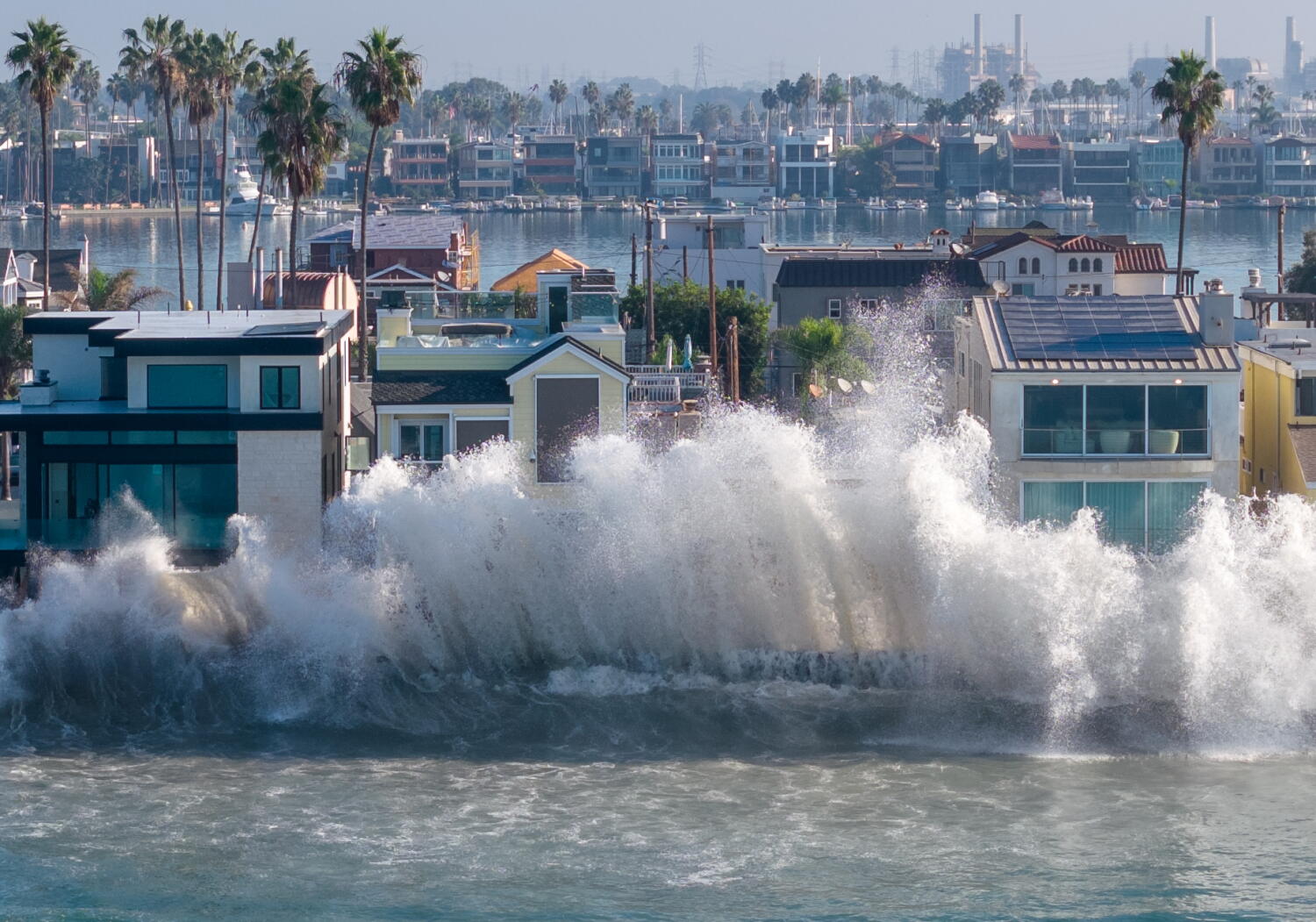
California’s coastline is losing a war of attrition, and traditional government buyouts have largely failed to stop the bleeding. To break the stalemate between retreating coastlines and stubborn property values, coastal economists and urban planners are turning to buy-and-leaseback programs, a novel financial mechanism where the state purchases vulnerable beachfront homes at fair market value and rents them back to the owners until the ocean physically claims the structure.
This approach solves the immediate political and financial gridlock of managed retreat. Instead of forcing residents out today or waiting for a catastrophic El Niño storm to wipe out municipal tax bases overnight, the state acquires the underlying land rights now and offsets the acquisition cost using decades of steady rental income.
The Math of a Disappearing Coastline
For decades, the standard playbook for coastal erosion was simple. Build a wall, dump sand on the beach, and hope the next winter storm season spares the foundation.
That strategy is bankrupt. When powerful El Niño cycles collide with baseline sea-level rise, the resulting storm surges do not just nibble at the bluffs; they carve away entire streets in a single weekend. From the crumbling cliffs of Pacifica to the low-lying luxury enclaves of Malibu and Del Mar, the Pacific Ocean is aggressively reclaiming real estate that lenders, insurers, and local governments priced as permanent.
Traditional voluntary buyouts—long the gold standard for inland floodplains along the Mississippi River—hit a brick wall on the California coast. The numbers simply do not work. In the Midwest, the Federal Emergency Management Agency (FEMA) might spend $250,000 to acquire a repeatedly flooded suburban home, demolish it, and turn the lot into a public park. Along the California coast, a modest, single-family bungalow perched on an eroding bluff routinely commands $3 million to $5 million. Luxury properties easily clear $15 million.
No municipal budget can absorb those acquisition costs at scale. Even with state and federal grants, buying out a single neighborhood requires hundreds of millions of dollars.
Worse, local governments face a perverse financial incentive to do nothing. California cities rely heavily on property taxes to fund schools, fire departments, and basic infrastructure. When the state buys a private coastal home and converts it into open space, that parcel vanishes from the tax rolls forever. Mayors and city council members, staring down immediate budget deficits, quietly resist managed retreat because they cannot afford to lose the tax revenue today to prevent a disaster twenty years from now.
Homeowners face their own paralysis. Even when residents recognize that their backyard is shrinking by two feet every winter, selling on the open market becomes nearly impossible once hazard disclosures pile up and private insurers pull out of the zip code. Yet taking a traditional government buyout means walking away from a prized lifestyle immediately, often at a steep discount compared to what the home was worth before the cliff started cracking.
How the Buy-and-Leaseback Mechanism Works
The buy-and-leaseback model flips the timeline of managed retreat. Instead of treating property acquisition as an immediate eviction notice, it treats coastal real estate as a depreciating asset with a predictable expiration date.
Consider a hypothetical example to see how the ledger balances. Imagine a coastal municipality or state conservancy identifies a stretch of fifty oceanfront homes projected to become uninhabitable within thirty years due to chronic erosion and king tides. Each home has a current appraised value of $3 million, putting the total acquisition cost at $150 million.
Under a traditional buyout, the agency must raise $150 million upfront, buy the homes, pay millions more to demolish them, and immediately forfeit the annual property tax revenue. The political resistance is instant and overwhelming.
Under a buy-and-leaseback structure, the agency issues municipal revenue bonds to purchase the properties at their current market value. The former owners get their equity out immediately, freeing them from the anxiety of catastrophic loss and soaring, uninsurable risk. Then, those same owners—or new tenants—sign a long-term lease to remain in the home.
If those fifty homes rent for $10,000 a month—a realistic figure for prime California coastal property—the program generates $6 million a year in gross rental income. Over twenty-five years, before the ocean reaches the foundation, that rental stream brings in $150 million. The revenue pays down the debt service on the bonds, covers ongoing maintenance, and funds a dedicated reserve for the eventual demolition and ecological restoration of the site.
The lease agreements are drafted with strict, non-negotiable trigger clauses. Unlike a standard residential lease, occupancy is tied directly to physical safety and infrastructure viability. The contract explicitly states that the lease terminates automatically when specific environmental thresholds are crossed:
- Bluff setbacks: When the eroding cliff edge comes within a predetermined number of feet of the primary foundation.
- Utility failure: When municipal water, sewer, or electrical lines can no longer be safely maintained without massive public expenditure.
- Red-tagging: When local building officials declare the structure unsafe for human habitation following a major storm event.
Once a trigger is pulled, the tenant vacates, the agency uses the accumulated rental reserves to tear down the structure before it collapses into the surf zone, and the land reverts to a natural public beach or coastal wetland.
Why Insurers and Lenders Are Quietly Cheering
To understand why this financial engineering is gaining traction in Sacramento and coastal city halls, you have to look beyond environmentalism and follow the institutional money. The private market is already staging an unorganized, chaotic retreat from the California coast.
Major property and casualty insurers have spent the last several years aggressively shedding coastal policies, pushing homeowners onto the California FAIR Plan—the state's insurer of last resort—which offers bare-bones coverage at eye-watering premiums. Without affordable private insurance, conventional thirty-year mortgages become impossible to underwrite.
When buyers cannot get mortgages, the coastal real estate market fractures. Cash-rich investors swoop in to buy distressed blufftop properties at a discount, hoping to extract maximum short-term vacation rental income before the house falls into the sea. When a massive El Niño winter finally strikes, those corporate owners walk away from the wreckage, leaving taxpayers to foot the bill for hazardous debris removal and emergency seawall repairs.
A structured buy-and-leaseback program prevents this speculative decay. By stepping in while the properties still hold significant economic value, the state stabilizes the market, protects homeowners from total equity wipeouts, and ensures that properties are maintained responsibly until their end-of-life triggers are met.
Mortgage lenders, who sit on billions of dollars in coastal debt across California, view the model as an orderly exit ramp. Rather than watching their collateral wash into the Pacific and dealing with mass defaults, banks get their loans paid off cleanly at the time of the state's acquisition.
The Legal Minefield of Coastal Armoring
Any serious discussion of California’s shoreline eventually collides with the California Coastal Act of 1976 and the fierce battles over seawalls.
For decades, wealthy coastal enclaves have relied on concrete seawalls, rock revetments, and riprap to hold back the ocean. While these structures temporarily protect the private homes sitting directly behind them, coastal geologists have proven beyond doubt that they destroy public beaches. When waves slam into a vertical concrete wall instead of dissipating gently up a sandy slope, the reflected energy scours away the sand in front of the wall. Over time, the beach vanishes entirely, leaving deep water lapping against concrete at high tide.
Under the California Coastal Act, the California Coastal Commission is mandated to protect public beach access and natural shoreline processes. The law generally prohibits new seawalls for developments built after 1976, yet homeowners routinely exploit emergency permit loopholes during severe El Niño storms to dump tons of boulders onto public beaches—structures that almost always become permanent.
Buy-and-leaseback agreements cut straight through this regulatory warfare. As a condition of the purchase, the state permanently extinguishes the property’s right to future shoreline armoring. Because the public entity now owns the underlying fee title to the land, there is no private owner left to sue the Coastal Commission for a "regulatory taking" when a seawall permit is denied.
When the waves eventually reach the property, there are no emergency boulders dumped on the sand and no decade-long courtroom battles over constitutional property rights. The building is simply removed, allowing the beach to migrate inland naturally as it has done for millennia.
The Hard Truths Nobody Wants to Admit
For all its elegance on a spreadsheet, the buy-and-leaseback model is not a silver bullet. Treating it as a painless cure-all ignores several brutal economic and political realities that could still derail the concept before it scales.
First, there is the equity problem. Taxpayers across California—many living in inland working-class communities struggling with extreme heat and their own infrastructure deficits—will inevitably balk at the optics of the state spending billions of dollars to bail out wealthy beachfront homeowners, only to let those same people continue living in oceanfront mansions as tenants. Even if the program is theoretically self-funding through bond repayments, the upfront capital allocation requires massive political capital. Critics argue that public funds should prioritize low-income coastal communities vulnerable to flooding, such as parts of Imperial Beach or Pajaro, rather than rescuing multi-million-dollar estates in Laguna Beach or Montecito.
Second, actuarial math is unforgiving. The financial viability of a leaseback program depends entirely on accurately predicting how fast the coast will erode. If a coastal agency buys a home assuming it has twenty-five years of rentable life left, and a back-to-back series of atmospheric rivers and El Niño surges destroys the bluff in four years, the rental revenue collapses. The state is then left holding an unpayable bond debt and an immediate demolition bill, turning a clever financial hedge into a massive taxpayer bailout.
Third, human psychology resists trigger clauses. Signing a contract that says you must leave your home when the cliff erodes to within fifteen feet of your back porch is easy when the ocean is fifty feet away. It is entirely different when that day actually arrives. History shows that coastal residents routinely organize, lobby local politicians, and file eleventh-hour injunctions to delay eviction orders, even when their homes are visibly tilting toward the surf. Enforcing trigger clauses requires a level of bureaucratic spine that local governments rarely display when facing angry voters.
Finally, rental market dynamics fluctuate. High-end coastal rentals command top dollar when the beach is wide and sunny. Once the shoreline narrows, roads begin flooding regularly during king tides, and neighboring homes are torn down, the desirability of the remaining properties plummets. Agencies cannot assume they will collect peak market rents right up until the final year of a property's life; rental income will inevitably decay alongside the coastline.
A Blueprint Beyond the Golden State
Despite these vulnerabilities, the mechanics of buy-and-leaseback represent the first realistic bridge between the hard physics of climate change and the stubborn realities of real estate finance.
Coastal communities from the Outer Banks of North Carolina to the barrier islands of New Jersey and the low-lying neighborhoods of Miami-Dade County are watching California’s experiment closely. Every coastal state faces the same fundamental trap: waiting until a disaster strikes makes buyouts politically acceptable but financially ruinous, while acting early makes sense financially but remains politically impossible.
By separating the immediate transfer of land ownership from the eventual end of human occupancy, buy-and-leaseback programs offer a way out of that trap. They acknowledge that coastal real estate is no longer a permanent store of wealth, converting it instead into a finite, managed utility.
The ocean is going to take the coastline back regardless of what zoning boards, mortgage lenders, or homeowners decide. The only real choice left is whether California pays for that retreat through chaotic emergency bailouts and ruined public beaches, or through a cold-eyed financial mechanism that forces the land to pay for its own demise.



