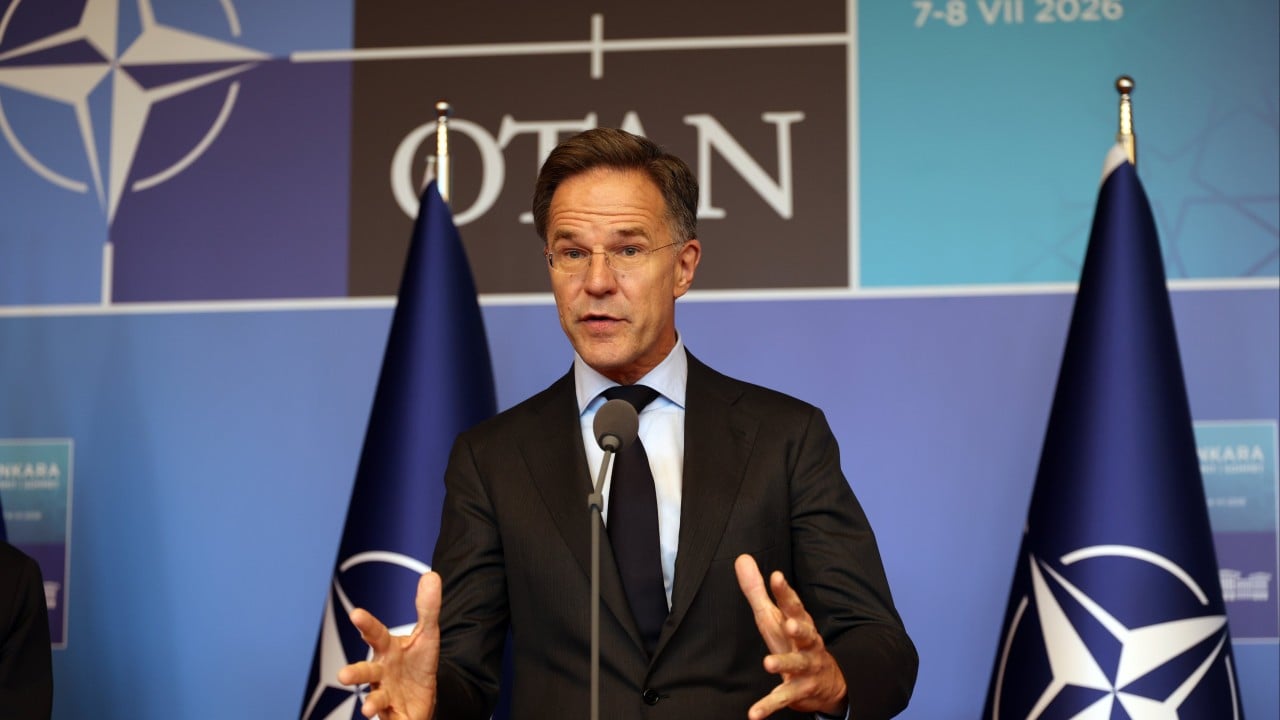
The renewed friction between Washington and Brussels over the Arctic is not a sudden fit of presidential pique. It is the logical culmination of a decades-long American misreading of European defense priorities and a fundamental misunderstanding of what Greenland actually represents in modern geopolitics. When Donald Trump landed at the alliance summit in Ankara and immediately revived his demands for the resource-rich territory—tying the issue directly to a threat to yank all American forces from European soil—headlined reports focused heavily on the shock value. They missed the deeper mechanics at play. The reality is that the White House is attempting to use a twentieth-century leverage model against a European continent that has spent the last two years systematically insulating itself from American fiscal and military volatility.
This is a geopolitical standoff disguised as a real estate negotiation. By telling Turkish President Recep Tayyip Erdogan that his very attendance at the summit depended on personal chemistry rather than institutional alignment, the administration signaled that old treaty frameworks are secondary to transactional wins. But threatening to withdraw the roughly 100,000 American military personnel stationed across Europe unless Denmark yields on Greenland ignores a critical transformation. Europe is no longer entirely dependent on the American security umbrella, and the Arctic is no longer a forgotten sheet of ice.
The Fiction of the Empty Arctic
For generations, Washington viewed the far north as a frozen buffer zone, an empty expanse where the only true security concern was tracking Soviet ballistic missiles over the pole. That era is dead. Today, the melting ice has revealed a treasure trove of critical minerals, rare earth elements, and untapped shipping lanes that both Beijing and Moscow are actively eyeing.
When the administration appointed a special envoy to Greenland and insisted the U.S. must control the territory to prevent a Russo-Chinese takeover, it operated on the assumption that Denmark was asleep at the wheel. It was a massive miscalculation. Copenhagen responded not with diplomatic hand-wringing, but with hard cash and steel.
The Danish government poured 14.6 billion kroner into its Arctic defense budget, followed quickly by an additional 27.4 billion kroner. They did not do this to appease Washington; they did it to protect their own sovereign economic future. When European powers launched Operation Arctic Endurance, deploying elite combat troops, naval frigates, and fighter jets to Greenland, they sent a message that went largely unread in Washington. Europe is willing to militarize the north on its own terms.
The administration’s claim that Denmark cannot secure the region without a total transfer of ownership is systematically refuted by reality on the ground. European capitals have already begun laying the groundwork for a permanent mission dubbed Arctic Sentry. This mechanism, modeled on the successful policing operations in the Baltic states, cements European, rather than purely American, command over northern Atlantic chokepoints.
The Failure of Transactional Leverage
The threat to pull out American troops from bases like Ramstein and Aviano is designed to terrify European voters and force heads of state to the bargaining table. It is an old playbook, but the pages are wearing thin. The assumption that Europe will trade away a massive, resource-rich landmass to retain American garrison troops ignores a profound shift in continental defense spending.
At the Hague summit, European allies committed to an unprecedented target of spending 5% of their GDP on defense. While the White House treats this as a business ledger where allies must prove they have signed big procurement contracts, the broader effect is that Europe is rapidly building a self-sustaining military industrial base.
Consider the logistical reality of a sudden U.S. troop withdrawal.
- Infrastructure Ownership: The massive airbases, radar installations, and hospitals scattered across Germany and Italy do not belong to the Pentagon; they are host-nation properties operated under strict bilateral agreements.
- The Logistical Nightmare of Retreat: Moving tens of thousands of personnel, heavy armor, and sensitive intelligence hardware back to the continental United States would cost billions of dollars and take years to execute, all while stripping the U.S. of its primary forward-operating platforms for the Middle East and Africa.
- Loss of American Influence: A full withdrawal would permanently break the institutional memory of NATO, effectively ending Washington's veto power over European security architecture.
If the U.S. abandons its European bases, it does not just leave Europe exposed; it blindfolds itself. The intelligence-sharing networks, forward-deployed logistics chains, and early-warning radar systems based in Europe are the literal foundation of American global power projection. Giving them up to pursue an unattainable island purchase is a classic example of trading long-term strategic positioning for a short-term rhetorical victory.
What the Tech Coalition Really Wants
Behind the public warnings about Russian submarines and Chinese investments lies a separate, much quieter driver of this crisis. A influential circle of Silicon Valley venture capitalists and energy entrepreneurs has been quietly lobbying the administration to secure Greenland for a entirely non-military purpose.
They do not want another standard military outpost. They want a legal tabula rasa.
Documents and proposals circulated within tech-policy circles outline a vision of Greenland transformed into a network of corporate-governed special economic zones. These are framed around libertarian ideals of minimal regulation, designed to host massive data centers cooled by the Arctic air, space launch facilities free from mainland environmental constraints, and experimental micronuclear energy projects.
This explains why simple offers of increased U.S. military access—which Copenhagen and Nuuk have repeatedly extended under the framework of the 1951 bilateral security treaty—are continuously rejected by the White House. Increased troop presence does not grant regulatory control. It does not hand over seabed mining rights for cobalt and neodymium. It does not allow for the creation of corporate charter cities. The administration is holding out for absolute ownership because its domestic backers want the right to rewrite the rules of the territory from scratch.
The Sovereign Base Fallacy
The administration’s strategy ignores a clear historical lesson in how modern states handle strategic choke points. Decades ago, during the collapse of the British Empire, London faced an identical dilemma regarding its military access to the eastern Mediterranean via Cyprus. The British government desperately wanted to retain complete colonial sovereignty over the island to guarantee its military footprint.
The breakthrough came when policymakers realized they did not need to own the entire population or the territory to secure their military requirements. The resulting 1960 settlement created independent Cyprus but carved out Sovereign Base Areas—Akrotiri and Dhekelia—which remain under British military jurisdiction to this day. These bases successfully supported operations in the Middle East for over sixty years without requiring Britain to manage the local economy or police a hostile populace.
The United States already has its own version of this model in Greenland via Pituffik Space Base. The 1951 treaty provides the Pentagon with virtually unhindered operational freedom to run early-warning radars and space tracking systems. Demanding a total transfer of the island’s sovereignty when a perfectly functional, legally protected basing model already exists is a profound diplomatic error. It forces an otherwise cooperative ally into a defensive corner.
The Price of Institutional Fracture
The true danger of reviving this dispute at the Ankara summit is not that Denmark will suddenly capitulate and hand over Nuuk to the highest bidder. The danger is that the constant weaponization of alliance commitments is forcing Europe to build a parallel security structure that excludes Washington entirely.
When the administration implemented a 10% tariff on Denmark, the UK, and other European nations earlier this year, the goal was to use economic pain to fracture European solidarity. The plan backfired. The European Union stabilized its internal markets, suspended major transatlantic trade talks, and actively discussed counter-sanctions against American goods. The stock market volatility that followed forced a temporary rhetorical retreat at Davos, but the underlying intent never changed.
By tying the preservation of NATO to a territorial land grab, the White House is teaching its closest allies that American security guarantees are highly volatile commodities. European defense ministries are already adapting. They are buying European-made hardware, expanding joint command structures, and treating the U.S. as a highly capable but fundamentally unreliable partner.
The strategic deadlock will not be broken by theatrical walkouts or strongly worded communiqués in Ankara. If the United States truly wishes to secure the Arctic against its near-peer adversaries, it must abandon the fantasy of nineteenth-century map-painting. It must reinforce its existing treaty rights at Pituffik, support the European-led militarization of the far north, and recognize that a secure, independent Greenland backed by a unified Europe is infinitely more valuable to American national defense than an isolated, annexed island managed by a fractured alliance.