Silence.
That is the first thing you notice when you step off the ferry onto Lantau Island, leaving the relentless, neon-soaked thrum of Hong Kong’s financial district behind you, only to walk directly into a sound that makes no geographic sense at all. It is the sharp, unmistakable crack of seasoned ash wood striking stitched leather. It is the dull, heavy thud of boots digging into damp, subtropical turf. It is a chorus of accents from Cork, Donegal, and Dublin mixing seamlessly with Cantonese, Malay, and Japanese, echoing off the lush green hills of Tai O and Discovery Bay while glass towers gleam across the water. For a different perspective, check out: this related article.
For two days every autumn, the Asian Gaelic Games transforms a corner of Hong Kong into an unlikely parish.
Most outsiders view international amateur tournaments through the lens of simple tourism or casual expat nostalgia. They see a weekend of sunburn, cheap beer, and nostalgic singalongs in a foreign bar. That reading misses the point entirely. When hundreds of players descend on Hong Kong from Seoul, Singapore, Tokyo, Jakarta, Kuala Lumpur, and Shanghai, they are not merely playing a sport. They are performing an act of cultural survival in cities designed to grind individual identity into corporate dust. Similar analysis on the subject has been provided by NBC Sports.
The Architecture of Loneliness
To understand why a thirty-two-year-old software engineer from Galway would spend two thousand dollars and sixteen hours in transit to play six twenty-minute matches of Gaelic football in thirty-degree humidity, you first have to understand the quiet ache of the modern Asian metropolis.
Consider a hypothetical character—let us call him Liam, though his story belongs to dozens of men and women taping their ankles on the sidelines at King's Park. Liam moved to Tokyo three years ago for a promotion. By every metric on a LinkedIn profile, he is thriving. His apartment overlooks a pristine rail line. His salary affords him Michelin-starred ramen on a Tuesday. Yet, by month eight, the sheer efficiency of his new life had begun to feel like a glass box. In cities where millions of people commute in synchronized, polite silence, you can go weeks without anyone knowing your middle name, let alone the specific geography of the parish you left behind.
Expat life sells you freedom, then quietly hands you the bill in isolation.
That isolation is the invisible stake behind the Asian Gaelic Games. Founded in 1996, the Asian County Board—the governing body overseeing Gaelic games across the region—started with a handful of clubs scraping together enough bodies to field a team. Today, it encompasses more than twenty-five clubs stretching from the Arabian Gulf to the Sea of Japan. When these clubs converge on Hong Kong for the flagship two-day championship, the tournament serves as an annual pressure valve for an entire diaspora.
You see it in the way people greet each other at the pitch gates on Saturday morning. There are no polite handshakes. There are rib-cracking embraces, immediate mock insults, and the instant resumption of conversations paused twelve months prior in a different time zone.
What Actually Happens on the Pitch
If you have never watched Gaelic football or hurling, the first ten minutes can look like controlled chaos—a sport invented by people who looked at rugby, soccer, and field hockey and decided none of them required quite enough cardiovascular suffering.
Let us strip away the mystery. Imagine a hybrid of soccer and basketball played on a pitch roughly forty percent larger than a standard soccer field, with H-shaped goalposts at either end. In Gaelic football, players carry a round leather ball, bouncing it or soloing it—dropping it onto the foot and kicking it back into the hands—every four steps. You can punch the ball to a teammate or kick it across the field. Put it over the crossbar, and you earn one point; drive it under the crossbar past a diving goalkeeper, and you earn a goal, worth three points.
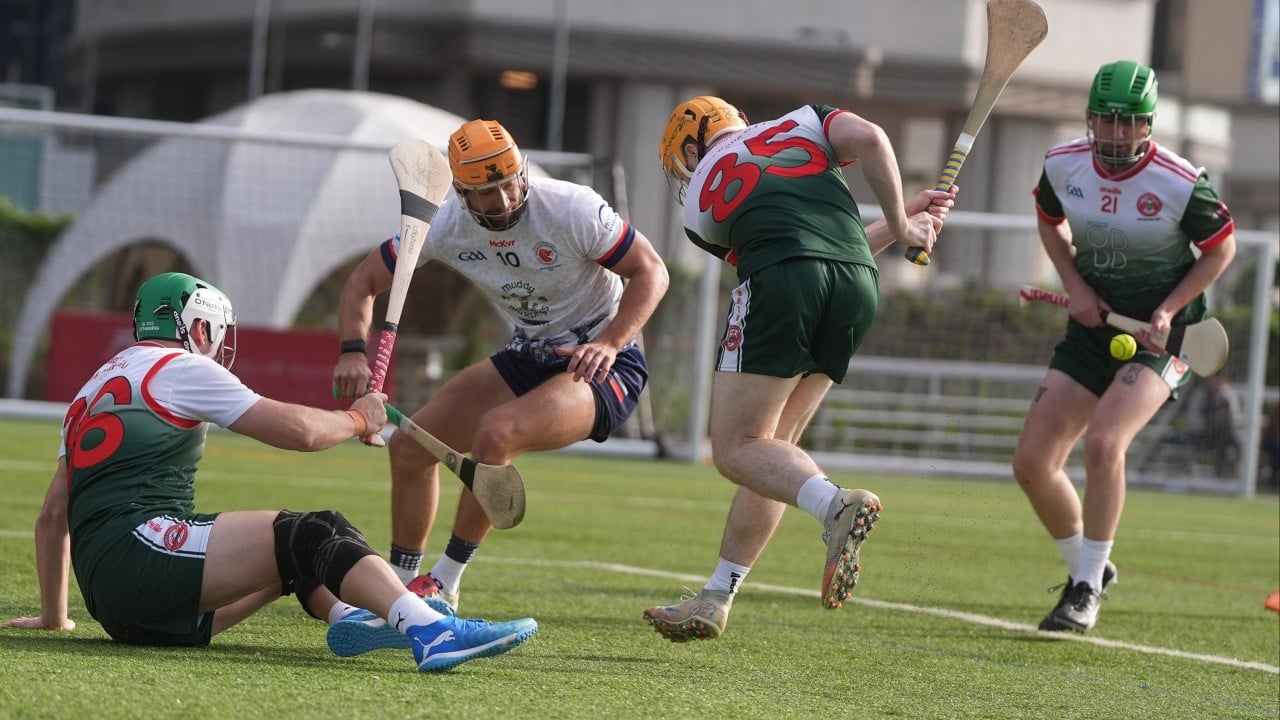
Then there is hurling, the ancient stick-and-ball cousin that regularly leaves uninitiated spectators wide-eyed. Think of lacrosse played at highway speeds without helmets covering the face, using a flat-bladed ash stick called a hurley and a hard, cork-centered leather ball called a sliotar that travels faster than a major league fastball. Alongside hurling runs camogie, the women’s equivalent, played with the exact same ferocity and zero concessions to fragility.
The physical toll in Hong Kong’s climate is brutal.
By noon on Saturday, the subtropical sun turns the artificial and natural pitches into convection ovens. Humidity hovers near eighty-five percent. Sweat does not evaporate; it simply coats the skin like warm oil, making a leather football feel like a bar of wet soap. I have stood on those sidelines in previous tournaments, watching grown men—accountants, teachers, logistics managers—collapse onto the grass after a fifteen-minute half, lungs burning as if they had inhaled steam, their jerseys soaked black with sweat.
Yet nobody asks to come off.
Why? Because on that patch of green, the hierarchy of the corporate world evaporates. The managing director of a Hong Kong investment bank takes a shoulder charge from a twenty-four-year-old English teacher from Busan, gets up spitting turf, and nods in respect. The titles on their business cards mean nothing when the ball is thrown in. What matters is whether you track back when your lungs are screaming, whether you take the hit to release a hand-pass, and whether you show up for the person beside you.
Beyond the Green Jersey
A curious thing happens when a cultural tradition travels six thousand miles from its birthplace: it stops belonging exclusively to the people who inherited it by blood.
Walk through the team tents at the Hong Kong tournament, and the stereotype of the homogenous Irish expat club falls apart within seconds. In clubs like the Tokyo Gaels, the Seoul Gaels, or the local Hong Kong GAA, up to forty percent of the roster in any given year consists of non-Irish players. There are local Hong Kongers who wandered past a training session in Happy Valley out of curiosity and stayed for the camaraderie. There are Americans, Australians, Frenchmen, and Malaysians who had never heard of Croke Park until a coworker dragged them to a Tuesday night drill.
To explain how this happens, think of a neighborhood pub that refuses to put a lock on its front door. Most cultural institutions abroad act like museums: they put velvet ropes around their traditions, preserving them behind glass so nothing gets scratched. The Gaelic Athletic Association in Asia operates like a kitchen table. You do not need a passport to pull up a chair; you just have to be willing to wash a few dishes when dinner is over.
Mei-Ling, a hypothetical composite of the dozens of local Hong Kong athletes who now anchor the women’s football and camogie divisions, illustrates this shift perfectly. Raised in Kowloon, she spent her twenties playing competitive basketball before a colleague invited her to try Gaelic football. At first, the rules baffled her—why could she not just run with the ball without tapping it to her toe? Within six months, the intuitive spatial awareness she had honed on concrete basketball courts made her the most dangerous corner-forward in the league. By the time the Asian Gaelic Games rolled around in Hong Kong, she was not a guest learning someone else’s pastime. She was the player opponents double-marked in the final ten minutes of a knockout match.
This cultural cross-pollination is the quiet engine keeping the tournament alive. As expat demographics shift and traditional corporate relocation packages shrink across Asia, clubs survive because they have become genuinely local communities anchored by an Irish framework.
The Invisible Economy of a Two-Day Festival
Pulling off a two-day celebration of all things Irish in one of the most expensive, densely packed cities on earth requires a logistical miracle disguised as a party.
Hong Kong does not offer spare land easily. Every square foot of flat terrain on Hong Kong Island and Kowloon is contested territory, squeezed between steep granite mountains and Victoria Harbour. Securing multiple full-sized pitches for two consecutive days—alongside medical tents, hydration stations, youth brackets, and referee rotations—demands months of negotiation by unpaid volunteers who work sixty-hour weeks in their day jobs.
Then there is the cultural apparatus surrounding the sport.
The tournament is never just about the silverware—the coveted cups named after sponsors and fallen friends that teams hoist on Sunday evening. It is an ecosystem of Irish heritage transplanted into East Asia. Between matches, traditional musicians unpack fiddles, bodhráns, and tin whistles under canvas awnings, playing reels that drift across the field over the whistle blasts of referees. Irish dancers in intricate, embroidered dresses perform on makeshift wooden stages, their hard shoes hammering out rhythms that draw crowds of bewildered, delighted local joggers.
For families raising children abroad, the weekend solves a profound parenting dilemma. How do you explain to a seven-year-old born in Singapore or Shanghai what it means to be Irish when their entire sensory world consists of tropical rainstorms, skyscrapers, and Mandarin? You bring them to Hong Kong. You put a miniature hurley in their hands during the youth blitz on Saturday morning. You let them see hundreds of adults treating an ancient, slightly absurd rural game as the most serious thing in the world. Suddenly, heritage is no longer a bedtime story about a distant island; it is mud on their knees and a medal around their neck.
The Sunday Reckoning
By Sunday morning, the glamour of Friday night’s welcome drinks has burned away completely.
The tournament enters its ruthless phase. Saturday’s round-robin group stages—designed to give every club, regardless of skill level, a full slate of games—give way to the knockout brackets: Senior, Intermediate, and Junior divisions. The atmosphere shifts from festival to crucible.
Bodies are stiff. Hamstrings are wrapped in layers of beige athletic tape that peel loose in the humidity. Voices are hoarse from shouting defensive assignments across seventy-meter stretches of turf. In the dugout areas, ice bags are passed around like currency.
There is a specific kind of vulnerability that surfaces during a knockout match in thirty-two-degree heat when your team is trailing by two points with four minutes left on the clock. Your legs feel like wet concrete. Your brain is foggy from dehydration. Every rational instinct tells you to jog, to conserve energy, to accept that it is only an amateur tournament thousands of miles from home and nobody back in Dublin will ever read the box score.
And then you look at the person marking you—equally exhausted, equally bruised—and you sprint anyway.
That refusal to coast is what separates the Asian Gaelic Games from a corporate charity fun-run. The standard of play at the sharp end of the Senior divisions has climbed dramatically over the past decade, fueled by former inter-county players from Ireland taking jobs in Asian tech and finance hubs, alongside hyper-fit local athletes who train three nights a week year-round. The hitting is heavy. The tactical discipline is unforgiving. When a long-range point sails between the uprights from forty-five meters out in the dying seconds of a semifinal, the roar from the sideline carries the exact same voltage as a championship afternoon in Munster or Ulster.
The Long Night in Wan Chai
When the final whistle blows on Sunday afternoon and the trophies are filled with whatever celebratory liquid is closest to hand, the tournament moves to its third, unofficial venue: the pubs of Wan Chai and Central.
To an outside observer strolling down Lockhart Road on Sunday evening, the scene looks like a sudden, inexplicable invasion. Hundreds of sunburned, limping men and women in matching polo shirts spill onto the pavements, blocking pedestrian traffic outside Irish pubs, trading jerseys with bitter rivals from twelve hours earlier.
Look closer, though, and you see the real currency of the weekend changing hands.
A young graduate from Limerick who just landed in Hong Kong two weeks ago without a permanent apartment is standing at the bar with a veteran player from the local club; by Monday morning, he will have three job leads and a spare room in Sai Ying Pun. A teacher from Hanoi is comparing notes on visa renewals with a nurse based in Kuala Lumpur. The tournament is an informal safety net woven across an entire continent—a reminder that no matter how far you drift from the place you started, you are never entirely without a parish.
It is messy, exhausting, expensive, and entirely irrational by the standards of the hyper-efficient cities that host it.
Late on Sunday night, long after the trophies have been photographed and the band has packed away its amplifiers, a few players always end up walking slowly back toward the harbourfront, too sore to dance and too wired to sleep. Across the black water of Victoria Harbour, the monolithic towers of Kowloon blink in synchronized LED light shows, advertising global banks, luxury watches, and shipping conglomerates. In the damp air, smelling faintly of salt water and Deep Heat muscle rub, someone starts humming an old air—quietly at first, just to keep pace with their limp—until three or four others pick up the melody, their voices carrying out over the dark water toward home.