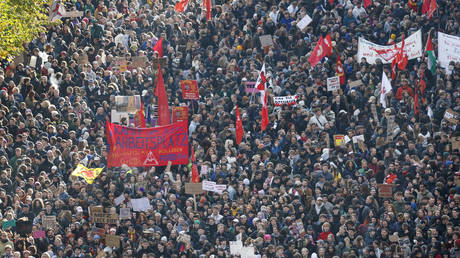
The rain in Berlin does not fall so much as it hangs, a cold gray mist that turns wool coats heavy and makes the neon signs of corner Spätis bleed onto the wet asphalt. It was on a Tuesday evening in late autumn, somewhere between the Alexanderplatz station and the Ministry of Finance, that the sound of twenty thousand boots hitting wet pavement drowned out the usual hum of the city.
They were not carrying the tattered banners of professional activists. They were wearing thrifted Patagonia fleeces, scuffed Adidas Sambas, and the exhausted, hollow-eyed expressions of people who had just finished a twelve-hour shift of studying and pouring overpriced oat-milk flat whites.
Look closely at the viral footage circulating from Frankfurt, Munich, and Hamburg right now. You will see cardboard signs scrawled in thick black Sharpie. “Miete frisst Seele.” Rent eats the soul. You will see twenty-two-year-olds chanting rhythmically outside glass-walled corporate headquarters, their breath pluming in the freezing air.
To understand why German Gen Z has suddenly traded quiet compliance for street-level disruption, you have to forget everything you think you know about Europe’s economic powerhouse. The old story—the one about Germany being the land of stable careers, affordable public universities, and predictable social mobility—is dead. The young people marching through the drizzle are merely the first ones willing to hold the funeral.
The Architecture of a Slow Squeeze
Consider a hypothetical twenty-four-year-old named Lukas. Lukas is a composite, a statistical mirror built from the reality of millions of young Germans navigating adulthood right now. He moved from a small town outside Dresden to Munich to study mechanical engineering. On paper, Lukas is doing everything right. Tuition at his public university is practically free, save for a modest semester administrative fee. He works twenty hours a week as a Werkstudent—a working student—at a mid-sized logistics firm, earning roughly €1,400 a month after taxes and mandatory student health insurance deductions.
Ten years ago, Lukas would have been living modestly, perhaps sharing a cramped flat with two roommates, eating pasta with pesto four nights a week, and saving just enough for a summer train pass through Italy.
Today, Lukas is drowning.
In Munich, a single room in a shared apartment—a WG-Zimmer—regularly commands upwards of €850 to €1,000 a month. In Berlin, long romanticized as the bargain capital of Western Europe, asking rents for newly listed apartments have surged by more than 100 percent over the last decade, driven by a severe housing shortage, lagging construction, and institutional landlords squeezing every drop of yield from aging brick buildings.
After paying €920 for a twelve-square-meter bedroom where the radiator clanks like a dying engine, Lukas has €480 left. Subtract €135 for mandatory student health insurance—which has climbed steadily alongside rising healthcare costs—and €49 for his Deutschlandticket transit pass. He is left with €296 to cover groceries, utilities, textbooks, a phone bill, and any semblance of a human life for thirty days.
Grocery inflation in Germany hit generational highs between 2022 and 2024, and while the rate of increase has cooled, prices never went back down. A basic basket of staples at Aldi or Lidl—bread, eggs, butter, vegetables, cheap coffee—costs roughly 30 percent more than it did before the pandemic. Every trip to the supermarket becomes an exercise in quiet humiliation. You put back the olive oil. You skip the fresh berries. You calculate the price per kilogram of dried lentils in your head while standing under flickering fluorescent lights.
When you live like this, poverty is not a dramatic cliff you fall off. It is a slow, suffocating tide. It is the constant, low-grade hum of panic in the back of your throat every time your phone buzzes with a notification from your bank.
The Broken Social Contract
Why are they angry now? Why didn't this boil over two years ago?
Because resilience has a shelf life. During the initial shock of the European energy crisis and post-pandemic inflation spikes, German youth absorbed the blow quietly. They turned down their thermostats, wore extra sweaters indoors, took on second gig-economy jobs delivering food on e-bikes in the snow, and waited for the promised relief.
That relief never arrived. Instead, they watched a political establishment paralyzed by coalition infighting and tethered to the Schuldenbremse—Germany’s constitutionally enshrined debt brake—which severely restricts public borrowing even as bridges crumble, trains run chronically late, and affordable housing projects stall out.
To appreciate the psychological rupture happening in Germany right now, think of the economy as an escalator. For seventy years, the German social market economy—the Soziale Marktwirtschaft—operated on an unspoken promise: if you step onto the escalator, get educated, work hard, and follow the rules, the machinery will carry you upward. You might not become a billionaire, but you will own a modest home, take annual vacations, and retire without fear.
Gen Z stepped onto that escalator only to realize the motor had been stripped for parts. Worse, they are being told to walk up the stationary metal stairs while carrying the weight of an aging population on their backs.
Germany is undergoing one of the most aggressive demographic shifts in the developed world. As the massive Baby Boomer cohort retires en masse, the ratio of workers to pensioners is shrinking rapidly. Every paycheck Lukas earns is already shaved down to fund a pension system he openly doubts will exist when he turns sixty-seven. Meanwhile, the government’s flagship student financial aid program, BAföG, has struggled for years to keep pace with actual living expenses, leaving hundreds of thousands of students reliant on parental wealth that many working-class families simply do not possess.
The result is a quiet caste system emerging inside a country that prides itself on egalitarianism. If your parents can wire you €600 a month to cover your Berlin rent, you get to take unpaid internships, finish your degree on time, and launch a career. If they cannot, you spend your twenties working night shifts in warehouses, dropping out of seminars, and watching your future narrow into a hallway with no doors.
Inside the Echo Chamber of the Streets
I stood near the edge of a demonstration in Cologne earlier this month, watching the crowd gather outside the central station. The air smelled of wet tobacco, cheap energy drinks, and rain-soaked concrete. Beside me was a nineteen-year-old apprentice mechanic named Miriam, her fingernails still rimmed with dark grease from her morning shift.
"My grandfather bought a three-bedroom house outside Bonn on a single factory salary," she told me, shouting slightly over a megaphone crackling three rows ahead. "I make decent money for an apprentice, and I still live in my childhood bedroom because moving out means spending seventy percent of my income on a studio apartment with mold on the ceiling. They tell us we’re lazy. They tell us we don't want to work anymore. I work forty hours a week and I can't afford a couch."
Her frustration cuts straight to the heart of a generational gaslighting campaign that has played out across German talk shows and newspaper op-eds. For the past three years, commentators have spilled endless ink lamenting Gen Z’s supposed obsession with work-life balance, their reluctance to work overtime, and their demand for four-day workweeks.
But when you talk to the kids holding the megaphones, a completely different logic emerges. Why, they ask, would you burn yourself to ash for a company when working fifty hours a week still leaves you priced out of the housing market? If the reward for total exhaustion is simply being slightly less broke, opting out of the hustle isn't laziness. It is basic math.
And that is why the protests look different from the climate marches of 2019. Fridays for Future was driven by existential dread about a warming planet—a moral crusade aimed at saving tomorrow. The demonstrations erupting across German cities today are driven by immediate material survival. You cannot worry about carbon emissions in 2050 when you cannot pay your electricity bill in November.
The Digital Wildfire
Look at the videos flooding TikTok, Instagram Reels, and YouTube Shorts under hashtags like #Mietenwahnsinn (rent madness) and #GenZStreik. They are raw, chaotic, and utterly devoid of the polished media training that usually sanitizes German political discourse.
In one clip filmed in Hamburg, a group of students stages a mock auction outside a luxury apartment complex where units sit empty as speculative investments, bidding imaginary millions while holding up receipts from discount grocery stores. In another, filmed at night in Leipzig, hundreds of young people bang wooden spoons against empty metal cooking pots—a visceral, deafening echo of cacerolazo protests from Latin America, transplanted onto the cobblestones of Saxony.
Social media did not invent this anger, any more than a match invents dry kindling. What the algorithms did was strip away the isolation. For years, struggling young Germans internalized their financial strain as personal failure. If you couldn't afford an apartment in Frankfurt, you assumed you just hadn't budgeted hard enough or chosen the right major. Seeing ten thousand other twenty-somethings chanting the exact same numbers—€900 rent, €1,300 wage, zero savings—transforms private shame into collective fury.
What Happens When the Engine Stalls
It is easy for older generations, insulated by decades-old rent-controlled leases or paid-off mortgages, to dismiss these marches as youthful melodrama. Every generation complains about money when they are twenty-two. Every generation eats cheap noodles and lives in cramped flats.
Except the numbers refuse to bend to nostalgia.
In 2010, a student or entry-level worker in a major German city spent roughly 30 to 35 percent of their net income on rent. Today, in cities like Berlin, Munich, Hamburg, and Stuttgart, it is routine for young renters to hand over 50 to 65 percent of their take-home pay just to keep a roof over their heads. Economists define spending more than 30 percent of income on housing as being "cost-burdened." Spending over 50 percent is severe housing distress. When an entire demographic cohort spends half its youth in severe financial distress, the consequences ripple outward for decades.
You delay moving out of your parents' house. You delay starting a business because you have zero financial cushion to survive six months without a paycheck. You delay having children—pushing Germany’s already fragile birth rate even lower and accelerating the very demographic crisis politicians claim they want to solve.
I will admit something that rarely makes it into tidy economic analyses: watching this unfold is deeply unsettling, because there is no clean, painless lever left for policymakers to pull. Germany cannot simply print its way out of a structural housing deficit that requires building hundreds of thousands of new apartments every year amid high interest rates, strict environmental building codes, and soaring material costs. You cannot instantly conjure millions of new skilled workers to balance the pension ledger without triggering fierce political backlash over immigration. Every solution demands a sacrifice from someone—either higher taxes on wealth, deeper public debt, looser zoning regulations, or reduced benefits for retirees who represent the largest voting bloc in the country.
The Line in the Asphalt
Yet standing in the crowd does not feel like standing at a wake. There is a sharp, electric clarity to what is happening in the streets of Berlin, Cologne, and Munich right now.
For years, German politics has been defined by consensus, caution, and incrementalism—a culture of weiter so, of keeping things moving smoothly along familiar tracks. Gen Z is the first generation to look at those tracks, see the bridge washed out ahead, and pull the emergency brake.
Whether these protests force immediate legislative action—whether they bring back stricter nationwide rent caps, overhaul BAföG grants, or force a reckoning over how Germany taxes wealth versus labor—remains an open question. Politicians are remarkably skilled at waiting out street anger until the winter cold drives protesters back indoors.
Still, something permanent shifted on those rain-slicked avenues this season. Around midnight in Berlin, long after the police vans had cleared the main intersections and the chanting had faded into the hum of late-night trams, a small group of students lingered near the Spree River, peeling wet cardboard signs off a stone balustrade. One of them—a girl in a bright yellow beanie no older than twenty—folded her soggy placard neatly under her arm before descending the steps into the U-Bahn station. Written across the damp cardboard in thick black ink were just three words: Wir zahlen nicht. We won't pay. Not anymore.